
Slowing the flow to boost carbon storage at Gurteen College
Although requiring small changes to grazing management, a rewetting project at Gurteen College has had a positive impact on reducing emissions from peat soils, Patrick Tuohy, Senior Research Officer, Kenneth Flynn, Farm Manager and Lecturer at Gurteen College, and Siobhan Kavanagh, Teagasc Signpost, tell us more
As part of the Department of Agriculture, Food and the Marine funded Rewet Project, Gurteen College carried out some ‘rewetting’ on heavy peat soils over the last three years.
Although apprehensive at first, the overall outcome was positive. The rewetting – albeit requiring small changes in grazing management – had a positive impact on reducing emissions from peat soils at Gurteen College.
Back in 2022, Jon Parry, College Principal, and Ken Flynn, Farm Manager, started a conversation with the Teagasc research team from Moorepark and Johnstown Castle about installing an Eddy covariance tower in the college, and the possibility of ‘rewetting’ the field that the tower stood in. The former measures the carbon and methane going in and out of the soil, also known as ‘net ecosystem exchange’.
In the below video, Kenneth Flynn, Farm Manager and Lecturer at Gurteen College, and Pat Tuohy, Teagasc Researcher, explore water table management and carbon storage on peat soils:
Managing the water table
Rewetting is a very unfortunate term, as it conjures up images of flooding fields and thus making them unmanageable.
The correct term is managing the water table. Raising the water table on a proportion of some peat soils will not see farmland being flooded as is often the perception. It will, however, slow the outflow of drainage systems, thereby extending the time taken for drainage to occur.
Raising the water table on peat soils reduces greenhouse gas emissions. There are approximately 340,000 hectares of peat soils under grassland nationally and 140,000 hectares of those are considered to be drained.
The experiences of Gurteen College
Some of the land at Gurteen College is peat soil. These areas are used mainly for drystock grazing. When approached to do this work, they felt it was pointless for the college to put a lot of effort into adopting technologies like reducing chemical nitrogen use, protected urea, age at finish etc to reduce emissions but to ignore the issue with drained peat soils emitting carbon.
The plan was met with much reluctance and caution from college staff. Ken and his colleagues had images in their heads of the field being completely flooded and all the drains 100% blocked.
Their biggest concerns were:
- The impact on grass production, grazing potential and profitability of the beef unit;
- What sort of mess would it create in the field;
- And, odd as it might sound, what would be the perception of the staff, students, parents of students and neighbours.
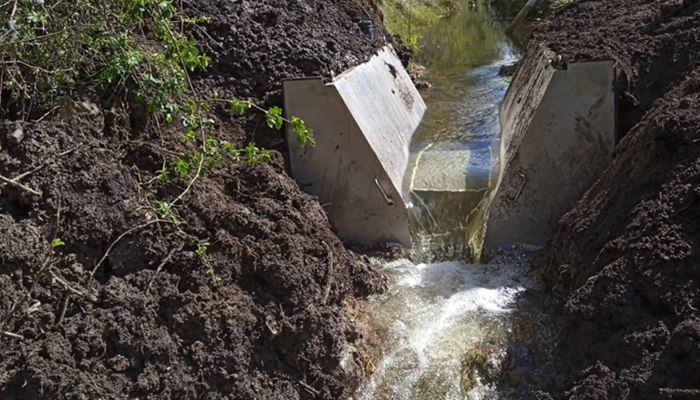
The team from Teagasc was quick to put them at ease explaining that the image in their heads was not at all what they were trying to achieve. Their goal was to manage the water table by slowing the flow in the drain by installing a shallow dam that would still allow water to pass over it, just slowing the flow.
The installation process
In February 2023, the shallow dam was installed in the drain to slow the flow of water. Part of the drystock unit in the college, the field has about 12 inches to 6 feet of drained peat or reclaimed bog.
The dam was a simple structure which allows for flow from the drain to be controlled. It was installed in a few hours. The drain level was lifted in one location to hold more water, with the impacts in the field examined over a three-year period.
Ken kept a close eye on this dam, as he didn’t really know what effect it would have on the water table in this field.
Over the three years the dam was installed at the college, the key thing they noticed was some more surface water in the field during the winter period. This meant that they started grazing that field later in the Spring and had to come out a little earlier in the Autumn. Overall, with roughly 12 fields allocated to drystock, the cattle and sheep were out grazing across the whole farm for the same total length as any other year.
The impacts
Data from the study site at Gurteen College is telling us that lifting the water table by 30 cm increases the amount of carbon stored by 1 tonne per hectare per year; although the impact of raising the water level in open drains varied around the field. There are other factors at play including variations in the depth of the peat across the site, weather effects and proximity to open drains.
The data from this site provides us with better information and an opportunity to lower emissions. The information collected at Gurteen College and similar sites will help guide future policy regarding the management of such soils.
For Ken and his colleagues, some small adjustments in their grazing plan have made a big difference to their carbon footprint. Ken’s message to other farmers is: once the supports become available, engage with them and don’t be afraid to give it a go.
The above article first appeared in the Farming Independent as a Signpost Programme Update and was adapted for use on Teagasc Daily.
For more on the Teagasc Signpost Programme, visit here.