
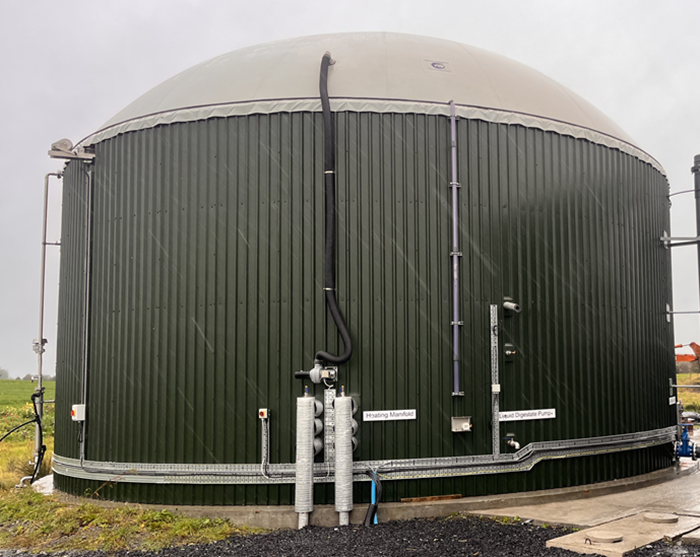
Barry Caslin, Teagasc Energy and Rural Development Specialist, with contributions from Dr. Shaun Connolly, Research Officer, Teagasc Johnstown Castle, and Dr. Adriana Ferreira Maluf Braga, Research Technologist, Teagasc Grange, explores the opportunities that exist in small-scale biogas production.
Anaerobic digesters can harness gas produced by cattle, pigs and sheep and are already widely used in other European countries. There are just 31 biogas plants in Ireland, with 10 biogas plants using animal-by-products (ABPs). Across the EU, there are about 21,100 anaerobic digester (AD) plants, with the European Biogas Association estimating that 67% of biogas output comes from agricultural sources. These digesters mainly use manure, agricultural residues, and energy crops, with many plants running solely on livestock manure. Plant capacities range from 4 kWe to over 3,000 kWe. In the UK, roughly 427 on-farm AD plants exist, 79 of which run exclusively on livestock manures. The main driver for biogas plant construction anywhere in the world is government support. Incentives such as Feed-in Tariffs (FiTs), a Support Scheme for Renewable Heat (SSRH), capital grants, green gas certificates, Contracts for Difference (CfD), grid and infrastructure support, and technical assistance all play a critical role in enabling these projects.
When these supports are available, the financial viability of farm-scale AD improves significantly. Recently, there has been renewed interest in small-scale (sub-100kW) AD systems using on-farm animal manures in Ireland. Dairy and livestock farms, with their steady supply of slurry and manure, are well-positioned to benefit, especially with increasing political and market pressures to reduce greenhouse gas emissions and improve the carbon footprint of milk and meat production. Irish farms produce approximately 40 million tonnes of livestock waste annually, offering a huge opportunity to process more of this material through AD. This not only helps reduce emissions but also delivers sustainability goals by producing digestate – a more plant-available, nutrient-rich fertiliser.
Sustainability and emission reduction are now a priority for milk buyers and retailers. AD plants convert slurry and manure into biogas (a mix of methane, carbon dioxide, and other gases). This biogas can be used in combined heat and power (CHP) plants, boilers, or upgraded to biomethane for use in engines or injection into the gas grid. While small-scale biogas offers many advantages beyond energy generation, a lack of government support and clear policy direction for small, on-farm AD is a significant barrier. Support currently focuses on large-scale biomethane plants, leaving smaller farms at a disadvantage. Future supports based on carbon savings, rather than just energy generation, could make small-scale AD more competitive. Many farmers believe AD is not financially viable without incentives like capital grants, FiTs, or SSRH.
Key benefits include:
- Capturing additional value (energy) from farm waste
- Less exposure to volatile energy markets – improving energy security on-farm
- Reduced methane emissions from livestock waste
- Supporting regenerative farming and reducing the carbon footprint
- Improved utilisation of slurries and manures as more usable fertiliser
- Enhanced soil, water, and air quality
- Boosting soil carbon content and contributing to net-zero targets
Valuing these wider benefits is difficult, and there are questions over who should reward them. Some initiatives – like Arla’s FarmAhead scheme in the UK – offer a premium for milk produced with a lower carbon footprint, including via AD. Irish dairy co-ops could follow suit, gaining a marketing advantage as carbon labelling becomes more common across the EU.
Who is farm-scale AD for?
AD plants are designed to run 24/7 and require a reliable supply of feedstock – typically, farms with at least 120 cows housed year-round and a steady on-site energy demand. Using self-generated electricity on-site (at about €0.35/kWh) is far more profitable than exporting it to the grid (€0.20 cent /kWh). Farm-scale AD units are often modular, with capacities from 11 to 74 kW, costing between €250,000 and €550,000. Some use traditional round reactors for improving the fermentation and gas production; others capture gases from existing sealed slurry stores. The system must be scaled appropriately – over-sizing to chase incentives can lead to operational problems if there’s not enough feedstock.
Table 1: Example Costings – 44kWel On-Farm Biogas Plant
| Parameter | Value (€) | Notes |
| Electrical capacity | 44 kW | Suitable for 300 cows & farmhouse |
| Thermal capacity | 66 kW | Assumed 1.5:1 heat:power ratio |
| Capacity factor | 92% | 8,060 hours per year |
| Capital Cost | €450,000 | |
| Annual Electricity Generation | 354,640 kWh (354.6 MWh) | Based on continuous operation |
| Heat usage per year | 177,320 kWh | 354,640 x 0.5 |
| Value of heat | €5,320 | 177,320 kWh x €0.03c/kWh |
| Value of Self-Used Electricity | €0.35 per kWh | Displacing purchased electricity |
| Farm Annual consumption | 146,000 kWh | |
| Value of self use | €51,100 | 146000 kWh x €0.35 |
| Exported electricity price | €0.20 kWh | |
| Digestate value | €7,000 | |
| Revenue from export | €41,728 | 208,640 kWh x €0.20 |
| Total annual revenue | €105,148 | |
| Total annual costs | €115,800 | |
| Simple payback period | Not achieved without financial supports |
Note: this table assumes no financial support – The feedstock is 100% cattle slurry
Breakeven Analysis
To break even, the plant would need either:
- Higher value for exported electricity (e.g., a feed-in tariff or premium)
- Higher value for heat (if all heat is used to offset expensive fuel)
- Lower capital cost (via grant support)
- Lower OpEx (if achievable)
- Or a combination of the above
Breakeven electricity price calculation
- Total annual costs: €115,800
- Total kWh generated: 354,640
- Required average electricity price: €115,800 / 354,640 = €0.33/kWh
With these assumptions, a 44 kWe AD CHP plant is not financially viable without additional support or higher energy prices. The main challenge is the high capital cost relative to the scale and the relatively low value of exported electricity and heat. If a capital grant (e.g., 40–50%) or a higher export tariff were available, the project could become viable.
Estimating heat usage
The figure of 177,320 kWh of heat usage per year is based on the typical performance and energy flows of a small-scale farm-based AD CHP (Combined Heat and Power) plant. In such systems, the CHP unit generates both electricity and usable heat from biogas produced on-farm. For a 44 kWe CHP plant operating at an 92% capacity factor, the annual electricity generation is approximately 354,640 kWh. CHP units typically have an overall efficiency of around 80 – 92%, depending on the size and efficiency of the overall biogas unit. In practice, not all of the heat produced is usable on the farm – some is lost in the process or used to maintain the digester temperature (parasitic load). To estimate the usable heat, we assume that about 50% of the total heat output is available as recoverable heat for on-farm use (such as heating water for dairy operations, space heating, or other agricultural processes). This is a conservative and realistic figure, reflecting both the technical characteristics of small CHP units and the practical limitations of heat recovery and use on a typical dairy farm.
Value of digestate
Digestate is the nutrient-rich by-product of the anaerobic digestion process, consisting of the remaining organic material after biogas has been extracted from feedstocks like slurry and silage. This material retains nearly all the nitrogen, phosphorus, and potassium from the original feedstock, making it a valuable organic fertiliser for farmland.
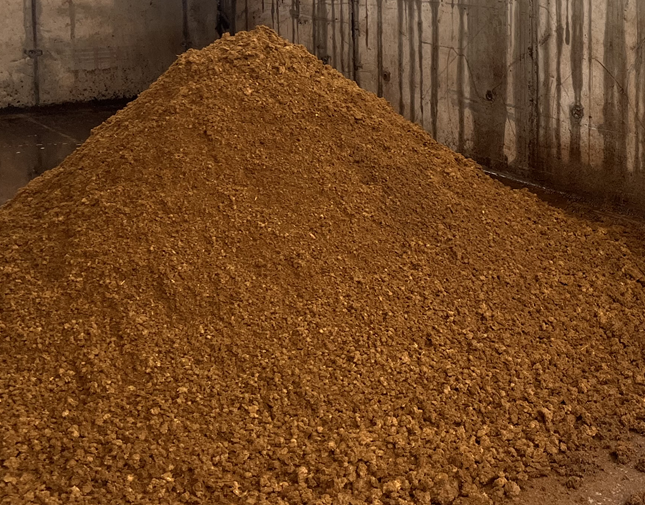
During the AD process, organic nitrogen in the slurry is converted into ammonium (NH₄⁺), the form of nitrogen most readily available for plant uptake. This transformation means that digestate contains a higher proportion of immediately plant-available nitrogen compared to raw slurry.
For a 44 kWe plant, an estimated 3,500 tonnes of digestate per year can be produced, with a direct fertiliser value of €5,900 – €9,400 annually; to remain conservative, €7,000 per year is used in this analysis. Its higher proportion of readily available nitrogen supports quicker grass growth and allows for more precise nutrient management, helping farmers improve yields, boost grassland productivity, and reduce reliance on chemical fertilisers – all while supporting better soil health and nutrient cycling. From an environmental perspective, because the nitrogen in digestate is mainly in the ammonia form and more susceptible to volatilisation, digestate should not be spread using splash-plate technology; instead, it requires low-emission application methods such as trailing shoe, trailing hose, or direct soil injection to minimise ammonia losses and retain more fertiliser value in the soil.
Calculating total annual costs
Operating Expenses (OpEx) – €52,800 covers all annual running costs, including:
- Maintenance and servicing of the AD and CHP systems
- Labour (staff time for operation and management)
- Insurance, administration, and compliance
- Utilities and consumables
- Any minor repairs or replacements
Capital Charge (Return on Capital) – €63,000
This represents the annualised cost of the initial investment, calculated as:
- Capital cost × Required rate of return
- For this example – €450,000 × 14% = €63,000 per year
This approach uses a 14% required return on capital to reflect the opportunity cost and risk for investors.
Greenhouse gas savings
Greenhouse gas (GHG) reductions are one of the most compelling societal reasons to support small-scale anaerobic digestion on farms. On a typical Irish dairy farm with 200 milking cows, installing an AD plant can prevent the release of approximately 567 kg CO₂-equivalent per day by capturing methane that would otherwise escape from slurry storage – amounting to over 200 tonnes of CO₂eq each year. This direct methane abatement addresses one of agriculture’s largest climate challenges: methane, a greenhouse gas 27 times more potent than CO₂ over a century, is responsible for a major share of farming’s climate footprint.
Table 2: Summary of total GHG Abatement
| Source of GHG savings | Daily Avoided
CO₂e (kg) |
Annual Avoided
CO₂e (tonnes) |
| Methane abatement (slurry storage) | 567 | 207 |
| Replacement of grid electricity & fuel oil | 429 | 157 |
| Replacement of synthetic N fertiliser | 25 | 9 |
| Total (Combined Heat & Power) CHP scenario | 1,021 | 373 |
Beyond this, when the biogas is used to replace fossil fuels for heat and power, even more emissions are avoided. For example, if the biogas generated from a 200-cow herd is used in a combined heat and power (CHP) unit, it can displace both grid electricity and heating oil, leading to an additional 429 kg CO₂eq of savings per day – or nearly 160 tonnes CO₂e annually – by substituting for carbon-intensive energy sources. Furthermore, by using digestate in place of synthetic nitrogen fertilisers, farms can avoid another 9 tonnes of CO₂e per year associated with fertiliser manufacture.
When all these effects are combined, anaerobic digestion on a single 200-cow dairy farm can cut emissions by over 370 tonnes of CO₂eq annually, with even greater savings possible as systems scale and more slurry is treated. At the sector level, widespread adoption of AD could reduce emissions from European livestock farming by millions of tonnes per year, helping agriculture, energy, and food supply chains transition towards climate neutrality. These benefits are recognised by both the FAO and IPCC, and extend far beyond the farm gate – improving air quality, reducing odour, and supporting a circular, low-carbon rural economy.
Other considerations
Grid connection may be an issue for any new energy generation project, even if most electricity is used on-site, so contact ESB Networks early. Siting and planning require careful attention to logistics, cabling, environmental constraints, and local regulations. Planning permission is required for all AD developments but concerns about traffic and odours are generally more relevant to larger facilities. For slurry-only AD plants, all feedstock is generated on-farm, minimising extra vehicle movements. AD is not generally suitable for farms where cows are bedded on sand due to equipment abrasion and sediment buildup. The biggest hurdles remain planning and permitting flexibility.
More from Teagasc Daily: The rise of hydrogen-fuelled tractors and vehicles
More from Teagasc Daily: Diversifying Irish agriculture – navigating new paths to farm resilience
More from Teagasc Daily: Exploring Farm Diversification: Renewable Energy
More from Teagasc Daily: Unlocking Ireland’s rural income potential
More from Teagasc Daily: Harvesting renewable energy with SRESS