
Table: Does calving at 24 months of age affect subsequent suckler cow performance?
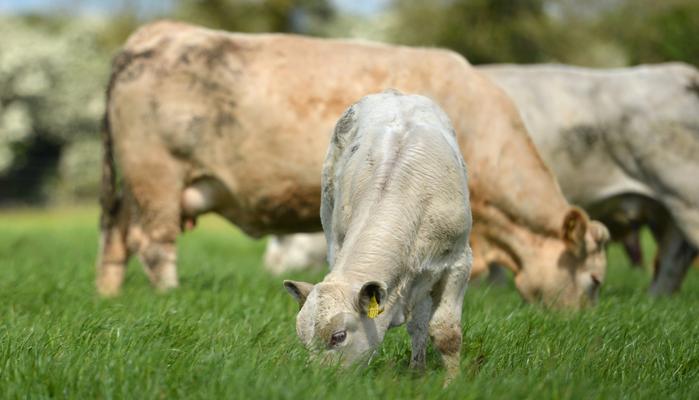
Despite its benefits from a production, cost saving and emissions point of view, suckler farmers have been slow to move to calving their suckler replacements at 24 months, often citing concerns around mature cow size, calving difficulty or retention within the herd as barriers.
Through its series of recent farm walks, hosted on the farms of John Pringle in Co. Wicklow and John and James Dunne in Portarlington, Co. Offaly, the Teagasc Future Beef Programme turned to the ICBF’s National database to dispel some of the fears often cited by farmers.
“Calving heifers at 24 months of age, once the appropriate management practices are followed, is really a no brainer for suckler farmers,” explained Future Beef Programme Manager, Martina Harrington, who admitted that the pace of progress has been slower than desired.
“Just 23% of suckler replacements calve between 22 and 26 months of age, representing a missed opportunity to produce more calves over a cow’s lifetime, increase the profitability of suckler systems, increase the rate of genetic change within herds or even to reduce the herd’s carbon footprint.”
At the Future Beef Farm Walks, attendees heard that moving from 36 to 24-month calving could reduce a farm’s carbon footprint by 7% (kg GHG emissions / kg carcass) and increase net profit by €87 per livestock unit, yet farmers have concerns – often unfounded.
“We’ve asked our colleagues in the ICBF to analyse data from suckler-bred heifers born in 2019 and to track their performance up to calving for the fifth time. The dataset of 115,233 heifers has provided us with some rather interesting insights to help dispel some of the fears farmers may have about calving at 24 months of age.
“When calved at 24 months of age versus 36 months of age, heifers have a shorter calving interval between their first and subsequent calf; fewer heifers – albeit mated to easier calving bulls – required assistance at first calving; and the weight difference as third calvers was merely 8kg. Importantly, from a cow longevity point of view, heifers that calf at 24 months of age for the first time are also more likely to be retained within the herd cow up to their fifth calving,” Martina Harrington added.
Table 1: ICBF data on age of first calving and resulting performance and retention (115,233 heifers born in 2019)
| Age at first calving
(months) |
Average subsequent calving interval
(days) |
Calving for second time
(%) |
Average calving difficulty of bulls used
(%) |
Heifer calving unassisted
(%) |
Mortality at first calving
(%) |
Heifers reaching fifth parity
(%) |
Cow weight parity 3
(kg) |
Calf weight parity 3
(kg) |
Average calving to date |
| 23-26 | 394 | 82 | 7.7 | 50 | 2.8 | 43 | 641 | 296 | 3.68 |
| 27-30 | 417 | 78 | 8.2 | 53 | 1.7 | 31 | 636 | 288 | 3.26 |
| 31-35 | 413 | 83 | 8.3 | 58 | 1.6 | 23 | 652 | 291 | 3.29 |
| 36-40 | 404 | 86 | 8.5 | 57 | 1.1 | 12 | 649 | 294 | 2.99 |
To maximise the benefits of calving at 24 months of age, Martina Harrington added: “We’ve seen some excellent examples of the benefits calving at 24 months of age can bring from the farmers enrolled in the Future Beef Programme.
“For instance, 100% of heifers on John Pringles’ farm in Co. Wicklow have always calved at 24months of age, central to achieving this is genetics – selecting the right replacements, nutrition – ensuring animals hit key performance targets along the way, and health.
“Ideally a replacement heifer should be 60% of her mature body weight at breeding. Given their younger ages, farmers should only use proven sires for calving difficult (target of >80% reliability) at less than 8% calving difficulty for beef heifers.”
Upcoming event – BEEF2026
The BEEF2026 Open Day takes place on Wednesday, 1st July at Teagasc, Grange, Dunsany, Co. Meath and providing a flavour of what to expect from the event, Martina Harrington added:
“Driving sustainable performance in suckler systems means focusing on the key performance indicators that directly influence profitability. At BEEF2026, Teagasc researchers, specialists and advisors will be on hand to showcase the latest technologies and practices to help you improve on-farm efficiency, increase output per livestock unit and maintain cost control.
“Our aim through the suckler beef village is to help farmers strengthen overall farm performance while building more resilient and sustainable suckler enterprises,” Martina Harrington added.
Key discussions on the day will centre on breeding and selecting the suckler cow of the future, the latest from Teagasc Grange on synchronisation programmes and timed AI, best practice in weaning, infectious diseases and the bluetongue challenge, along with the latest from the farmers enrolled in the Future Beef Programme and the Newford demonstration herd.