

Edited By
Ciaran Collins
Crops Specialist
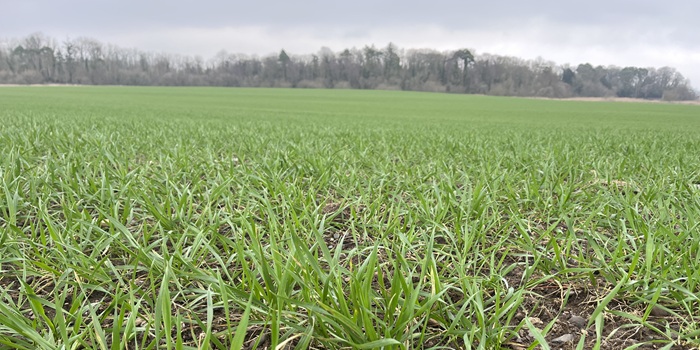
Welcome to the Teagasc March Tillage Management Notes. In this edition, Teagasc Crops Specialist, Ciaran Collins brings you timely advice on winter crop agronomy, establishing spring crops and a key reminder on the recently launched tillage support scheme.
Key Actions for March
- Apply for the National Tillage Sustainability Support Scheme before March 9th.
- Plant beans as soon as ground conditions are suitable.
- Apply the first nitrogen (N) split to winter barley now and complete the main split by growth stage (GS) 31 (first node).
- Take plant counts in winter cereals and use the results to set fertiliser and growth regulator plans.
National Tillage Sustainability Support Scheme
The 2026 Tillage Sustainability Support Scheme payment is in recognition of the significant additional pressures encountered in the tillage sector in recent years. The scheme will provide for a degressive rate of payment (outlined in table 1 below) to applicants who declared cereal and oilseed rape crops on their 2025 Basic Income Support for Sustainability (BISS) and other area-based application.
Important points to note:
- Online applications can be made via the MyAgFood portal.
- Closing for applications is March 9th, 2026.
- Eligible crops under the scheme are barley, wheat, oats, rye triticale and oilseed rape.
- The eligible crops must have been declared by the applicant on their 2025 BISS and other area-based application.
- All payments will be subject to the EU rules on de minimis.
Table 1: Rates of payment under the National Tillage Sustainability Support Scheme
| Hectare (ha) | Payment Rate |
| >1 ha to </=100 ha | €110 |
| >100 ha to </=125 ha | €90 |
| >125 ha to </= 150 ha | €70 |
| >150ha | €50 |
For full terms and conditions, visit the Department of Agriculture, Food and the Marine’s website.
Winter Cereals
Wet weather since the start of the year has slowed field work, but crops have generally stood up well thanks to excellent establishment last autumn. There has been relatively little rainfall damage, and most crops are at or, in some cases, above target plant numbers. The immediate priority is application of fertiliser, beginning with the thinner winter barley crops, then move on to those at normal tiller numbers.
Take time now to walk crops and assess plant and shoot numbers. This information is essential for planning nitrogen and plant growth regulator (PGR) programmes for the season ahead.
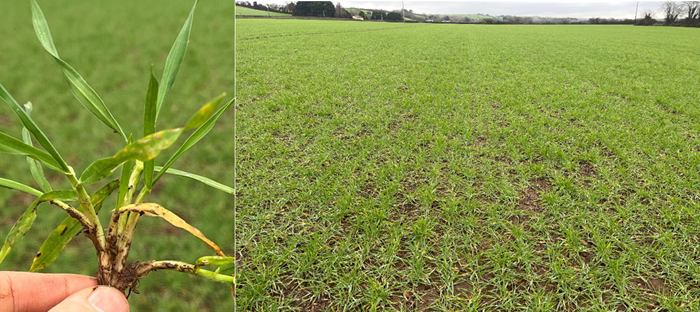
‘Take plant counts to plan fertiliser and PGR for the season ahead’
Some crops currently have very high plant populations and will require careful management to reduce lodging risk. Crops with higher plant populations have an increased risk of root lodging, due to reduced anchorage strength and by altering the spread of the crown roots. An increase in plant number of 50 plants per m² can alter the lodging resistance by 2 points on a scale of 1 – 9.
Winter Barley
Aim to apply the main split of nitrogen (N) by growth stage (GS) 31. Sulphur (15 kg/ha) and trace elements (based on soil analysis and field history) should also be applied before GS 31.
Target growth regulation on crops with a high lodging risk at GS 30. A follow up treatment can be applied at GS 32 – 39, if required. Moddus/Medax Max plus 1.0L/ha CCC can be applied from GS 30 but needs active growth to be effective.
Assess crops for weeds and where a tidy up is required, use a sulfonylurea/Zypar/Galaxy/Hurler etc. depending on weeds present. Active growth and high rates are needed to control overwintered weeds. It is too late to control annual meadow grass.
Winter Wheat
Apply 40 – 50 kg/ha of N as the first split in mid-March or by GS 30. Increase rates to 75 kg/ha for thin crops, second wheat or where take-all is a risk. Generally divide the nitrogen applications 25%:50%:25% over three splits. Apply the main split by GS 31 and the last split by GS 39.

Aim to spread first N on winter wheat by GS 30
Where grass weeds are present, Pacifica Plus/Monolith + Biopower are options. Broadway Star/Manhattan + supported adjuvant is a strong brome option where annual meadow grass has already been controlled. Avoid crops under stress and be careful of tank mixes.
Winter Oats
The first application of approx. 50% of the total nitrogen requirement should be applied by GS 30 (early to mid-March). Where no autumn herbicide has been applied, treat with a sulfonylurea (Cameo Max/Ally Max) and a suitable partner to match weed spectrum.
The most successful PGR strategy in Teagasc trials is a two-spilt approach, with the first application at GS 30/31, followed by a second application at GS 32. The second application will have a greater shortening effect. Remember, only apply PGRs when there is active growth and avoid frost and large tank mixes.
Winter Oilseed Rape
Use the BASF Green Area Index (GAI) app to measure the green area index of your crop. Target GAI is 3.5 at the start of flowering. Crops with large canopies will result in significant savings on nitrogen.
Crops with a GAI below 1.0 will need 225 kg/ha of nitrogen, with the first application as soon as growth starts. In contrast, crops with a GAI of 2.0 will require 165 kg/ha, and the first split of 100 kg/ha can be delayed until mid-March.
For more on fertiliser applications for winter oilseed rape, visit here.
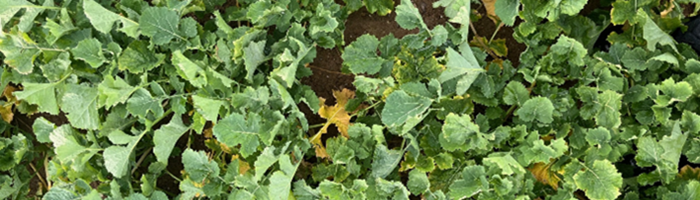
Calculate GAI to determine nitrogen rate and timing
Caryx (0.7 – 1.2L/ha) can be applied from green bud to yellow bud for canopy management and to reduce lodging risk. Use the higher rate in crops with a high GAI during a period of active growth. Add prothioconazole 0.3L/ha for additional light leaf spot control.
Spring Crops
Spring Beans
Beans make good financial sense with a forward price of €230/t on offer in addition to guaranteed income from the protein payment, which was €600/ha in 2025. Beans are more profitable than spring feed barley but also increase profitability across the rotation.
For guideline costs on spring bean production, view the Teagasc Crop Costs and Returns publication.
Plant beans as soon as conditions are suitable. The target is to have beans sown by mid-March. In addition to a late harvest, the yield potential of beans is reduced when sown after mid-March. However, do not compromise on seedbed conditions.
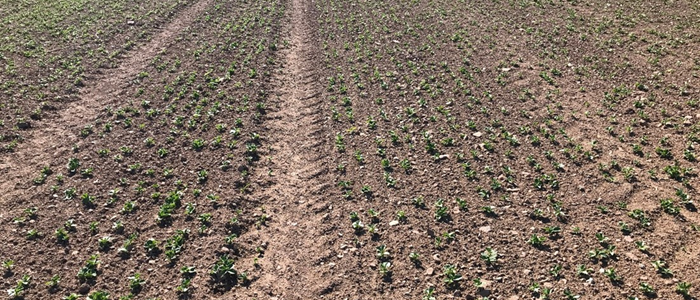
Beans make sound financial sense
Aim for a target plant population of 25-30 plants/m2. Increase target plant population to 40 plants/m2 for later sowing or on unproductive soils. A thousand grain weight (TGW) of 550g will need a sowing rate of 206 kg/ha (13.1 st/ac). Take note of the TGW on the bag as big seed requires high seed rates.
It is essential that pre-emergence residual herbicides are used. The main pre-emergence herbicide options are: Nirvana 4.0-4.5L/ha, Nirvana 2.5 + Defy 4.0L/ha, Stallion 3.0L/ha and Chanon/Emerger 2.5 + Defy 2.5L/ha.
Spring Barley
There is an excellent choice of varieties on the 2026 Recommended List. It is worth taking some time to study the Recommended List and select a variety that is suitable for your farm. There are several varieties with the ‘full package’ (good straw and resistance to disease), which can save on growing costs.
Aim to sow 350 seeds/m² to establish 300 seeds/m² in good conditions. Consult the bag for the thousand grain weight.
Teagasc Tillage Edge Podcast
For all the latest tillage news the Teagasc tillage podcast is available on the Teagasc website, Apple Podcasts or Spotify. Listen to some recent episodes below:
Health and Safety: Plan Workload
With field operations increasing, it is important to plan your workload and avoid rushing. Be vigilant to avoid injuries associated with being crushed. High risk areas include raised loads like bulk bags of fertiliser, raised machines and being in contact with a moving vehicle. Stay vigilant and stay clear of crush zones.
For more from Teagasc Crops, visit here.
Keep up to date with Teagasc
Teagasc offers a suite of digital products – ranging from insightful podcasts, trusted eNewsletters, social media, website and mobile app channels – to provide you with the latest news, information and knowledge.