

Edited By
Niall Kerins
Cattle Specialist
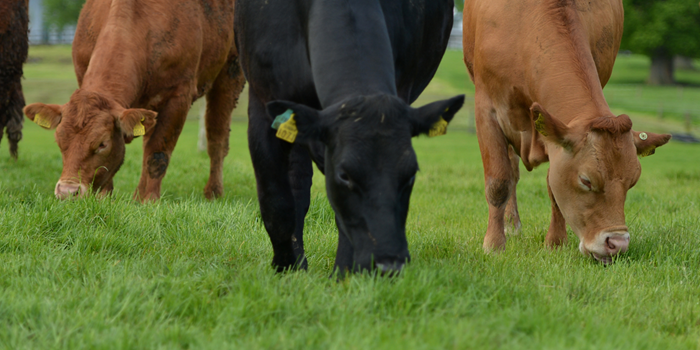
Welcome to the Teagasc June Beef Management Notes. In this edition, Teagasc Cattle Specialist, Niall Kerins focuses on replenishing silage stocks, fertilising second-cut silage ground, why it’s the time for lime and previews some of the approaching events that will be of interest to beef farmers, including BEEF2026 at Teagasc, Grange.
Complete a fodder budget
Securing adequate silage reserves is a must on beef farms, especially as the prolonged winter housing period resulted in additional fodder being used and previously built-up reserves being depleted on many farms.
To help build fodder reserves and correct grass quality, paddocks that become too strong for grazing should be baled up as silage.
As first-cut silage harvest is well underway, now is a good time to complete a fodder budget. This will allow you to assess how much fodder is in the yard and how much is still required. The fodder budget, available in table 1 below, should be completed to assess where the fodder situation is on your farm.
Table 1: An example of a fodder budget template for a beef farm
| Stock type | Number of stock | Winter months | Tonnes of fresh weight silage required | Number of bales required | Total required |
| (A) | (B) | (C) | (D) | (A x B x C or D) | |
| Suckler cows | |||||
| 2+ year olds | |||||
| 1-2 year olds | |||||
| Weanlings | |||||
| Total tonnes of fodder required | |||||
Points of note:
- When measuring the fresh weight in tonnes in your silage pit, measure length X width X height in meters and divide your answer by 1.4 (this is allowing for a silage pit containing silage at 22% dry matter).
- Fresh weight of bales can vary from farm to farm. As a guide, allow 800 kg fresh weight per bale when completing your calculations.
- Fodder in the table above is calculated on a monthly demand basis, no concentrates being fed is assumed.
Fertiliser for second-cut silage
To ensure you have sufficient winter fodder in your yard, first complete a fodder budget to assess your silage reserves. Secondly, where additional fodder is required, fertilise silage ground now to secure an adequate crop of second-cut silage.
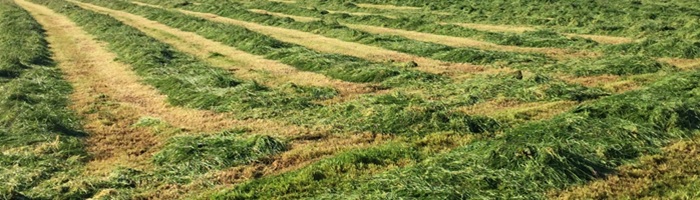
Silage swards require nitrogen (N), phosphorus (P), potassium (K) and sulphur (S); follow your Nutrient Management Plan to identify the amount that can be spread on your farm.
Table 2 below illustrates how much N, P, K + S is required for second-cut silage based on the yield required:
| Grass yield (t DM/ha) | N kg/ha (units/ac) | P kg/ha (units/ac) | K kg/ha (units/ac) | S kg/ha (units/ac) |
| 2 (4t/ac fresh grass) | 50 (40) | 8 (6) | 50 (40) | 8 (6) |
| 3 (6t/ac fresh grass) | 75 (60) | 12 (10) | 75 (60) | 12 (10) |
| 4 (8t/ac fresh grass) | 100 (80) | 16 (13) | 100 (80) | 15 (12) |
Cattle slurry is an effective source of N, P and K, and should be applied at approximately 2,000 gallons per acre on second-cut ground. Cattle slurry (6% dry matter) has the equivalent of 6 units of N/1,000 gallons, 5 units of P/1,000 gallons and 32 units of K/1,000 gallons when applied through LESS. To meet crop demand, additional nitrogen is required – target 1.2 bags per acre (60kg/ac) of 38% protected urea with sulphur.
If not done already, complete an analysis of slurry from an agitated tank. This will allow you to assess the N, P and K content, results which prove valuable when applying slurry.
Sulphur is vital for soil fertility, enhancing grass growth, improving nitrogen efficiency and reducing nutrient losses. Apply 6–12 units of sulphur per acre to optimise second-cut silage performance.
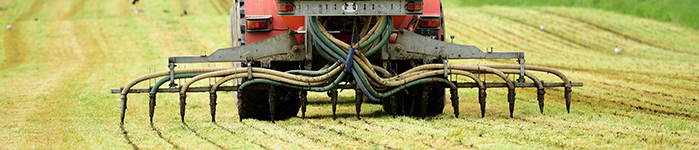
It’s time for lime
- 2026 has once again proved how volatile the fertiliser market can be. Applying lime is the key to get full use from applied fertiliser or slurry.
- Lime corrects soil pH and increases the availability of nitrogen, phosphorus and potassium for grass growth.
- Grass requires a soil pH of 6.3. Follow your liming plan and apply lime where necessary to bring soil fertility to optimum.
- Ground where silage has been cut recently presents the perfect opportunity apply lime.
- Lime, when spread, increases the availability of applied fertilisers for grass growth and subsequently reduces your fertiliser bill. It also releases locked nutrients in the soil, making them available for grass growth.
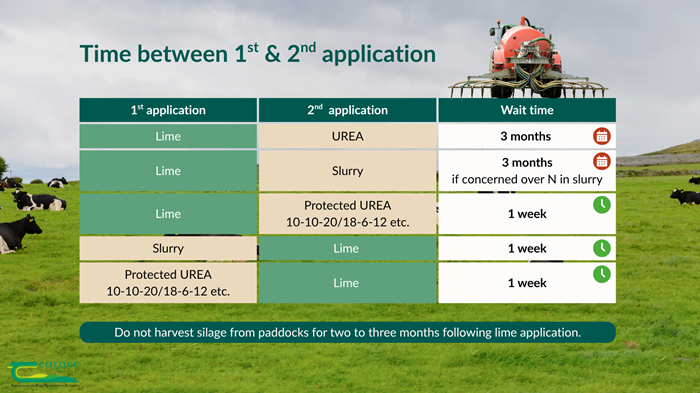
The graphic below illustrates best practice when spreading lime alongside fertilisers
Research update
Jamie O’Driscoll of Teagasc, Grange provides an update on dairy-beef systems research, which is focused on the performance of early and late-maturing sired dairy-beef cattle.
The performance of early-maturing (Angus and Hereford) sired dairy-beef cattle has been well researched in recent years, but there is a lack of up-to-date information on the performance of late-maturing (Limousin and Belgian Blue) sired cattle.
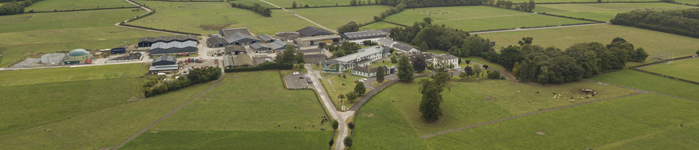
Current research is comparing the growth and carcass performance of steers sired by the four main beef sires used on the dairy herd (named above). Sixty steers from each sire maturity are being managed in two separate farmlets, allowing a full farm system appraisal to be conducted. Preliminary carcass performance from the first production cycle is shown below.
Table 3: Preliminary carcass data for early maturing and late maturing steers
| Age at finish months | Carcass weight kg | Kill out % | Conformation | Fat score | |
| Early maturing | 21.7 | 303 | 51% | O= | 3+ |
| Late maturing | 22.4 | 321 | 54% | O+ | 3= |
The 2025 steers currently weigh 395 kg and have had an average daily gain of 0.98 kg/day since turnout in early March. Preliminary economic analysis from the first production cycle, as well this year’s steers, will be on display at the Teagasc Grange Beef Open Day on July 1st, 2025. In addition, a sensitivity analysis on calf purchase price and input costs will be on discussed.
Farm safety: Keeping children safe on the farm
During June and throughout the busy summer period, protecting the health and safety of children on farms is especially important. Parents and guardians play a key role in teaching, encouraging and guiding young people on how to stay safe around the farm. Important measures include providing a secure play area for younger children and ensuring proper supervision whenever young people are on the farm.
Children and young people should be kept away from high-risk activities such as silage harvesting and slurry spreading. Where young people are helping with farm work, tasks should be suitable for their abilities, they also should receive appropriate guidance and support.
To learn more, view a video on Child Safety on the farm below:
Upcoming events
BEEF2026
The Teagasc BEEF2026 Open Day will take place on Wednesday, July 1 at the Teagasc, Animal & Grassland Research and Innovation Centre, Grange, County Meath. This year’s open day will focus on the theme of ‘Driving Sustainable Performance’.
BEEF2026 will showcase systems and technological advances that can be utilised by cattle farmers from across the country to increase production and drive income in a sustainable way. This event takes places every second year and is a worthwhile free event to attend for all types of beef farmers across the country to attend.
Watch the short video below to find out more about what to expect on the day:
Visit the BEEF2026 webpage for further information.
Future Beef National Farm Walk
On Friday, June 5 at 6.30pm, the Teagasc Future Beef team has organised a National Farm Walk on the farm on John and James Dunne, Tinnacrannagh House, Portarlington, Co. Offaly. Eircode: R32 V127.
Topics to be discussed include farm financials, calving heifers at 2 versus 3 years, water quality and Farming for Water EIP funding, bull selection and breeding decisions, the dairy calf to beef enterprise, red clover performance and soil health, handling facilities, and feeding home-saved grain. All are welcome to attend, and refreshments are kindly provided by Dawn Meats.
View the Future Beef webpage for more information.
Farming for a Better Future, Teagasc, Johnstown Castle
On Wednesday, June 10, Farming for a Better Future 2026 will take place at Teagasc, Johnstown Castle, Co. Wexford.
The theme of this year’s open day is ‘Innovating for Healthy Soils and Clean Water’ and will focus on protecting soil health and improving water quality at the farm systems level. The open day will demonstrate how to build resilient soils and improve water quality across dairy-beef, organic, spring and winter milk and tillage farming systems.
Further details on the Farming for a Better Future 2026 open day are available here.
Teagasc/AHI CalfCare events
Teagasc, in association with Animal Health Ireland, is running three CalfCare events, focusing on grassland management for dairy beef calves. Top tips on grazing infrastructure and animal health will be discussed followed by the host farmer’s own experience on grassland management during the main grazing season.
- Tuesday, June 9: Francis Bellew, Hamlinstown, Monasterboice, Drogheda, Co. Louth, A92 NR52 at 7pm.
- Wednesday, June 10: Caroline and Kieran Henry, Toberscarden, Tubbercurry, Co. Sligo, F91 X3C4 at 7pm.
- Thursday, June 11: Simon and Peter Byrne, Newtown, Castledermot, Athy, Co. Kildare, R14 R763 at 7pm

The Beef Edge Podcast
The Beef Edge is Teagasc’s weekly beef podcast for farmers. Presented by Catherine Egan the podcasts will cover the latest news, information and advice to improve your beef farm performance.
Listen in to the latest episodes below:
Demonstration Farm Programmes
The Teagasc Drystock Knowledge Transfer Department run dedicated demonstration farm programmes in the areas of suckler and dairy beef.
For the latest from the Teagasc DairyBeef 500 Programme, view its latest newsletter here.
For the latest from the Teagasc Future Beef Programme, view its latest newsletter here.
To keep up to date with the latest happenings from both programmes, sign up to their frequent e-newsletters here.