

Edited By
Shay Phelan
Crops Specialist
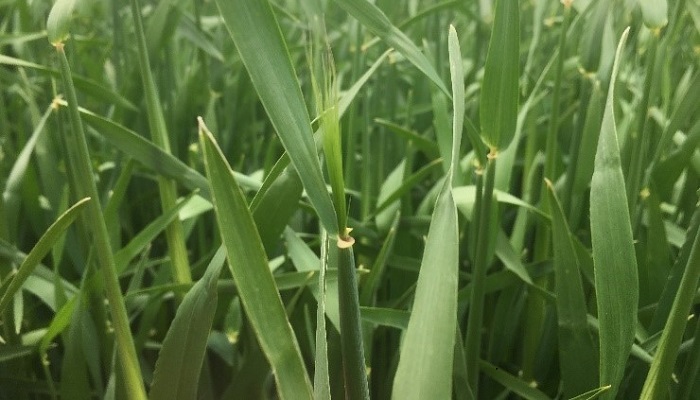
Welcome to the Teagasc June Tillage Management Notes. In this edition, Teagasc Crops Specialist, Shay Phelan brings you an update on disease control in winter wheat, spring barley and bean crops, and reminds growers that preventing seed return of grass weeds is the first line of defence for next year’s crop.
Winter wheat – Disease control
Septoria levels have been very low up to this point, as a result of all the dry weather in late May. Yellow rust has been an issue in some crops, mainly those that didn’t receive a leaf 4 application and can still be seen in crops on the flag leaf.
The final ‘Head’ spray helps to top up control of disease on the flag leaf and it gives some protection against fusarium and other ear diseases, especially if the weather is broken during flowering.
Time the final fungicide application at early flowering, which is normally three weeks after the flag leaf spray. Options include Prosaro/Protendo Extra, LS Promet at 80-100% rates. If there is active yellow rust, consider Elatus Era/Velogy Era at 80-100% rate.
Spring barley – Disease control
Many of the March drilled crops have already received their final fungicide by the end of the first week of the June. However, most of the later sown crops still have to receive their final application. Late season disease control in spring barley is designed to control ramularia and diseases such as rynchosporium or net blotch.
However, ramularia will probably be an issue this year due to the weather conditions in May, ranging from cold north winds in the first half of the month to record temperatures at the end of the month. While different varieties have differing levels of tolerance to ramularia, being able to predict which varieties are going to show signs of infection is very difficult. For this reason, we would recommend that growers protect all barley crops from ramularia.
Repeated trials have clearly shown that from flag leaf fully emerged to the awns peeping is the optimum timing for applying the final fungicide. However, waiting for the heads to come fully out and to start flowering (i.e. 10 -14 days later) can reduce yields by 0.3-0.4 t/ha.
This yield loss clearly shows that allowing ramularia to develop in the crop makes it more difficult to control, so earlier applications of fungicides are important. This is because all the products that are available will only work preventatively; they will not cure it when it is visible. Therefore, by applying a fungicide early we are trying to delay the infection from occurring for as long as possible, thus keeping the crop greener for longer. The graph below shows that applying a fungicide at GS 59 (heads flowering) gives no benefit over GS 49 (awns peeping).
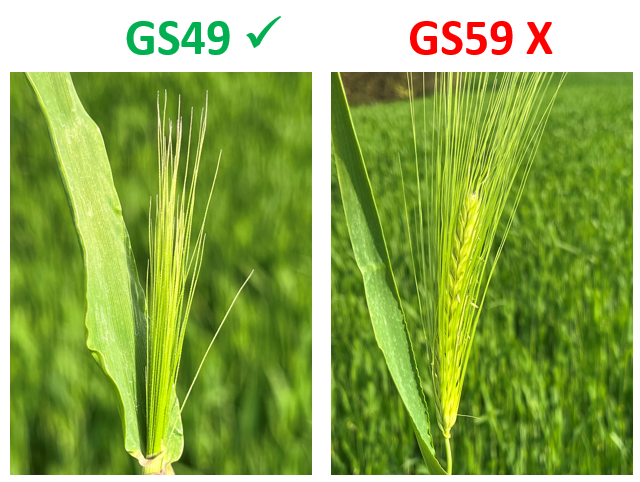
That final fungicide at awns peeping GS 49 (i.e. the ‘paintbrush stage’) will consist of a multisite, folpet (Arizona) 1.5 L/ha + (½ rate triazole + strob/SDHI mix). Various options are available but once you have the basic components in the mix (folpet + triazole + strob/SDHI), you should expect good control of diseases.
Teagasc trials consistently show that 50% rates of any triazole + SDHI/strobulurin mix are adequate to control diseases such as rynchosporium and net blotch.
Table 1: Spring barley fungicide options
| Timings and products |
| T2 timing: Flag leaf to awns visible (GS 37-49) |
| Folpet 1.5 L/ha (Arizona/Stavento/Mirror/Freedom/Lamast) |
| + |
| ½ – ¾ rate SDHI/Azole mix (Navura, Revystar packs, Macfare Xpro, Siltra, etc) |
| or |
| Folpet 1.5 L/ha + ½ – ¾ rate Azole (Proline, Decoy, Pride etc.) |
| + |
| ½ rate SDHI (Imtrex) or ½ rate Strobilurin (Amistar, Comet/Modem) |
Barley Yellow Dwarf Virus (BYDV) has been evident in many crops this spring, even those that have received an insecticide. How much this will affect crops will depend on the level of infection. For most. However, the level is probably around 5% so it should have a negligible effect.
Beans
Foliar diseases such as chocolate spot, downy mildew and rusts must be controlled to keep the foliage for as long as possible. All diseases develop quickly in warm humid conditions.
For chocolate spot control, fungicides need to be applied before the disease develops. Therefore, apply a fungicide at the first signs of disease or in any case at the start of flowering and repeat two to three weeks later. Signum 0.5-0.75 kg/ha can be applied at both timings for good control. Elatus Era is also an option and has approval for a single application on beans at 0.66 L/ha.
For downy mildew control, there are no fungicides currently available that will give control, however, Basfoliar Active and Nutriphite PGA which are bio-stimulants both claim to give some control.
Beans offer growers a good opportunity to control problematic grass weeds such as bromes, ryegrasses and wild oats with graminicide type herbicides. Good control can be achieved where products such as Fusilade Max (1.0 – 3.0L/ha), Stratos Ultra (1.5 – 4.0L/ha) or Falcon (0.7 -1.5L/ha) are used in time. Generally, they need to be applied before flowering has commenced for best control.
Grass weed control
June is a critical month for grass weed control as, for many, they will now be easier to identify once they have headed out. While blackgrass was added to the list of noxious weeds in 2025, this will not solve the issue, growers need to be proactive in dealing with the problem.
Preventing seed return of grass weeds like blackgrass, Italian ryegrass or wild oats has to be the first line of defence for next year’s crop. Where populations are low, rogueing should be carried out. However, where populations are too high for manual control then spot spraying with glyphosate has to be considered.
Resistance testing in Oak Park will only be available in 2026. It is unlikely that it will be available as a service in 2027. If you have a problem, collect some seed and see if it is resistant to the common herbicides. This is the first step in dealing with the issue.
On a recent podcast, Michael Hennessy spoke with farmer Philip Harris on how he deals with problem grass weeds and his no-nonsense approach to dealing with the issue. The episode is a must listen for any grower who has a weed problem. Listen to the podcast below:
Teagasc Tillage Edge podcast
For all the latest tillage news the Teagasc tillage podcast is available on the Teagasc website, Apple Podcasts or Spotify. Listen to some recent episodes below:
Keep up to date with Teagasc
Teagasc offers a suite of digital products – ranging from insightful podcasts, trusted eNewsletters, social media, website and mobile app channels – to provide you with the latest news, information and knowledge.