The science behind reducing methane emissions from grazing dairy cows
A new review featuring research from Teagasc has summarised the main drivers of methane emissions in pasture-based dairy systems and the mitigation options available in these systems, Dr. Ben Lahart, Research Officer at Moorepark and Dr. Muireann Egan, Teagasc Climate Centre, tell us more.
As part of its Climate Action Plan, Ireland has committed to reducing its greenhouse gas (GHG) emissions by 51% by 2030. Within this, the target for agriculture is to reduce its emissions by 25%, compared to 2018. According to the EPA’s provisional 2025 estimates, agriculture accounted for approximately 39% of Ireland’s GHG emissions. Methane is the second highest contributor to GHG in Ireland, behind carbon dioxide, accounting for 28.8% of total national emissions across all sectors.
Enteric methane is the dominant GHG emitted from pasture-based dairy systems. Methane emissions are a byproduct of enteric fermentation – a natural digestive process in ruminant animals, such as dairy cows, during which microorganisms break down feed in the rumen, producing methane that is released primarily through belching.
Measuring methane emissions
Large-scale, on-farm methane measurements are logistically challenging. Therefore, national inventory reporting methodologies rely on prediction models to estimate enteric methane output. These models use standardised methane conversion factors, which express methane as a percentage of gross energy intake.
Advances in measurement technology have allowed for improved data collection of methane emissions from pasture-based systems.
Recent studies conducted in Teagasc, Wageningen University and Dairy NZ have shown that baseline methane emissions from lactating cows grazing pasture are lower than currently accounted for within inventory models. Ultimately, this information will lead to more precise estimates of enteric methane emissions in grazing dairy systems, enabling better-informed decisions on methane mitigation strategies.
Technological interventions
Technological interventions to reduce methane emissions include feed additives, vaccines or other compounds that directly reduce methanogenesis or modify rumen fermentation.
Feed additives such as Asparagopsis spp or 3-NOP have shown methane reductions of 20-40% in housed total mixed ration systems. However, in grazing systems their efficacy is reduced due to infrequent doses offered twice daily at milking times.
Alternative delivery routes are being explored but uncertainty around actual inhibitor intake make it more difficult to remain within regulatory guidelines and may contribute to inconsistent methane mitigation responses.
Vaccines targeting methanogens are being developed but further work is required to demonstrate efficacy in field settings.
Genetics
Genetic selection offers a potential mitigation pathway with permanent and cumulative effects. Research has demonstrated that high genetic merit dairy cows for the Economic Breeding Index produce more milk solids, but do not have increased methane output, ultimately leading to a reduction in the proportion of methane emitted per unit of milk solids.
Direct selection for a methane trait could deliver annual reductions of 0.5-1%. However, breeding for reduced methane emissions needs to be considered against potentially compromising gains in productivity, efficiency and economic performance.
Pasture management
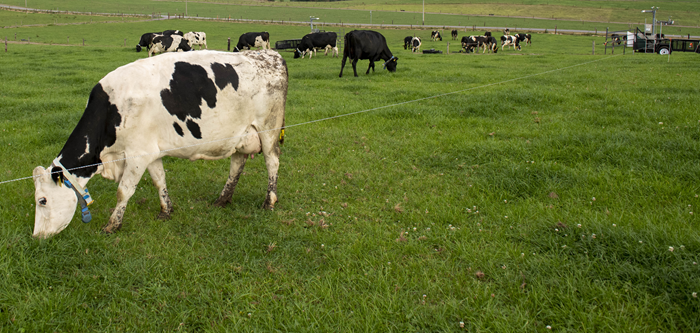
Grazing management also has an important role to play in reducing methane emissions. Research from Teagasc and Wageningen University has shown that high-quality spring grass can lead to large reductions in methane emissions than summer and autumn grass.
Reducing silage feeding during spring further reduces methane emissions. Therefore, getting animals out to grass earlier in spring and reducing silage supplementation all help to reduce methane emissions.
During the main grazing season, methane emissions per unit of milk solids output can be lowered by maintaining highly digestible swards. This can be achieved by targeting optimal pre-grazing covers of around 1,400 kg DM/ha.
Maintaining grass quality also reduces the need for concentrate supplementation, thereby cutting the off-farm emissions associated with the growth, manufacture and transport of these feeds.
Studies comparing animals grazing alternative sward species with those on grass-only swards have shown mixed results. For example, including clover in perennial ryegrass grazing swards has sometimes increased total methane output in dairy cows.
The major benefit of incorporating white clover into grazing swards is the displacement of nitrous oxide emissions associated from the manufacture of synthetic fertiliser. More recently, mixed-species swards containing grass, clover, plantain and chicory have shown potential to reduce methane output when emissions are expressed relative to milk solids production.
Overall, the review concludes that while baseline methane emissions from pasture-based dairy systems may be lower than current accounted for by inventory models, developing and implementing mitigation measures suitable for grazing systems remains challenging.
Read the full publication: Enteric methane emissions and mitigation strategies within pasture-based dairy systems
Read more about climate and biodiversity research at Teagasc here.