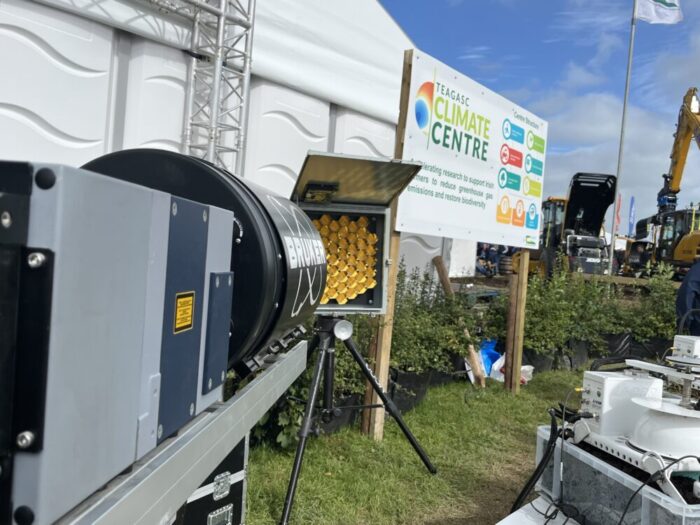
At Ploughing25, the Teagasc Climate Centre is showcasing how its research is supporting the Irish agriculture sector to meet its commitments in reducing greenhouse gas emissions. Muireann Egan tells us more.
Scientists from the Climate Centre are demonstrating some of the cutting edge instruments and tools that are being used across Teagasc to get accurate research data on soils, emissions and slurry nutrient quality. This data will be used to accelerate efforts to develop and implement technologies to reduce greenhouse gas emissions.
Understanding Irish Soils
Soil cores taken with precision tools allow researchers to examine layers of soil without disturbance. These insights reveal how land has been used over time, how organic matter is stored, and how soil structure differs across regions. This knowledge helps farmers make decisions that protect soil health and ensure its long-term fertility.
Accurate Greenhouse Gas Data for Irish Farms
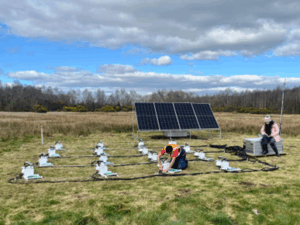
Greenhouse gas emissions from soils are influenced by factors such as soil type and farm management. By measuring emissions continuously in field trials using long-term auto-chambers, we get an accurate picture of how Irish soils release gases like nitrous oxide and carbon dioxide. This evidence is critical for developing climate-smart farming practices and ensuring Ireland meets its environmental targets.
Maximising the Value of Slurry
Research on slurry shows that its nutrient content can vary widely. By understanding this variability and using tools such as a slurry hydrometer in combination with Teagasc’s Slurry Calibration Tool, farmers can reduce nutrient losses, target their slurry application for better water quality, and enhance soil health by increasing soil organic matter.
Reducing Ammonia Losses
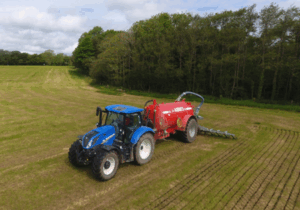
Ammonia emissions from manure spreading are affected by weather and spreading methods. FTIR (Fourier transform infrared spectroscopy) gives high frequency measurements of gas emissions from large plots and can be used to measure ammonia from slurry application. This data is used to model effect of weather and spreading method on ammonia emissions, which is used to guide ammonia mitigation technologies and improve manure management.
In the video below Saorla Kavanagh of the farmbionet project spoke to Dominika Krol about the FTIR on display at the Teagasc stand at #Ploughing25
View this post on Instagram
Together, these studies highlight how science supports practical, evidence-based solutions that benefit both Irish farmers and the wider environment.
The Teagasc Climate Centre is a virtual centre to co-ordinate agricultural climate and biodiversity research and innovation across Teagasc.