
The winning balance – why William Dennehy’s farm stood out
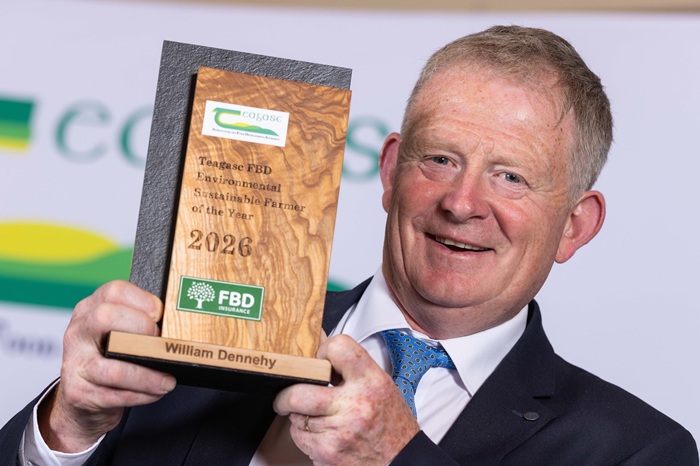
William Dennehy, a dairy farmer from Currow, Co. Kerry, has won the overall Teagasc/FBD Environmentally Sustainable Farmer of the Year 2026.
The winning farmer had to demonstrate productivity and profitability, while also protecting the environment and achieving a good work-life balance. In this article, judging panel chair Siobhan Kavanagh explains why William Dennehy and his family were selected for the award.
Productivity and profitability
Operating a spring-calving dairy herd, William focuses on maximising the use of grazed grass. Having grown 13.9t DM/ha in 2025, as measured through PastureBase, the results of this approach flow through to the bulk tank. A Kinisla supplier, milk solids yield of 497kg/cow were recorded through milk recording in 2025, stemming from a grass-based diet and just over 700kg of concentrate input.
To improve efficiency, William has also focused on breeding and the associated key performance indicators. The herd average EBI is €156 (5-star), a calving interval of 373 days was recorded, 81% of cows calve in six weeks and 96% of heifers calved at 22-26 months.
Sexed semen has also reduced the number of dairy bull calves produced, placing an emphasis on producing high-quality calves for sale to beef farmers. To do this, William uses high Dairy Beef Index (DBI) sires with a high beef sub index, thus producing high Commercial Beef Value (CBV) calves. The intention is to provide beef farmers with calves that are capable of achieving higher carcass weights at a younger finishing age.
This is a profitable farm with high levels of output while at the same time doing a good job looking after the environment.
For more on William Dennehy’s video, watch the below video:
Reducing emissions
Considerable effort has been made to reduce reliance on chemical nitrogen (N) on the farm. William is part of the Clover150 project with Teagasc Moorepark and 56% of his milking platform has an average of 21% clover content. Additionally, to produce high-quality forage for freshly calved cows, four hectares of red clover were established on the out farm in 2025.
Through this approach and by trusting the clover to fix N, chemical N use has fallen substantially to 157kg/ha in 2025, with some paddocks getting no chemical N. Almost all the nitrogen (98%) is applied as protected urea.
There has been an emphasis on soil fertility on this farm for many years. The farm is soil tested every year with more frequent testing on fields earmarked for reseeding. Over 55% of the land is optimal for soil pH, phosphorus (P) and potassium (K). Lime is applied regularly and it shows, with 91% of the farm optimum for soil pH, 80% optimum for P and 48% optimum for K.
High levels of milk output as well as good breeding performance are contributing to reducing emissions on the farm. Breeding high-quality high CBV calves is helping reduce age at finish of beef cattle, an important action in the toolbox for reducing methane emissions.
Improving water quality
The farm is situated along the Brown Flesk River, a river with good status. William is very passionate about maintaining the quality of the river, viewing himself as a custodian, a responsibility he takes very seriously.
William met with his Agricultural Sustainability Support and Advisory Programme (ASSAP) advisor and, using the Pollution Impact Potential (PIP) maps, identified the risks to water quality on the farm.
Armed with this information, William has implemented measures to reduce the risk of N getting into the water, including reducing reliance on chemical N, as discussed above. Good use of nature-based solutions has also been made, including riparian buffer zones, riverside hedge planting as well as installing a reed bed in 2024, with support from the Farming for Water EIP. This reedbed treats grey water before it enters the river.
A weather station is also located on the farm, and William finds this really useful to guide him on when to apply chemical N and slurry – avoiding difficult weather conditions and only going out in spring when soil temperatures are above 5oC to maximise the efficiency of the fertility/slurry applied.
William has sufficient slurry storage for his livestock, but he has applied for TAMS funding to construct additional storage. As the shoulders of the year become more challenging with extra rain expected to fall, William wants to be able to hold slurry and apply it when it suits to get the best value from it. There is also a very good network of roads and spur roads on the farm, allowing for on-off grazing during difficult grazing conditions.
Enhancing biodiversity
Riparian buffer zones, riverside hedge planting and tree establishment provide important protection for water quality while also enhancing biodiversity and habitat connectivity. William is continuously improving through active engagement in sustainability programmes and EIPs. Hedge management has evolved over time, leading to improved habitat quality and biodiversity. The establishment of new native hedgerows in recent years will further enhance the farm’s biodiversity value and strengthen wildlife corridors across the farm.
Decision support tools and resources
William makes really good use of the decision support tools and the resources available to him and is always up for taking on new technologies. He uses tools such as PastureBase, AgNav, NMP and ICBF reports. PastureBase allows him to make important grazing decisions during the year and to also decide on the appropriate paddocks to reseed. William also keeps his NMP maps posted on a wall in the yard, serving as a reminder of where to apply lime, P and K.
ASSAP support was used to protect water quality, while supports like TAMS and the Farming for Water EIP are leveraged to provide financial support to implement strategic technologies to support farming and the environment. To further develop the farm, he’s also involved in projects like Clover 150, Teagasc Kinisla Agribusiness Monitor Farm Programme and ClimateFarmDemo.
William has been a long-standing member of the CFS (Currow, Firies & Scartaglin) discussion group, having been involved for 31 years. This group has both challenged and supported him over the years and has been a great resource in developing his farm.
William works hard on the farm, but he sees the value of taking time away to recharge the batteries and to give something back to the local community. William started Social Farming in 2024. This involves bringing people with intellectual disabilities to the farm for a few hours every week. He finds this hugely rewarding.
William Dennehy was announced as the Teagasc / FBD Environmentally Sustainable Farmer of the Year 2026 at the awards ceremony in County Laois on Thursday, 1st October.
For more on the Teagasc / FBD Environmental Sustainability Awards, visit here.