
06 January 2024
Watch: Gearing up for calving with Future Beef farmer Ruairi Cummins
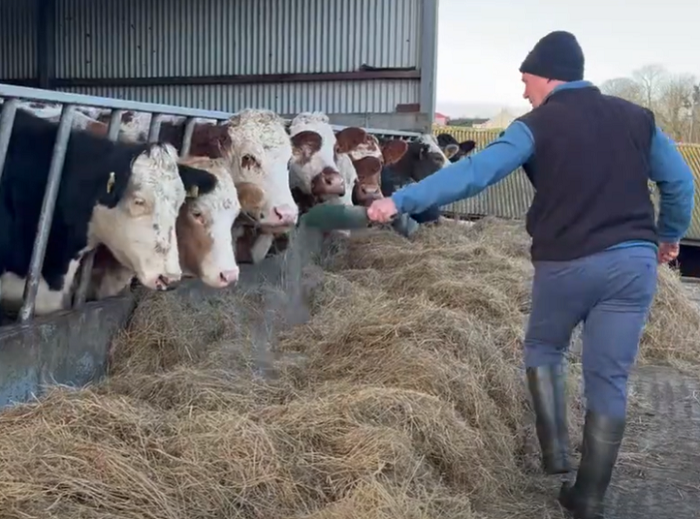
Preparations for calving have been underway on Ruairi Cummins’ Future Beef farm in Kilmoganny, Co. Kilkenny, since cows were housed in early November.
Ruairi runs a 45-cow, spring-calving suckler system, with bull calves brought through to slaughter at under-16 months and heifers sold as stores at 16-18 months. Some of the lighter bull calves are castrated and sold as stores at 16-18 months also. Ruairi is using two Charolais stock bulls, with AI used to breed maiden heifers.
At housing, cows were grouped according to body condition score (BCS). Thin cows, first calvers and in-calf heifers are housed in one shed and fed better quality silage than the fatter cows that are being fed haylage.
They were scanned and are due to start calving from January 20 until March 31. In the lead up to calving, Ruairi is taking a number of steps, these include:
- Feeding pre-calving minerals six weeks before calving (from-mid December).
- Vaccinating cows with Rotavec Corona three to 12 weeks pre-calving.
- Penning cows based on calving date after Christmas.
- Cleaning out and disinfecting calving pens in early January.
- Keeping pens well bedded to maintain good hygiene.
- Preparing calving equipment and facilities:
- Checking the calving camera;
- Checking handling facilities are in safe working order;
- Buying calving gloves, powdered colostrum, lube, a stomach tube, naval spray, colour coded calving ropes, feeding bottles, etc.;
- Checking that lights are working properly.
- Ordering calf tags.
- Keeping the yard and sheds tidy to avoid any trip hazards.
- Ensuring the vet’s number is available on his phone and that he has the phone at all times during the calving season.
Watch the video below to see Ruairi’s set up pre-calving:
Pre-calving minerals
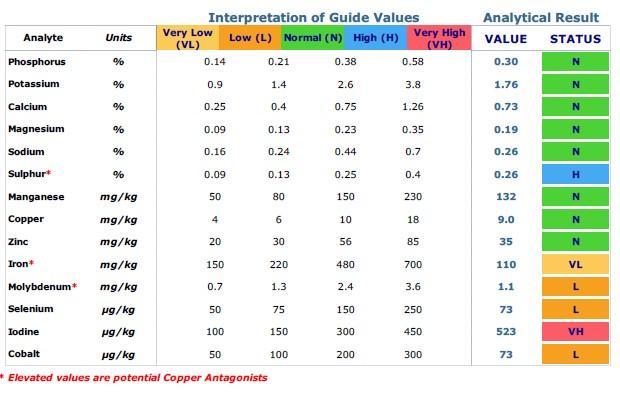
Ruairi took a sample from his silage to analyse the mineral profile. The results, as shown in Figure 1 below, show that the macro minerals (i.e. phosphorus, calcium, magnesium and sodium) were all at normal levels. The micro minerals were more variable with sulphur testing high, manganese, copper and zinc testing normal, a very high result for iodine, and iron, molybdenum, selenium and cobalt testing low.
Figure 1: Mineral analysis results
Ruairi is feeding a complementary pre-calving mineral to the cows to meet their daily requirements. It is providing a good supply of selenium and cobalt – micro minerals that are low in the silage tested. The mineral is dusted along the silage and fed at a rate of 120g/head/day. The label for the mineral shows that at this feeding rate, it is providing the following minerals daily:
Macro minerals
- 24g magnesium (17-20g recommended)
- 44g calcium (<2g recommended)
- 6g phosphorus (4.5g recommended)
- 8g sodium (15g recommended)
Micro minerals
- 360mg copper (200-400mg recommended)
- 6mg selenium (4-6mg recommended)
- 60mg iodine (20-60mg recommended)
- 12mg cobalt (5-10mg recommended)
- 240mg manganese (335-415mg recommended)
- 600mg zinc (335-600mg recommended)
Vitamins:
- 48,000 iu vitamin A (>60,000 iu recommended)
- 14,400 iu vitamin D (>12,000 iu recommended)
- 600 (>500 iu recommended)
The macro minerals are not stored in the body and therefore have to be fed daily. Further information on the role of each mineral and suckler cow recommendations can be found here.
This article was adapted from the Future Beef Newsletter for January. For more information on the programme and to sign up to subsequent newsletters, click here. For more information on Ruairi’s farm, including an update on performance, click here.