
Dairy beef animals are now responsible for the lion’s share of Ireland’s prime beef throughput, with over 60% of prime finished cattle originating from the dairy herd.
Meeting carcass specifications for dairy beef animals, however, demands greater attention on selecting the right genetics and implementing effective management practices on finishing farms.
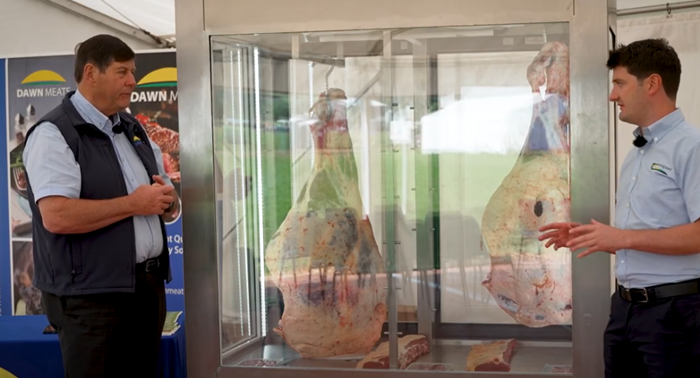
At part of this summer’s Moorepark Dairy Open Day, dairy beef Research Officer, Dr. Nicky Byrne was joined by Paul Nolan of Dawn Meats to discuss carcass specifications for dairy calf to beef systems.
As outlined in the below video and attesting to the importance of meeting carcass specifications with dairy beef animals, Paul Nolan explained: “It’s back to the old adage that you have got to produce what the customer is looking for… Predominately, they are looking for steaks of a certain size, thickness and a certain price level.”
“What we don’t want to see is a scenario where a consumer goes in and looks at two steaks and they are attractive, but they are very big steaks and very heavy because the price point of that will lead that consumer to saying ‘what are my alternatives?’,” Paul Nolan added.
Summarising what’s required to produce such as steak size, Paul Nolan added: “We are looking for an animal that is going to finish as early as possible that is going to give you a carcass size of 350kg for bullocks and around 300-320kg for heifers, giving us a steak size that fits the consumer’s requirement and animal that is not less really than a O+ in conformation and certainly no more than a 4= in fat cover.”
To deliver such a carcass, Dr. Byrne explained that genetics play an important role. Delving into the Teagasc Grange repository of dairy beef research, he explained: “We know that high beef sub-index animals on the DairyBeef Index have an increasing ability to achieve that overall spec in terms of weight and conformation.”
Through the use of a visual display, further details of which can be viewed in the above video, Paul Nolan noted that dairy farmers really need to focus on the best available genetics within each breed to make sure that the beef finisher who is ultimately going to take the calves from the dairy farm has a chance of getting into a premium market.
Dr. Byrne concluded: “The contribution of animal genetics is massive. It creates the potential within our dairy beef systems. However, the management of those animals in terms of the grass-based nutrition and the drafting policy in place can really fine tune dairy beef systems and create a pathway for profitable and sustainable beef production.”
More from Teagasc Daily: Feeding concentrates to finish cattle off grass