GROFarmS – Beef
 Developing practical and profitable organic beef production systems
Beef cattle production is the dominant enterprise on Irish organic farms. Until recently, however, there has been limited experimental evidence to guide organic beef farmers and those considering conversion on the most efficient and profitable approaches to beef production and finishing.
GROFarmS is addressing this gap through complementary research at Teagasc Grange and the Kildavin Organic Research Farm at Teagasc Johnstown Castle. Grange is generating controlled experimental evidence on alternative winter finishing diets, while Kildavin provides a dedicated organic systems research platform in which feeding strategies can be integrated with forage production, grazing management, breed and alternative finishing ages. Teagasc Organic Specialists informed the selection of feeding trials and livestock procurement.
GROFarmS is a Teagasc research project, in collaboration with UCD, investigating how organic farming systems can become more efficient, profitable and sustainable. The project includes research across organic beef, organic sheep and lamb, and the economic and environmental performance of organic farms.
Find out more:
GROFarmS Sheep
GROFarmS Economic
Actions
Reducing the cost of indoor finishing – Exploring Winter Finishing diets
Indoor finishing is one of the most expensive phases of beef production, a challenge amplified in organic systems by the relatively high cost of certified concentrate feeds. The Grange research is examining whether greater use can be made of home-grown feeds (both energy and protein sources) while maintaining animal and financial performance.
Late-maturing suckler steers were offered four contrasting finishing diets over 98 days:
- Perennial ryegrass silage plus barley-based concentrate ‘control diet’;
- Organic grass-red-clover silage plus organic barley-pea grain;
- Organic grass-red-clover silage only; or
- Organic barley-pea bi-crop silage.
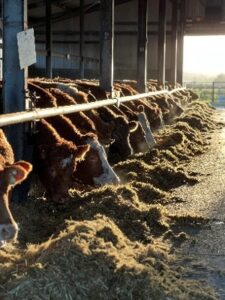
Cows eating red clover silage
Grange
What did the Grange experiment find?
The grass-red-clover silage plus organic concentrate treatment achieved the highest average daily liveweight gain at 1.33 kg/day, compared with 1.09 kg/day for the conventional control, 1.01 kg/day for the bi-crop silage and 0.85 kg/day for grass-red-clover silage alone.
Feed conversion efficiency was also highest for the conventional and grass-red-clover-plus-organic-concentrate diets, requiring approximately 8.0–8.5 kg DM per kg of liveweight gain, compared with 11.2 and 12.7 kg for grass-red-clover silage alone and bi-crop silage, respectively.
Financial margins were highest for the grass-red-clover silage plus organic concentrate treatment and lowest for the bi-crop treatment, although results were highly sensitive to store cattle purchase price and final beef price. The findings provide an evidence base for developing winter feeding strategies within the Kildavin organic beef system.
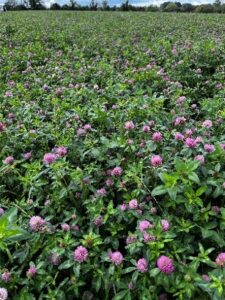
Red clover silage second cut
Kildavin
From experimental evidence to whole-farm systems research
The 48-hectare Kildavin Farm is in the process of conversio to organic standards to provide a long-term platform for organic beef systems research and demonstration. It provides an important bridge between controlled experiments and whole-farm production, allowing feeding strategies to be evaluated alongside grazing management, forage production, breed, animal health and finishing age within an integrated organic system.
In the first production cycle, 82 organically sourced, spring-born suckler-bred weanling steers, comprising early- and late-maturing breed types, entered the system in autumn 2024. During their first winter, cattle were offered either grass-red-clover or multi-species silage without concentrate supplementation, before turn-out to pasture.
Following their second grazing season, cattle followed three contrasting finishing pathways:
- 19 months – finished directly from pasture without concentrate supplementation
- 23 months – finished following a second winter on silage supplemented with organic concentrate or
- 26 months – overwintered on silage with a lower level of concentrate before returning to pasture for part of a third grazing season.
The research therefore examines the trade-offs between earlier finishing, winter feed requirements and greater use of grazed forage. Average carcass weights in the first production cycle were 302 kg, 359 kg and 396 kg at 19, 23 and 26 months, respectively.
Subsequent production cycles will build on these findings and evidence from the Grange finishing-diet research, allowing alternative feeding strategies, forage sources and breed types to be evaluated within the developing Kildavin organic beef system.
Joe Kelleher, Teagasc Organic Specialist tells us more about the Kildavin Organic Research Farm
Outputs
Developing an organic beef blueprint
The emerging evidence demonstrates that organic beef production cannot simply be viewed as conventional production with inputs removed. Forage production, breed, stocking rate, grazing management, winter feeding, finishing age, concentrate use and marketing interact to determine technical and financial performance.
GROFarmS is therefore progressing from the controlled evaluation of individual components at Grange to their integration within the whole-farm system at Kildavin, with the objective of developing an evidence-based blueprint for efficient and profitable organic beef production and identifying opportunities to maximise the use of home-grown feed while maintaining animal and financial performance.
Project Partners
Alan Kelly, University College Dublin
Funding