GROFarmS – Sheep
 Developing efficient finishing systems for organic lamb production
Researchers at Teagasc’s Sheep Research Farm at Athenry are examining practical finishing systems for both lowland and hill lambs, taking account of animal performance, forage production, environmental performance and economic returns. The feed trials were co-designed by the Teagasc researchers and the Teagasc organic specialists, with a focus on relevance for practical farm contexts and feed availability.
GROFarmS is a Teagasc research project, in collaboration with UCD, investigating how organic farming systems can become more efficient, profitable and sustainable. The project includes research across organic beef, organic sheep and lamb, and the economic and environmental performance of organic farms.
Find out more:
GROFarmS Beef
GROFarmS Economic
Actions
Lowland organic lamb production
The lowland research is investigating how legumes and forage crops can be incorporated into diets to provide productive, low-input systems capable of finishing lambs to organic farming requirements.
Two systems are being compared:
- high-legume pasture system, incorporating white and red clover to provide high-quality grazing and conserved forage
- high-legume plus forage-crop system, incorporating white and red clover alongside forage crops for post-weaning lamb finishing.
Across the first two years of the project, lambs in the legume-plus-forage-crop system recorded an average post-weaning growth rate of 150 g/day, compared with 138 g/day in the legume system. Average age at slaughter was consequently lower at 228 versus 239 days, while concentrate supplementation was also considerably lower at 1.4 versus 8.5 kg/lamb.
The forage-crop system has also increased overall forage production. Across Years 1 and 2, total dry-matter production averaged approximately 10.0 t DM/ha for the legume-plus-forage-crop system compared with 7.3 t DM/ha for the legume pasture system.
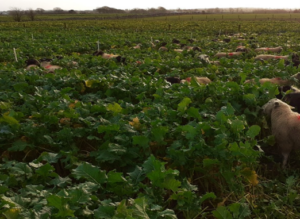
Hill lambs outdoors
The challenge of finishing organic hill lambs
A second strand of the research is examining indoor finishing options for smaller lighter hill-bred lambs. Organic finishing presents particular challenges because concentrates are expensive and organic standards restrict ad-libitium concentrate intake, increasing the importance of producing and conserving high-quality forage.
Initial work compared offering lambs ad-libitium access grass silage, red-clover silage or whole-crop silage plus 500g/head/day of organic concentrate supplementation. The first year’s study demonstrated the difficulty of finishing comparatively light hill lambs indoors; average daily gain was 119 g/day on grass silage, 95 g/day on red-clover silage and 45 g/day on whole-crop silage. Feed intake, forage quality and starting liveweight emerged as important constraints.
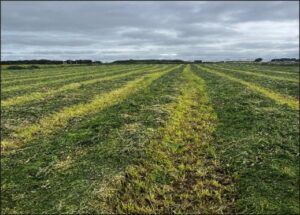
Organic red clover silage
The experiment was refined in year 2; a revised whole-crop treatment was devised to address the deficiencies identified in the review of year 1 treatments. Performance improved on red-clover silage, with lambs gaining 132 g/day, compared with 101 g/day on grass silage and 66 g/day on the revised whole-crop treatment. Half of the lambs offered red-clover silage reached slaughter specification during the feeding period (103 days for grass silage and red clover silage), compared with 36% on grass silage. However, none of the sheep on whole-crop reached slaughter.
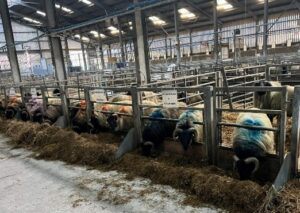
Hill lambs indoors
Outcomes
The research demonstrates that forage-based organic lamb production is possible, but the quality, intake and conservation of forage are critical. For hill lambs in particular, starting live-weight has a major influence on the viability of indoor finishing, while dependence on expensive purchased organic concentrate must be minimised.
Further work is quantifying actual dry-matter and energy intake and examining the economics of the different systems. The objective is to translate these experiments into practical finishing strategies that organic sheep farmers can apply under Irish conditions.
Project Partners
Tommy Boland, University College Dublin
Funding