
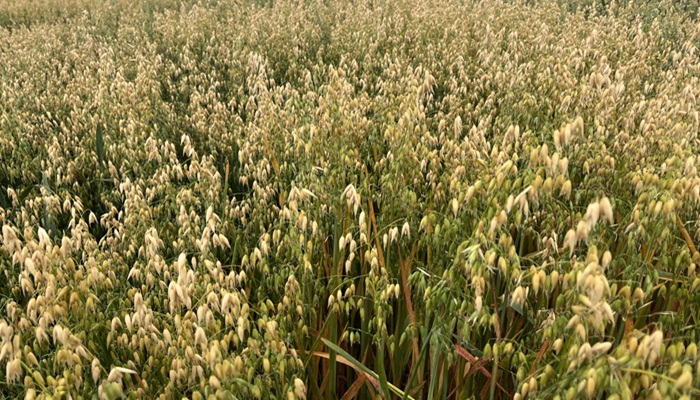
Research undertaken in the Teagasc Crops Research Centre, Oak Park, to support the development of the Winter Oat Guide, has offered new insights as to the most appropriate nitrogen fertiliser strategies for winter oat crops.
Leading this research has been Dr. Atikur Rahman, a Research Officer working in the area of oat agronomy and physiology, who shared some of the key findings at the Crops and Technology Open Day, an event organised in partnership between Teagasc and the Irish Farmers Journal, on June 25.
One specific focus of Dr. Rahman’s work has been the drivers of yield in winter oat crops. He noted: “Our work reaffirms that grain number per panicle is the main yield driver in winter oats, and our research has focused on how we achieve this yield potential by manipulating grain number per panicle.”
As expected, Nitrogen (N) fertiliser application strategy is the primary driver, but a balance is required between timing and total N supplied to the crop. Quantifying this, Dr. Rahman said: “From our research, our primary advisory recommendation is to apply the recommended application of nitrogen in two splits by growth stage 32.”
As to the why, Dr. Rahman added: “Applying nitrogen by growth stage 32, along with ensuring all other management practices are completed on time, ensures a healthy crop during the critical yield formation period.
“In winter oats, the most critical period for yield formation occurs between flag leaf emergence to panicle emergence. If the crop becomes stressed during this period, there is the potential for a significant reduction in yield through oat panicle floral abortion, occurring when the oat plant senses stress and causing the spikelets to go dry and die.”
Along with insufficient nitrogen applications being cited as a cause of the above, Dr. Rahman noted that harsh chemical mixes are also a stress factor during this period, adding: “In both cases, the oat plant – although its panicle may have had a very high potential to form grain – has decided not to [maximise yield] because it is under stress.”
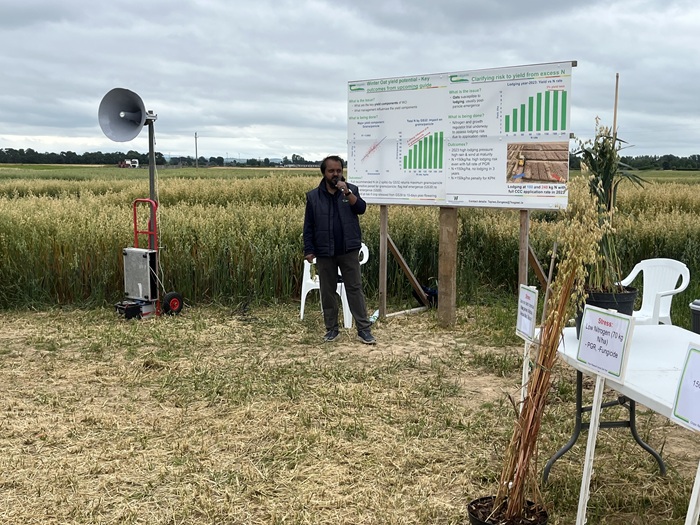
Dr. Atikur Rahman discussed Teagasc’s ongoing research in the area of oats at the Crops and Technology Open Day
Given the above, nitrogen applications prior to reaching growth stage 32 are key for optimising grain yield, but Dr. Rahman noted that balance is needed, especially when it comes to counteracting lodging. The Nitrogen index of the soil on which these studies were undertaken was index 1. Growers may need to adjust their applied N based on available residual N and the type of soil.
“Grain number is clearly influenced by nitrogen and some farmers might be tempted to put on more nitrogen, but lodging is a concern,” he added.
Explaining how this is the case, Dr. Rahman summarised work from Teagasc Walsh Scholar, Tapiwa Zengeza’s study which showed that in 2023 – a high lodging pressure year due to wind and rain – plots receiving more than 150kg of N/ha suffered yield losses through lodging.
“Studies undertaken at Oak Park show that at N application rates of >150kg/ha, there is a high lodging risk – even with full applications of plant growth regulators – and penalties for KPH. During 2023, we recorded yield losses of 3% when N application rates increased from 150kg N/ha to either 180kg N/ha or 240kg N/ha. Treatments receiving <150kg N/ha showed no lodging in the three years of this study,” Dr. Rahman concluded.
Highlights from the Oak Park Open Day
More highlights from the Teagasc Crops & Technology Open Day in Oak Park, Carlow were provided via the Tillage Edge podcast. Michael Hennessy spoke with Dr. Ewen Mullins about the event and farmer feedback, Veronica Nyhan gave a tour of the soil pit and Jack Jameson discussed his wheat variety trials.
Listen in below:
More from the Crops and Technology Open Day: Time to catch on to rye?
More from the Crops and Technology Open Day: What lies beneath: Insights from the Oak Park soil pit
More from the Crops and Technology Open Day: Fast-growing faba beans – a runner in shorter growing seasons?