
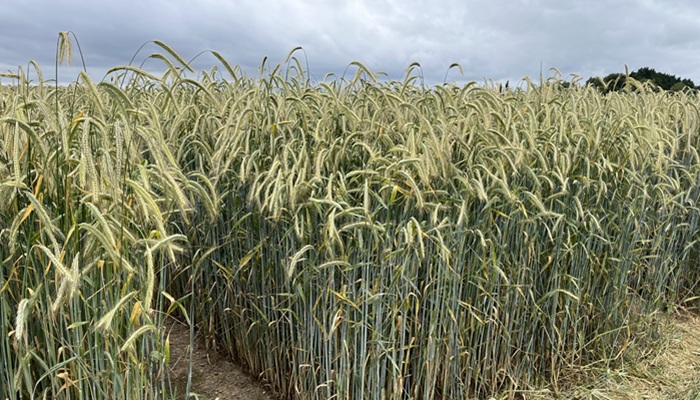
Rye, a relatively new crop to Ireland, sparked plenty of discussion among tillage farmers at the Crops and Technology Open Day, held in Teagasc Oak Park on June 25.
“Rye offers high yield potential, and our knowledge of its agronomy under Irish conditions has improved considerably in recent years,” Teagasc Research Officer, Richie Hackett prefaced before outlining the trial work ongoing in the Teagasc Crops Research Centre.
From its arrival on the Irish cropping scene in 2018, the area planted under winter rye has increased slowly to approximately 3,000ha in 2024, with the bulk of these crops being hybrids – varieties claimed to be less susceptible to ergot.
To provide farmers with the confidence and tools needed to grow rye, Richie Hackett explained that extensive trial work is ongoing at Oak Park, all with the aim of producing a guide to growing rye by 2026.
Early results of this research have been promising; rye yields have matched or outperformed winter wheat yields across a number of trial sites, the higher resistance to ergot claim has held true thus far, and rye crops achieved peak yield at lower nitrogen inputs per hectare than winter wheat varieties.
“Rye also benefits from having a longer sowing window. Planting can occur from the middle of September right through to the middle of November but ideally planting should be finished by mid-October.
“Our research has shown that hybrid rye varieties typically experience much lower levels of disease pressure than winter barley or wheat. Barley Yellow Dwarf Virus (BYDV) can occur, but its effect on yield of rye is much less than that of barley even when sown early, while the crop is less inclined to be affected by take-all disease,” Richie Hackett added.
Straw management, slugs and markets
Conor Kavanagh, a Crops Advisor based in Tipperary, discussed straw length, slug pressure and the importance of having a secure market if considering growing rye.
“Hybrid rye is a very tall crop, and it produces favourable straw yields – up to 20 bales/ac.
“Careful consideration on field selection is needed, as it can be very susceptible to slug damage and problem fields or following oilseed rape crops should be avoided,” Conor Kavanagh added.
He also reminded potential growers: “Don’t plant rye unless you have a merchant that is going to take it. Not every merchant will take the crop and have a conversation before sowing.”
Food applications for Irish-grown rye
The potential for Irish-grown rye to enter food applications was also discussed by Teagasc Walsh Scholar, Sinead Dermody who told the attending crowd of her ongoing research through the Department of Agriculture, Food and the Marine’s Protein-I project. Under this research, both hybrid rye and population rye varieties are being studied.
With the majority of winter rye grown in Ireland destined for animal feed, Sinead Dermody explained how her research is examining its suitability for food applications.
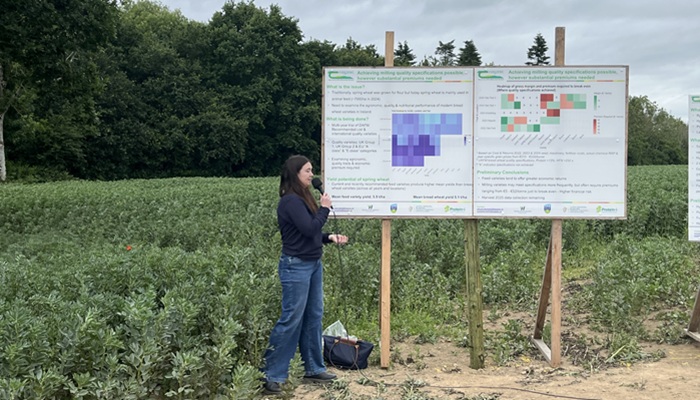
Sinead Dermody presented her ongoing research as part of the Department of Agriculture, Food and the Marine’s PROTEIN-I project at the Crops and Technology Open Day
“We are growing up to 14 multi-purpose varieties in two locations over the last three years, in Carlow and Waterford – varieties deemed by the breeders as suitable for feed, food and distilling, and our focus is food.”
“The preliminary outcomes so far indicate that hybrid varieties achieve higher mean yields than population varieties and this is no surprise given they have been subject to greater breeding efforts and exhibit hybrid vigour.
“What’s really promising is that the hybrid varieties, while more productive in terms of grain yield, also present with higher Hagberg Falling Numbers, which is an important specification for flour functionality.”
Other work on winter rye grain quality is ongoing within PROTEIN-I, which involves examining the hybrid rye grain milling and nutritional traits under high to low nitrogen application (0 kg/ha-180 kg/ha).
Along with collecting data from harvest 2025, further research in this area will be required in terms of flour functionality and safety.
More from Crops and Technology 2025: Highlights from the Oak Park Open Day
More from Crops and Technology 2025: What lies beneath: Insights from the Oak Park soil pit
More from Crops and Technology 2025: Fast-growing faba beans – a runner in shorter growing seasons?
More from Crops and Technology 2025: Handle pesticides safely
More from Crops and Technology 2025: Calculating the carbon footprint of your crops