
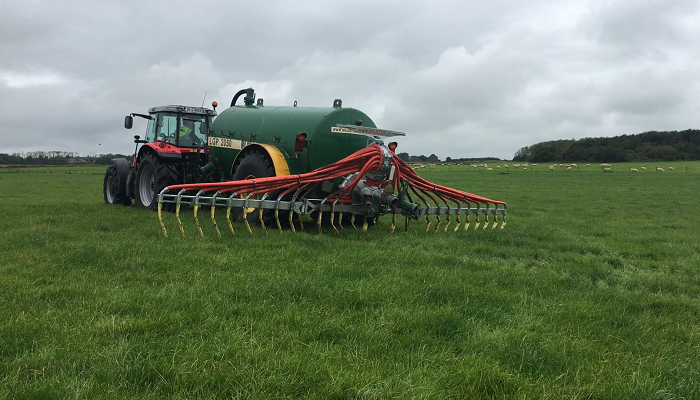
A new report on slurry nutrient distribution from Teagasc shows there are significant opportunities to enhance nutrient use efficiency on dairy farms by optimising slurry management, particularly by moving slurry applications from the milking platform to support blocks on some higher platform stocked farms.
The ‘Improving slurry nutrient distribution on dairy farm holdings’ report, prepared by Professor Laurance Shalloo and Professor Pat Dillon, as part of the preparatory work for Ireland’s next Nitrates Action Programme and presented to the Department of Agriculture, Food and the Marine, outlines that redistributing slurry produced over the winter from milking platforms to other parts of the farm can allow for better balancing of nutrient loads.
Based on milking platform stocking rate, the report examines the proportion or percentage of slurry required to be moved away from the milking platform and instead targeted at other areas, such as silage ground, of the farm to ensure nutrients are used efficiently, lessening the dependence on purchased nitrogen fertilisers and minimising nutrient losses to the environment. For example, herds with very high milking platform stocking rates may need to spread up to 100% of slurry away from the milking platform to manage nutrient levels effectively.
As part of the report, a methodology was developed with varying milking platform stocking rates to examine the different proportions of the slurry to be distributed to the area that was not available for grazing for the milking herd, based on the organic N excretion rate of the herd (Banding) and the chemical N application rate per hectare. The report highlighted that the methodology developed was not designed to limit platform stocking rate but was focusing on nutrient distribution across the whole farm.
Where the overall maximum chemical N allowance is 214 kg/ha, 25%, 50%, 75% and 100% of the slurry would be distributed for herds in Band 2 at milking platform stocking rates 3.3, 3.5, 3.6 and ≥3.9 cows/ha, the report states. No slurry is required to be distributed at stocking rates of less than or equal to 3.1 cows/ha for herds in Band 2.
Compared to herds in Band 2, herds in Band 1 can operate at a higher platform stocking rate before nutrient is required to be distributed, while herds in Band 3 would have to operate at a lower platform stocking rates before nutrient is required to be distributed.
Additional slurry storage
The ‘Slurry and dairy soiled water volume estimates’ report also prepared by Teagasc for the Department of Agriculture, Food and the Marine (DAFM) found that the volume of slurry and soiled water produced on dairy farms is underestimated presently compared to the current regulations. Current regulations require 0.33 m3/cow/week for slurry storage and 0.21 m3/cow/week for soiled water storage, plus an allowance for rainfall runoff from any adjacent uncovered area. This report will provide guidance to DAFM to inform policy associated with any potential changes to current regulations. Farmers will face significant costs to provide additional storage capacity should these higher rates be adopted and must plan ahead for investments, possibly using the Nutrient Storage Investment Scheme (TAMS 3).
View the Slurry and dairy soiled water volume estimates – final data summary here.
More from Teagasc Daily: Fewer cows, lower income and less national milk production
More from Teagasc Daily: Longer lead times needed before further reduction in fertiliser allowances