

Barry Caslin, Energy and Rural Development Specialist at Teagasc, with contributions from Dr. Shaun Connolly, Dr. Dominika Krol, and Dr. Donal O’Brien - all research scientists based at Teagasc's Johnstown Castle, takes a closer look at ReNure and the potential it may have for dairy farmers.
Irish dairy farmers face rising pressure from strict nitrogen limits aimed at protecting the environment. ReNure, while still a draft proposal, could offer a fresh way to manage nutrients and reduce costs – connecting closely with the emerging biomethane industry.
What is the challenge?
Irish dairy farmers are facing increasing pressure from the Nitrates Directive, which limits the amount of organic nitrogen (N) that can be applied to land from livestock manure. The standard limit is 170 kg of organic N per hectare per year. Some farmers can avail of a derogation to go higher (up to 220 kg or 250 kg N/ha), but this is subject to stricter rules and is being reduced in more nitrate-vulnerable zones
Recent changes mean that, depending on your herd’s average milk yield, the N excretion rate per cow is now 80, 92, or 106 kg N per year. For many, this pushes their farm over the 170 kg/ha limit, especially if they are in the higher bands. The derogation, which allows higher limits, has been extended until at least 2028, but the future is uncertain and the rules are tightening. For example, if your farm is in band 2 (92 kg N per cow per year) that means you are restricted to 170 / 92 = 1.84 cows per hectare otherwise you are breaching your legal limit as per the Nitrates Directive and a stocking rate above this is in derogation territory.
The problem with slurry exports
Currently, if a farm exceeds the 170 kg/ha limit, the main options are to:
- Export slurry to another farm that is under the limit, or
- Reduce cow numbers, or
- Rent or lease additional land
However, exporting slurry means losing valuable nutrients. Under current rules, if you export slurry to an anaerobic digestion (AD) plant, you cannot bring the resulting digestate back to your own farm if you are already at the organic N limit. This forces you to buy chemical fertiliser to replace the lost nutrients, breaking the circular nutrient cycle and increasing costs. Digestate is the nutrient-rich material left over after organic waste, like manure, is broken down in an anaerobic digestion process.
What is ReNure?
ReNure (Recovered Nitrogen from Manure) is a new proposal from the European Commission. It would allow certain types of processed manure – specifically, digestate from AD plants that has undergone further treatment – to be classified as a chemical fertiliser rather than organic manure. This means it would not count towards the 170 kg/ha organic N limit, and could be used to replace chemical N fertiliser on your farm.
If adopted in Ireland, ReNure would allow farmers to:
- Export slurry to an AD plant,
- Receive back processed digestate (if it meets ReNure standards),
- Use up to an additional 80 kg N/ha of this processed digestate as if it were chemical fertiliser.
According to industry insight, there will be a need for education here. It must be clear that qualifying ReNure is a fertilising product, not just organic manure. Engagement through Discussion Groups is seen as the first phase of this education. On-farm separation is viewed as a key part of the plan, offering derogation farmers options to maximise their organic fertiliser usage while returning ReNure at a lower cost and improved carbon intensity, alongside whatever commodity bonus structure they receive for their produce.
How does digestate qualify as ReNure?
Not all digestate will qualify. To be classified as ReNure, digestate must be further processed – for example, by ammonia stripping, membrane filtration, or chemical precipitation – to produce products like ammonium salts, mineral concentrate, or struvite. These processes make the nitrogen in digestate more plant-available and similar to chemical fertiliser, but require investment in technology and infrastructure at AD plants.
Is AD absolutely necessary or can ordinary manure that undergoes ammonia stripping also qualify?
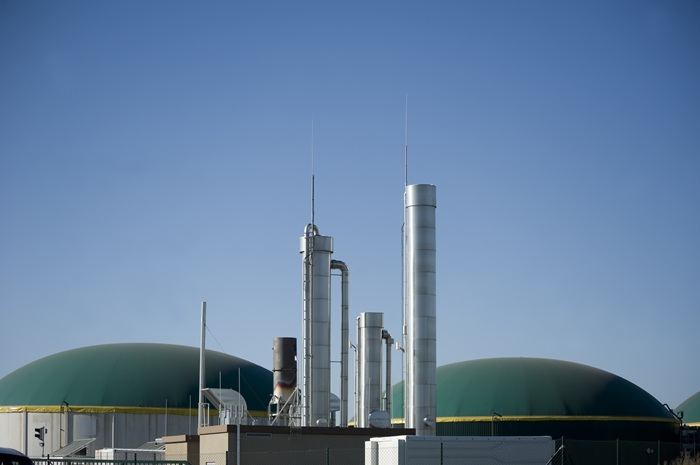
It is not absolutely necessary to have AD. However, ammonia stripping is a capital-intensive process, and to achieve the economy of scale needed for viability, plants will have to be very large scale. Because of this, ammonia stripping is more suited as a “bolt-on” to large-scale AD plants rather than as a standalone treatment.
What about the costs involved in qualifying to be a ReNure assured product?
Capital costs will likely require an independent certification process, which demands an economy of scale for implementation. Industry estimates suggest that BioBased ReNure costs will sit below current fertiliser processing costs before carbon taxes.
Worked Example – 120-Cow Dairy Farm
Let’s take a typical scenario:
- Herd size – 120 cows (Band 2, 92 kg organic N/cow/year)
- Land area – 52 hectares
- Total organic N produced – 120 cows × 92 kg = 11,040 kg N/year
- Stocking rate – 11,040 kg N ÷ 52 ha = 212 kg N/ha/year (over the 170 kg/ha limit)
- Current Situation
To comply with the 170 kg/ha limit, the farm must export enough slurry to bring its organic N down to 170 kg/ha
- Allowed organic N – 52 ha × 170 kg = 8,840 kg N/year
- Excess N to export – 11,040 kg – 8,840 kg = 2,200 kg N/year
This means exporting about 20% of the farm’s slurry. Under current rules, the farm cannot bring back digestate from the AD plant, so it must buy chemical N fertiliser to replace the nutrients lost.
With ReNure
If the exported slurry is processed at the AD plant and the resulting digestate qualifies as ReNure, the farm can import up to 80 kg N/ha of this processed digestate as chemical fertiliser.
- Total ReNure N allowed – 52 ha × 80 kg = 4,160 kg N/year
This digestate can directly replace chemical N fertiliser, reducing the need to buy urea or other synthetic products.In this case ReNure can replace all the nutrients exported in slurry (2,200 kg) and the remaining 1,960 kg can replace purchased fertiliser.
Nutrient availability and fertiliser savings
Research shows that digestate from AD is about 20% more plant-available N than raw slurry. For every 1 kg of N in digestate, you get more effective N for your crops.
- Daily N excreted – 120 cows × 0.252 kg/day = 30 kg N/day
- Available N in raw slurry (36%) – 30 kg × 36% = 11 kg/day
- Available N in digestate (20% more) – 11 kg × 1.2 = 13.2 kg/day
- Extra available N per day – 2.2 kg
- Annual extra available N – 2.2 kg × 365 = 803 kg N/year
- If the animals are housed for 185 days (typical in Ireland), about 60% of annual excreta is collected
- Annual benefit (60%) 803 kg × 0.6 = 482 kg N/year
Fertiliser cost savings:
- Value of N in 2025: €1.48/kg
- Annual saving 482 kg × €1.48 = €713 (for 185 days housing)
- If housed all year – 803 kg × €1.48 = €1,188
CO₂ savings:
- Emission factor for urea – 5.55 kg CO₂e/kg N
- Annual avoided emissions 803 kg × 5.55 = 4,456 kg CO₂e (if housed all year)
Phosphorus considerations
The AD process does not change the total amount of N, P, or K in the manure. However, most of the phosphorus ends up in the solid fraction of digestate, which AD plants often keep. If you only get the liquid fraction back, you may still need to buy in phosphorus fertiliser, as Irish soils are often phosphorus-deficient
When slurry is processed in an AD plant and then separated, the liquid fraction (which is typically what would be returned to the farm as ReNure) contains nearly all the nitrogen and potassium originally present in the manure. To meet ReNure requirements, further processing steps beyond separation are needed. For example, steps such as de-watering the liquid fraction and reverse osmosis (RO) treatment of the discharge water.
There may be options for farmers to take the solid fraction digestate, helping farmers manage their phosphorus needs directly on-farm.
Practical implications
Farmers can replace a significant portion of chemical N fertiliser with ReNure digestate, saving money and reducing carbon footprint.
Digestate must be further processed to meet ReNure standards, which may increase costs and require investment in AD infrastructure. Phosphorus management remains a challenge, as most P stays in the solid fraction. Record-keeping, soil testing, and compliance with spreading rules will be essential.
Quality controls and best practice guidelines will be crucial for ReNure acceptance. The most effective quality control measure is ISO Accreditation, which provides independent, comprehensive oversight of the entire production process. Achieving this accreditation will change the status of ReNure from a waste-based organic manure product to a recognised fertiliser product.
Policy and industry context
The European Commission’s Nitrates Committee has endorsed the ReNure proposal on 19th September 2025, and it is now with the European Parliament and Council for final approval. They have a three month window for observations. If adopted, it will be up to Ireland to implement the rules and support the necessary infrastructure.
The National Biomethane Strategy aims to build up to 200 AD plants by 2030, making large-scale nutrient recycling more feasible. The government and industry are supportive, but significant investment and clear policy direction are needed.
Conclusion
ReNure offers a real opportunity for Irish dairy farmers to maintain productivity and comply with tightening nitrates rules, by allowing processed digestate to be used as a chemical fertiliser substitute. This could reduce fertiliser bills, cut carbon emissions, and support the growth of the biomethane sector. However, success depends on investment in AD and digestate processing, and careful nutrient management on farms. ReNure does not increase the number of cows you can keep under the 170 kg organic N/ha limit. It allows in the example above to recycle up to 4,160 kg of your own N (as processed digestate) back onto your land as “chemical N,” reducing your need to buy chemical fertiliser.
More from Teagasc Daily:
Also read: Support needed to bring small-scale biogas into the mainstream
Also read: The rise of hydrogen-fuelled tractors and vehicles
Also read: Diversifying Irish agriculture – navigating new paths to farm resilience
Also read: Exploring Farm Diversification: Renewable Energy
Also read: Unlocking Ireland’s rural income potential
Also read: Harvesting renewable energy with SRESS