
BYDV and the role of tolerant barley varieties
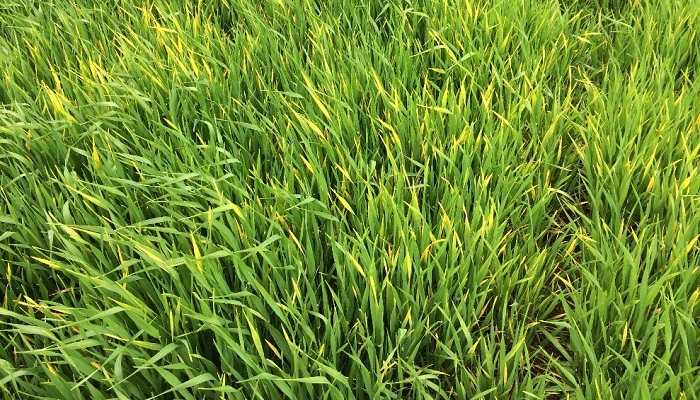
As part of the recent Teagasc National Tillage Conference, Teagasc Walsh Scholar, Jack Perry provided an overview of research aimed at validating the use of tolerant winter barley varieties to manage Barley Yellow Dwarf Virus (BYDV) in Ireland.
Addressing the delegates in attendance, Jack Perry said: “BYDV is transmitted into barley by aphids feeding on the crops and there are three BYDV species present in Ireland – BYDV MAV, BYDV PAV and BYDV PAS, with the dominant species being BYDV MAV. The main species present within mainland Europe is BYDV PAV, putting Ireland in a different BYDV environment than mainland Europe.”
Although promising tolerant varieties to BYDV have become available, Jack Perry noted that much testing on these varieties has been carried out in relation to BYDV PAV in mainland Europe. To quantify their effectiveness in Ireland against BYDV MAV, lab and plot scale trials have been undertaken at the Crops Research Centre, Oak Park.
“On the Department of Agriculture, Food and the Marine’s Recommended List, four varieties have some form of tolerance gene. Two of them have an Ryd2 gene and two of them have an Ryd2 + Ryd3 gene. These genes have been well studied against BYDV PAV in mainland Europe, but they have been under studied towards BYDV MAV in Ireland,” Jack Perry added.
Through Jack’s study, five different cultivars were examined – one susceptible and four with tolerant genes present. In lab studies, susceptible varieties had higher transmission scores than all four tolerant cultivars, which was to be expected.
In the field and working off average yields from harvests in 2024 and 2025, Jack Perry explained that tolerant varieties – when left untreated with insecticide – showed lower levels of BYDV symptoms, but BYDV was still present within the crop.
On the yield impact, the Teagasc Walsh Scholar added: “Susceptible varieties that are unsprayed suffer a yield penalty of around 2t/ha, something that we expected to see. In cultivars with the Ryd2 genes, we see a much-reduced drop in yield.
“When we examined the Ryd2 + Ryd3 cultivars, we do see a yield reduction when they are left unsprayed. This is only about 1t/ha and it is less than the yield penalty we see in response to susceptible cultivars treated for BYDV.”
Concluding his presentation, Jack Perry explained: “Our research has shown a proven reduction in BYDV transmission efficiency in tolerant cultivars and these tolerant cultivars maintain high yields despite visible BYDV symptoms. Tolerant varieties also show a reduced yield penalty when left without an insecticide.”
For more from Jack Perry’s presentation to the Teagasc National Tillage Conference, visit here.
More from Teagasc Daily: Second glyphosate-resistant Italian ryegrass found as ACCase/ALS resistance rises
More from Teagasc Daily: Can Irish rye meet food quality specifications?
More from Teagasc Daily: Tillage a valuable cog in Irish agri-food system