
Projects working together – news from the FarmBioNet and SAFER workshop
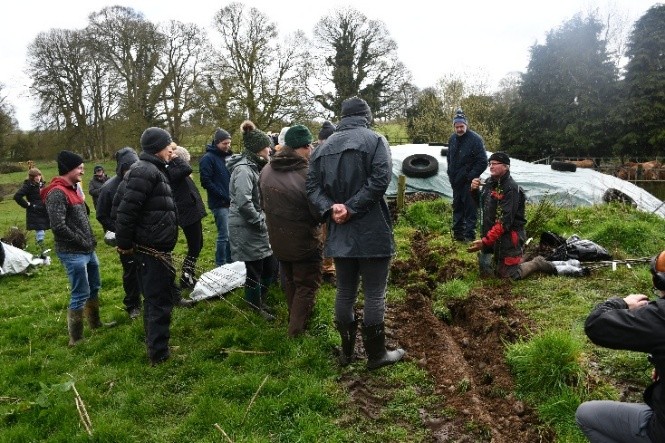
Featuring updates on the FarmBioNet and Safer Projects, assessing the effects of agroecology on biodiversity, a hedge planting demonstration and a guided tour of native flowering plants, the FarmBioNet and SAFER projects teamed up to host a one-day workshop on Kim and Mireille McCall’s Farm in Calverstown, Co. Kildare.
Beth Bryan, SAFER project PhD student; Claudia Barry, Biodiversity Research Technician; Niall Walshe FarmBioNet Research Officer; Meritxell Grau Butinyac, FarmBioNet Project Manager; Saorla Kavanagh FarmBioNet Project Coordinator & Research Officer, report on some of the key activities from the event.
Thirty-six people, including roughly 15 farmers, came together to share knowledge on farming, biodiversity and agroecology. The participants included representatives from farming (arable, beef, dairy, mixed, sheep and upland), industry (Ornua), policy (DAFM, DECC, DHLGH, NPWS), advisory (ACRES Breifne), research (UCD, TCD), the NBDC, Heritage Council and representatives from Project BASELINE, SCEENE-EIP, ReFarm and RestPoll.
After a cup of tea and catch up among the Farming and Biodiversity National Network, Dr Saorla Kavanagh, kicked off the day with a presentation on some of the results from the FarmBioNet project.
PhD student Beth Bryan introduced the SAFER project. SAFER, short for Strengthening Agricultural multiFunctionality through expansion of agroecology in EuRope, aims to understand and predict how increased use of agroecological farming practices could affect farmers and nature.
Biodiversity sampling
The SAFER team are looking for sites for their biodiversity sampling campaign this summer and are looking for more farms in Co. Kildare and the surrounding counties. If you’re interested in being involved, please get in touch with Beth (beth.bryan@teagasc.ie / +353892090437). The biodiversity sampling will involve earthworm counts, pollinator surveys, natural pest control evaluation and soil health assessments.
Assessing the effects of agroecology on biodiversity
Working with a network of partners across Europe, the SAFER Irish team will assess the effects of agroecology on biodiversity and benefits derived from nature. They will work with farmers to understand the drivers of, and barriers to uptake of these agroecological practices. Postdoctoral researcher Aisling Moffat guided attendees through exercises and group discussions to share their views on how interested different groups are in land management and what level of influence they felt they had. The exercises concluded with an interesting discussion on the importance of different benefits derived from nature within the region.
Workshop participants were asked two specific questions:
- Who is interested in and has influence over land use change in your area?
- Which ecosystem services do you think are most important in your area?
Hedgerow planting demonstration
The afternoon continued with a practical hedgerow planting demonstration led by host farmer, Kim. His approach is refreshingly straightforward, no chemical herbicides, minimal labour and highly effective results. Using a ripper on the back of his tractor, Kim rips two lines into the soil to minimise soil disturbance before planting. This method, he explains, keeps soil disturbance to a minimum while naturally suppressing species like thistles and nettles that might outcompete the saplings. Replacing the sod eliminates the need for plastic membranes, mulching or herbicides.
Kim favours a mix of native and carefully selected non-native deciduous and coniferous trees that are proven to thrive under local conditions, ensuring a resilient and productive hedgerow over time. He also highlighted that saplings 30-60cm in height offer the best value for money, as they are tall enough to compete with surrounding grasses without requiring excessive maintenance.
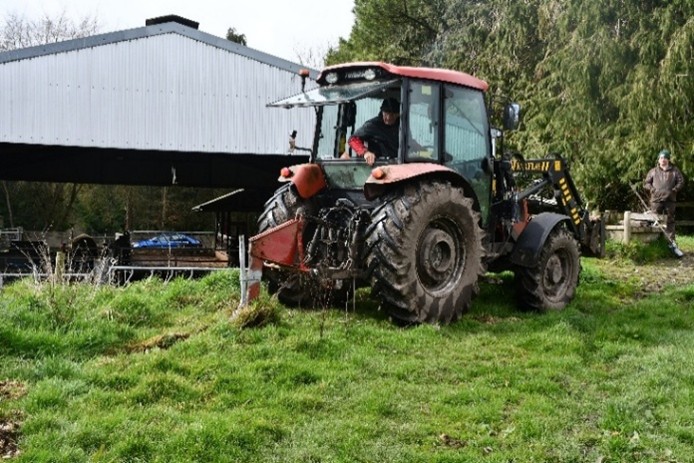
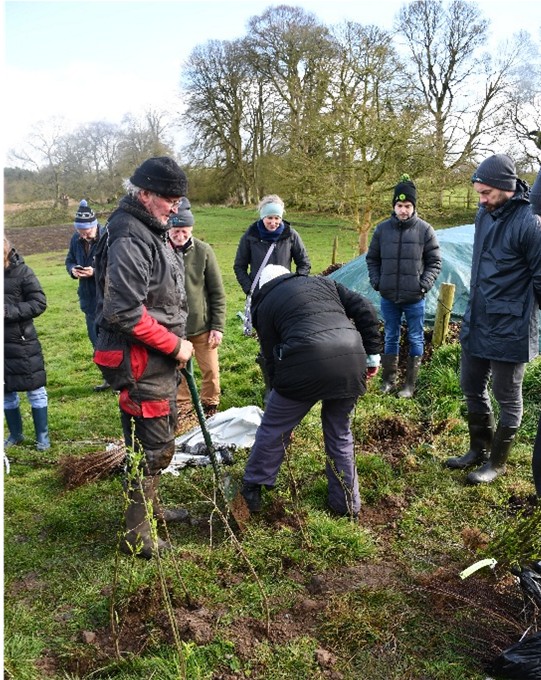
For this demonstration, Spindle (Euonymus europaeus), Mirabelle Plum (Prunus domestica) and a few Field Maple (Acer campestre) were planted. Kim then fences off the newly-planted hedgerow with an electric fence, with a fencer with a high voltage, this means he can walk away from the hedge and not have to worry about any further maintenance to the hedge or the need to mechanically or chemically remove any plants that might grow tall enough to reduce the shock of the fence.
Then it was time to get stuck in. Participants rolled up their sleeves and got their hands dirty.
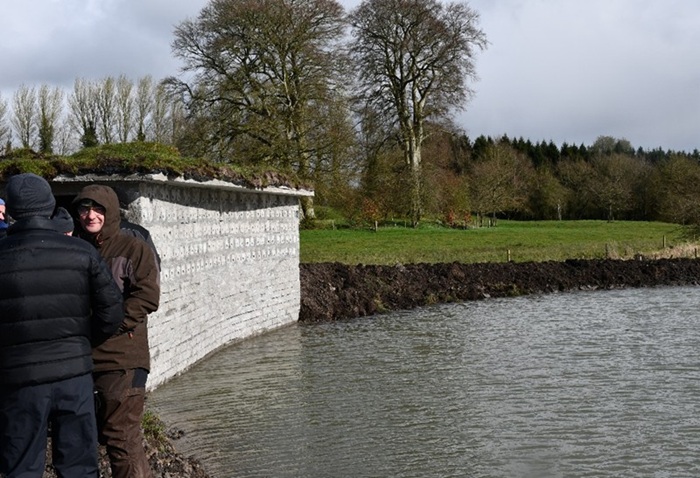
Participants were treated to an up-close look at a newly installed sand martin house on the farm, overlooking a newly dug pond, one of the many biodiversity ponds installed on the farm. The house will provide future nesting sites for sand martins and roosting sites for bats on the farm.
The vital role of native flowering plants
Paul Galvin, a passionate native plant enthusiast guided participants through the vital role that native flowering plants play in supporting pollinators. Paul shared his knowledge on seed collection and plant propagation, demonstrating how to propagate native species including primroses, cowslips, ragged robin, knapweed and bird’s-foot trefoil.
By the end of the session, participants left with a goody bag filled with native plants, to bring a little more biodiversity back to their own gardens and farms, along with a new appreciation for the beauty and importance of Ireland’s native wildflower species. Feedback from the day was very positive with lots of opportunity for peer-to learning.
The Farmer-Focused Biodiversity and Agricultural Knowledge Network (FarmBioNet) is a knowledge sharing agricultural European network aiming to reverse biodiversity loss by promoting biodiversity-friendly farming (BFF) practices across Europe. The network connects farmers, foresters, researchers, advisors and other stakeholders to exchange both traditional and evidence-based knowledge about farmland biodiversity.
SAFER is funded through the Agroecology partnership Call 1 and in Ireland it is co-funded by The Department of Agriculture, Food and the Marine, and Teagasc.
FarmBioNet is co-funded by European Union’s Horizon Europe Framework Programme and SERI.
For more on the SAFER Project, visit here.
For more on the FarmBioNet Project, visit here.
Related reading:
Have your say: What are your thoughts on pollinator conservation in agriculture?
Exploring a new BASELINE for Irish agriculture
Biodiversity-friendly farming practices