
Nitrogen is the key nutrient driving agricultural productivity in Ireland. It plays a central role in plant growth, forming the building blocks of proteins, chlorophyll and enzymes, and ultimately determining crop yield and grass production. In Ireland’s grass-based farming systems, nitrogen availability directly influences stocking rates, silage yields and overall farm output.
At the same time, nitrogen is one of the most dynamic and challenging nutrients to manage. It moves freely through soil, water and air, and exists in multiple forms, some beneficial for plant growth and others associated with environmental loss. Because of this mobility, the efficiency with which nitrogen is used on farms, known as nitrogen use efficiency (NUE), is a major focus of modern agricultural management. When nitrogen is not used effectively by crops, it can be lost to water as nitrate, to the air as ammonia, or as nitrous oxide, a potent greenhouse gas.
The nitrogen cycle in Irish soils
Nitrogen in agricultural soils is continuously transformed through biological and chemical processes known as the nitrogen cycle. This cycle describes how atmospheric dinitrogen (N₂) is converted into plant-available forms, moves through soil, plants and animals, and is ultimately returned to the atmosphere.
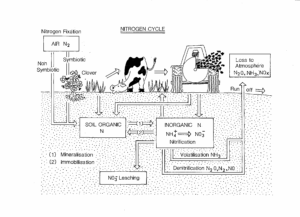
Nitrogen exists in several forms that influence its availability and behaviour in soil. The largest proportion of soil nitrogen is found in organic matter, which can contain more than 5,000 kg N/ha in Irish soils. This organic nitrogen, derived from plant residues, animal manures and microbial biomass, is not directly available to plants but acts as a long-term reservoir. It is released through mineralisation, a microbially driven process that converts organic nitrogen into ammonium. This process depends on soil temperature, moisture, oxygen availability and the carbon-to-nitrogen (C:N) ratio and typically peaks in late spring and early autumn under Irish conditions.
The main plant-available forms are nitrate (NO₃⁻) and ammonium (NH₄⁺). Both can be taken up by plants and soil microbes making it essential to match nitrogen supply with crop demand to maximise efficiency and minimise losses. Nitrate is immediately available for plant uptake and supports rapid growth but is highly prone to leaching due to its mobility in soil water. Ammonium is more stable and can be retained on soil particles and is converted to nitrate through nitrification.
Fertiliser nitrogen enters the soil in different forms. Urea is converted to ammonium and then nitrate, while products such as calcium ammonium nitrate (CAN) supply both forms directly. Nitrogen can also exist in gaseous forms which represent pathways of loss rather than sources of plant nutrition.
Nitrogen loss pathways
Nitrogen can be lost from the soil system through several pathways, all of which have both economic and environmental implications.
Volatilisation occurs when nitrogen is lost as ammonia gas (NH₃), particularly from slurry and unprotected urea-based fertilisers under warm, dry or high pH conditions. Denitrification occurs in poorly aerated or waterlogged soils, where nitrate is converted into gases such as nitrous oxide (N₂O), nitrogen gas (N₂) and nitric oxide (NO), which are released to the atmosphere. Nitrous oxide is of particular concern due to its role as a greenhouse gas.
Leaching is the downward movement of nitrate through the soil profile with drainage water. Because nitrate is not held by soil particles, it is especially prone to leaching in free-draining soils and during periods of high rainfall. This process represents a major route of nitrogen loss and is a key contributor to water quality issues.
Additional losses can occur through runoff and erosion, where nitrogen is transported from fields to surface waters, particularly during heavy rainfall events or where soil structure is poor.
The influence of Irish soil types
The behaviour of nitrogen varies significantly depending on soil type, which is particularly important in Ireland.
Free-draining soils such as Brown Earths and Brown Podzolics are highly responsive to nitrogen fertiliser due to good aeration and active microbial processes. However, these soils are also more prone to nitrate leaching, especially during periods of high rainfall.
In contrast, Gley soils are more poorly drained and prone to waterlogging. These conditions limit oxygen availability and increase the likelihood of denitrification, leading to nitrogen losses as gases. These soils can release nitrogen when conditions improve, but careful management is required to avoid losses. Artificial drainage often plays a key role in improving nitrogen efficiency on these soils.
Soils with high organic matter content, such as peats, have a greater capacity to store and supply nitrogen.
Irish grassland soils can supply between 17 and 131 kg of nitrogen per hectare over a five-week period through mineralisation alone, highlighting the importance of accounting for soil nitrogen supply in fertiliser planning.
Managing nitrogen for efficiency
Effective nitrogen management in Irish agriculture focuses on maximising crop uptake while minimising losses.
Maintaining optimal soil conditions is fundamental. Soil pH should be maintained around 6.3 to 6.5 for grassland, slightly higher for clover-based systems and between 6.5-7 for most commercial arable crops. At these levels, microbial activity and nitrogen mineralisation are enhanced, improving nitrogen availability.
Balanced soil fertility is equally important. Adequate phosphorus and potassium levels support plant growth and improve nitrogen uptake, increasing overall nitrogen use efficiency.
Timing is critical. Nitrogen should be applied when crops are actively growing and able to utilise it, typically when soil temperatures exceed 5.5°C and weather conditions are favourable. Applying nitrogen in smaller, more frequent applications helps match supply to demand and reduces losses.
The choice of fertiliser also matters. Protected urea, which includes a urease inhibitor, can significantly reduce ammonia losses while maintaining productivity. Organic manures such as slurry provide both readily available ammonium nitrogen and slower-release organic nitrogen, making them an important component of nutrient management strategies.
A system that requires balance
Nitrogen management in Irish agriculture is a balance between productivity and environmental protection. While soils have the capacity to supply significant amounts of nitrogen naturally, the potential for losses is high.
The nitrogen cycle is complex and highly interactive, and recovery of nitrogen in agricultural produce can often be relatively low due to these losses . This highlights the importance of careful management of fertilisers, soil conditions and organic manures.
Ultimately, the goal is not simply to apply more nitrogen, but to use it more efficiently. By aligning nitrogen supply with crop demand and understanding how nitrogen behaves in Irish soils, farmers can improve productivity while protecting water quality, air quality and the wider environment.