
Potassium (K) is one of the three primary nutrients required for plant growth, alongside nitrogen and phosphorus. It is essential for producing high yields, improving crop quality, and supporting plant resilience to stress. Unlike nitrogen, potassium is not a component of plant structures such as proteins, but it plays a critical regulatory role in plant processes. It controls water movement within the plant, regulates stomatal opening for carbon dioxide uptake, and activates a wide range of enzymes involved in growth and metabolism. As a result, adequate potassium supply improves drought tolerance, disease resistance and overall crop performance.
In Irish grassland systems, potassium is particularly important for maintaining productive swards. Deficiency is often difficult to detect visually, earning it the description of a “hidden” nutrient constraint. Over time, low potassium availability can shift the botanical composition of grassland away from high-performing species such as perennial ryegrass towards less productive grasses, reducing output and forage quality.
Potassium in soil
Potassium behaves differently to both nitrogen and phosphorus. It does not have a gaseous phase and exists entirely within the soil system, where it is held in a range of forms that differ in availability to plants.
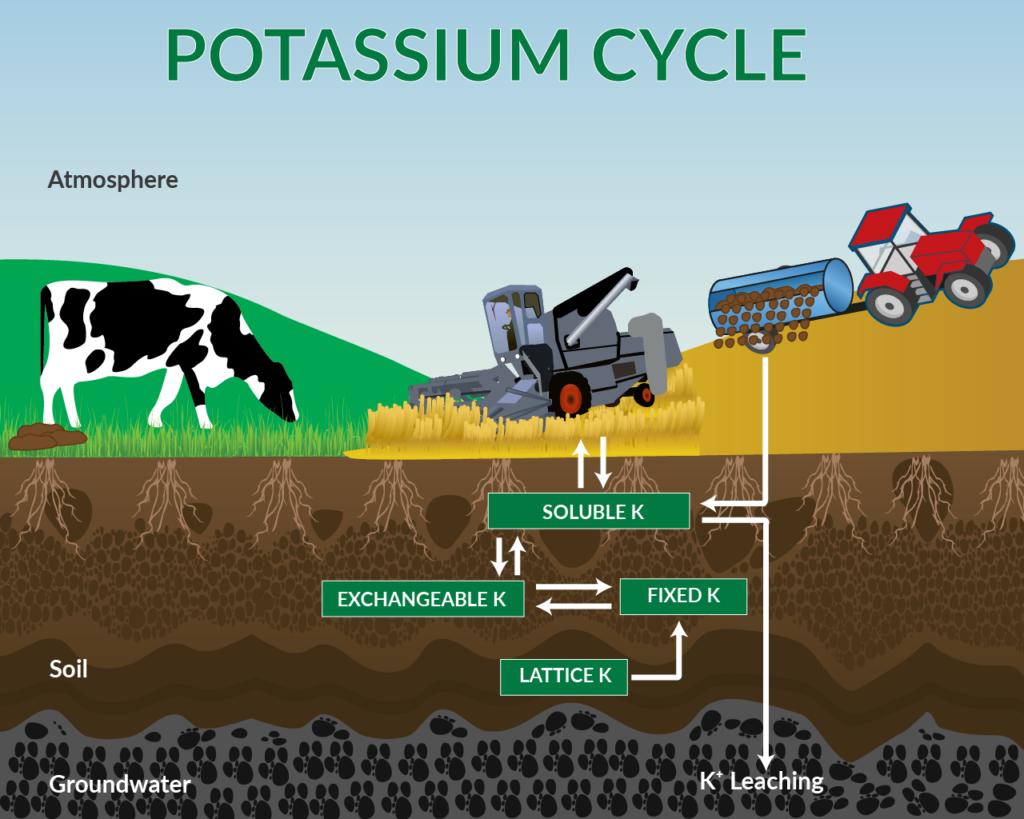
Only a very small proportion of total soil potassium is present in the soil solution as K⁺ ions, which are directly available for plant uptake. This fraction is continuously replenished by potassium held on soil particles (exchangeable K), which acts as a readily available reserve. Beyond this, larger quantities exist in more stable forms: fixed potassium, trapped within clay minerals, and lattice potassium, which forms part of the soil’s mineral structure and is released only very slowly through weathering.
These pools are in equilibrium, meaning that as plants take up potassium from the soil solution, it is replaced by potassium from other fractions. However, the rate at which this replenishment occurs depends heavily on soil type and mineral composition.
The influence of soil type
Soil type is a major determinant of potassium availability in Irish agriculture. Heavier soils with higher clay content generally have greater reserves of potassium and a higher capacity to hold it. However, some of these soils, particularly those containing certain clay minerals, can “fix” potassium, locking it away and reducing its availability to crops.
In contrast, lighter sandy soils have a much lower capacity to retain potassium. Because they have fewer clay particles and lower cation exchange capacity, potassium is more easily lost through leaching. These soils require smaller and more frequent applications to maintain adequate supply.
Peat soils behave differently again, as they lack the clay minerals needed to store potassium effectively. While potassium can be readily available in these soils, it is also more vulnerable to loss. Across all soil types, the underlying geology also plays a role, with soils derived from shale or similar parent materials often containing higher natural potassium reserves.
Movement and losses
Potassium is more mobile in soil than phosphorus but less mobile than nitrogen. It moves mainly by diffusion through the soil solution towards plant roots. This movement is influenced by soil moisture and the rate of plant uptake.
The main pathway for potassium loss is leaching. Because potassium exists as a soluble positively charged ion, it can be washed down through the soil profile, particularly in free-draining soils. Unlike nitrogen, potassium is not lost to the atmosphere, and unlike phosphorus, it does not bind as strongly to soil particles. This intermediate behaviour means that both soil type and rainfall patterns play a key role in determining how efficiently potassium is retained and used.
Crop uptake and removal
Plants take up potassium directly from the soil solution, and demand can be high, especially in intensive systems. Grass silage systems are a clear example, where large quantities of potassium are removed in each cut. Approximately 25 kg of potassium can be removed per tonne of dry matter harvested, making regular replenishment essential.
In cereal systems, potassium is distributed between grain and straw, with around half of the total potassium removed when straw is taken off the field. Where straw is returned, much of this potassium is recycled back into the soil.
Managing potassium for efficiency
Effective potassium management is centred on maintaining soil levels that can meet crop demand without excess. Where soil potassium levels are low, building them requires a combination of fertiliser and organic manures such as slurry or farmyard manure. On lighter soils or K-fixing soils, a “little and often” approach is more effective than large single applications, as it reduces losses and improves availability.
In grassland systems, timing is particularly important. High potassium applications in spring can increase the risk of grass tetany in grazing livestock by interfering with magnesium uptake.
Where soil potassium levels are high, applications can be reduced or omitted temporarily, with soil testing used to monitor changes over time.
A nutrient that requires balance
Potassium is essential for productive and resilient farming systems, but its management requires careful balance. While soils may contain large reserves, only a small proportion is immediately available to plants, and losses can occur where soils cannot retain it effectively.
By understanding how potassium behaves across different soil types, how it moves within the soil, and how much is removed in harvested crops, farmers can better match supply with demand. In doing so, they can maintain soil fertility, support crop performance, and reduce the risk of both deficiency and environmental loss.