
Phosphorus (P) is an essential nutrient for plant growth and plays a central role in energy transfer within plants. It is a key component of ATP (adenosine triphosphate), driving processes such as root development, cell division, and early crop establishment. Unlike nitrogen, phosphorus does not directly drive canopy growth but is critical for strong rooting, efficient nutrient uptake and overall plant development.
In Irish agricultural systems, phosphorus is vital for grassland productivity, crop establishment and animal performance. However, it behaves very differently to nitrogen. While nitrogen is highly mobile, phosphorus is relatively immobile and tends to become tightly bound to soil particles, making it less available for plant uptake.
The phosphorus cycle in soils
The phosphorus cycle describes how P moves between soil, plants, animals and water. Unlike nitrogen, there is no significant atmospheric phase, and the cycle is largely soil driven.
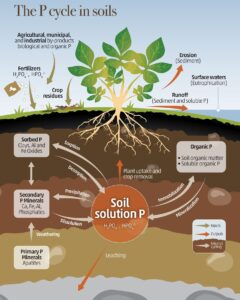
Source: FAO. 2022. Soils for nutrition: state of the art. Rome. https://doi.org/10.4060/cc0900en
Most phosphorus in soil exists in stable forms that are not immediately available to plants. Only a very small fraction, typically less than 1%, is present in the soil solution as plant-available phosphate (PO₄³⁻). As plants absorb this soluble P, it is replenished from the inorganic and organic soil pools.
These reserves can be thought of as a series of connected pools. The soil solution contains a very small amount of immediately available phosphorus, which is constantly being replenished by a more loosely held “labile” pool. In turn, this is supported by a much larger, more stable pool of phosphorus that is strongly bound to soil minerals and released only slowly over time.
Phosphorus is also present in organic forms within soil organic matter. This organic phosphorus becomes available through mineralisation, a microbially driven process, while immobilisation converts available phosphorus back into organic forms. The balance between these processes determines how much phosphorus is available to crops at any given time.
Behaviour of phosphorus in Irish soils
Phosphorus behaves almost opposite to nitrogen in soil systems. It is relatively immobile and interacts strongly with soil minerals, particularly aluminium (Al), iron (Fe) and calcium (Ca). In acidic soils, phosphorus binds tightly to aluminium and iron, while in alkaline soils it reacts with calcium to form insoluble compounds. As a result, optimum availability generally occurs within a relatively narrow pH range of 6.3 to 7.0.
Because of these reactions, applied phosphorus can become “locked up” or fixed in soils within weeks, reducing its immediate availability. This fixation is especially strong in clay-rich soils and soils with high aluminium or iron content.
Soil type and parent material also influence phosphorus supply. Irish soils derived from limestone, shale or sandstone vary significantly in their capacity to store and release phosphorus, which explains differences in fertiliser response across regions.
Availability and plant uptake
Plants take up phosphorus only from the soil solution, so maintaining an adequate supply in this small pool is critical. Because phosphorus moves very little in soil, root growth and root proximity to P sources are essential for uptake.
This is why phosphorus is particularly important during early growth stages, including seed germination, root development and early tillering. During these stages, a limited phosphorus supply can restrict crop establishment and reduce yield potential later in the season.
Cold, wet soil conditions, common in Irish springs, can limit phosphorus availability, even when soil reserves are adequate.
In low-input or organic systems, plants rely heavily on mycorrhizal fungi, which extend the root system and help “mine” phosphorus from soil particles in exchange for plant sugars.
Phosphorus loss pathways
Unlike nitrogen, phosphorus is not easily leached through most soils. Instead, its primary pathway of loss is through surface runoff. Phosphorus can be transported either in dissolved form within runoff water or attached to soil particles that are moved through erosion.
Losses are most likely to occur on poorly drained soils such as Gleys, following heavy rainfall, where soil phosphorus levels are high, or after recent applications of slurry or fertiliser. Even relatively small losses can have significant environmental consequences. Very low concentrations of phosphorus entering water bodies can trigger eutrophication, leading to algal blooms and a decline in water quality.
Managing phosphorus for efficiency
Effective phosphorus management in Irish agriculture focuses on maintaining optimal soil fertility while minimising environmental losses. Soil testing is central to this approach. The aim is to maintain soils at Index 3, where phosphorus supply is sufficient to meet crop demand without excess.
Management begins with correcting soil pH, as this has a major influence on phosphorus availability. Fertiliser applications should then be guided by soil test results rather than blanket rates. On soils prone to phosphorus fixation, applying smaller amounts more frequently can improve efficiency.
Targeting applications to periods of crop demand, especially during early growth, helps maximise uptake. In arable systems, incorporating fertiliser into the seedbed can further improve availability. It is also important to avoid applications in high-risk conditions, such as before heavy rainfall or on fields prone to runoff.
Organic manures play an important role in phosphorus supply, particularly in grassland systems, and should be managed carefully to optimise nutrient use and minimise losses. Where soil phosphorus levels are already high (Index 4), applications should be reduced or avoided to lower environmental risk.
A finite but essential resource
Phosphorus differs from nitrogen in one important respect: it is a finite resource, derived from mined phosphate rock. Global reserves are limited, making efficient use increasingly important for long-term sustainability.
In Irish agriculture, the challenge is to balance maintaining sufficient phosphorus for crop production with minimising losses to water and making the best use of both fertiliser and organic sources. By understanding how phosphorus behaves in different soils and managing it accordingly, farmers can support productivity while protecting the environment and conserving a valuable global resource.