
Grazing focus: Don’t let water be the weak link on your farm
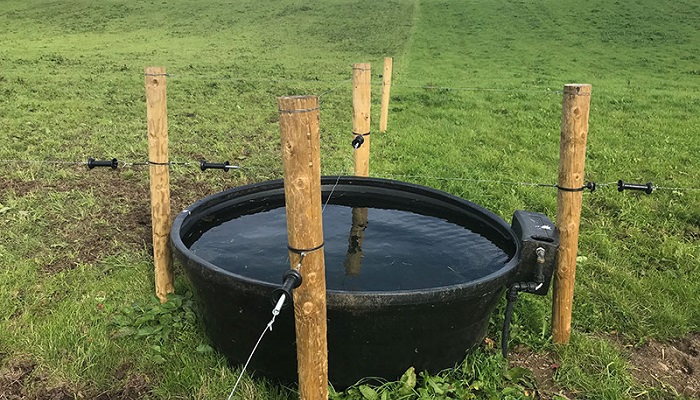
Common water supply problems on most farms centre on inadequacies in areas such as water source, pumping plant, pipe sizes, ballcocks and troughs. Teagasc Beef Specialist, Catherine Egan shares key recommendations and solutions to these problems.
A good water supply is extremely important for production, health and welfare of livestock. The water supply system must be good enough to supply adequate water needs in the paddocks.
On most farms, the water system consists of a series of expansions or additions carried out over the years as requirements changed. Only when the system fails to cope, such as during a dry summer, do people realise how marginal their system has become. Common problems on most farms centre on inadequacies in areas such as water source, pumping plant, pipe sizes, ballcocks and troughs.
Key requirements for a water system:
- Water intake: 10-15 litres per 100kgs body weight per day.
- Trough size: Allow 5-7 litres per livestock unit.
- Ballcock: Medium pressure gives flow rate of 32 litres/min versus 8 litres/min with high pressure.
- Main pipe layout: Ring/loop system preferable.
Water source
A bored well is the most common source on farms. If the well is unable to meet peak demand, the installation of a reservoir of, for example 9,000 litres (2,000 gallons) which can be a pre-cast concrete tank, will rectify the situation. The tank can be buried in the ground or placed overground. A booster pump is then used to pump the water from the reservoir into the water supply system, at whatever flow rate and pressure are necessary. Modern frequency controlled centrifugal pumps will automatically maintain pressure and flow in response to demand. The pump speed will increase when an extra tap or ballcock comes into use and vice versa.
Small pipe size
This is probably the most common problem with water supply on farms. Even on farms where piping was laid in recent years, under-sizing of pipes still occurs. This is illustrated in table 1 which shows the pressure loss in psi for different pipe bores over a range of flow rates for 100 metres length of water pipe.
For example, at a flow rate of 3m3 per hour (50 litres/min or 11 gallons/min) with a 32mm (1¼ inch) pipe, the pressure is reduced by 4.83psi for every 100 metres of pipe. The reason the flow rate reduces is because of friction between the water and the inside surface of the pipe.
Table 1 doesn’t take into account the extra pressure required if you are pumping uphill or the pressure gained pumping downhill. Pressure lost due to restrictions at ballcocks and fittings is also extra. Table 1 doesn’t show values for 12.5mm (½ inch) pipes because at any of the flow rates shown the pressure loss would be very high. Where 12.5mm pipes are used on farms the flow rate is reduced to a trickle due to pressure loss.
Table 1: Pressure loss in psi for different pipe sizes at various flow rates for 100 meters length of water pipe
| Pipe bore (mm) | Flow rate m3 per hour (litres per minute) | ||||
| 1 (17) | 2 (33) | 3 (50) | 4 (67) | 5 (83) | |
| 20 | 14.20 | ||||
| 25 | 3.27 | 11.50 | |||
| 32 | 0.64 | 2.27 | 4.83 | 7.60 | 11.65 |
| 58 | 0.34 | 1.21 | 2.49 | 4.05 | 6.25 |
| 50 | 0.11 | 0.38 | 0.88 | 1.34 | 2.06 |
Regarding pipe size, it’s the change in cross-sectional area in relation to its bore (diameter) that’s important. It’s hard to imagine that a 20mm (3/4 inch) pipe has approximately twice the cross-sectional area of 12.5mm (1/2 inch) pipe. Similarly, a 25mm (1 inch) pipe has four times the cross-sectional area of 12.5mm (1/2 inch) pipe, although it’s only twice the bore.
The pressure loss is also affected by the pipe length. The pressure loss and the resultant reduced flow rate are directly proportional to the length of the pipe, i.e. if you double the length of the pipe. you double the pressure loss.
You can use table 1 to judge how much pumping pressure is lost with various pipe sizes and flow rates, while taking the pipe length into account. The net effect of pressure loss is reduced flow rates. Increasing system pressure to maintain flow rate is not a good solution. It would be extremely energy inefficient and give rise to damaging levels of pressure. The answer is to use the right pipe size.
Ring system
If you are installing a new main line, incorporate the existing line as well if it’s in good condition and not too difficult to do. This is worthwhile where pressure is low or the main line is long and the end of the new line and the existing line are not too far apart. Connecting up the ends of two main lines (of the same size) to form a ring main will almost double the flow rate.
Laying pipes
If you are using a mole plough to lay the pipe, do it in stages, using a digger to make holes at intervals where connections are going to be made. Try to get the pipe down to a depth of 450mm or more. Tractors with double-acting rams on the arms can add enough weight to the mole plough to get the depth. Do a ‘dummy run’ first before feeding in the pipe and allow the pipe time to recover from the stretching before making connections.
Ballcock problems
Very often the ballcocks are the weak link in an otherwise satisfactory water supply system. Ballcocks are frequently over restrictive, even on systems where the pipe sizes are adequate. A high pressure 12.5mm ballcock in the drinking trough is not capable of allowing an adequate flow rate, which is in most situations about 16 to 22 litres per minute (3.5 to 5 gallons/min). In general, standard ballcocks are described by their size and pressure. Ballcocks can have high, medium or low pressure jets. The high, medium and low pressure refers to the pressure the ballcock can withstand without leaking when the trough is full.
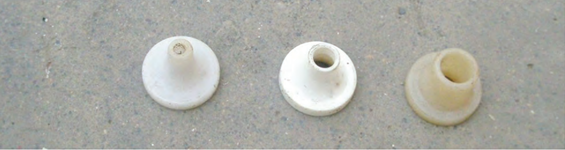
Photo 1: The high pressure jet has the smallest hole and the low pressure jet the biggest.
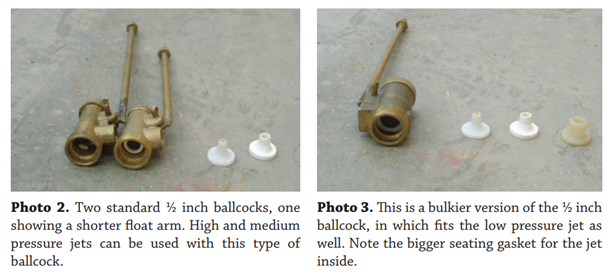
The high pressure jet in a standard ½ ballcock is only 1/8 of an inch in diameter whereas the medium jet is ¼ of an inch in diameter. Other ballcocks are available that have openings of ½ inch or greater. In most systems, medium pressure ballcocks will provide an adequate flow rate (see table 2). In practice, most standard ballcocks are sold with high pressure jets in them, which is one reason why so many farms have flow rate problems. High or medium pressure jets will fit into all 12.5mm ballcocks (see photo 2). The low pressure jet will not fit up against the gasket in standard 12.5mm ballcocks. If you want the option of using a low-pressure jet get the 12.5mm ballcock that can take any size of jet. It has a bigger plunger and a bigger gasket (photo 3).
Using a longer float arm or a larger float can solve the problem of leaking ballcocks by increasing the force on the gasket with the extra leverage. Longer float arms are available or they can be lengthened by braising on a piece. Ballcock jets should be checked from time to time to see that they are free flowing because they can become encrusted with lime scale or partially blocked with dirt.
Table 2: Flow rate l/min (gal/min) with a standard 12.5mm (½ inch) ballcock and a system pressure of 3.6 bar (52psi) for different jet size
| 12.5mm (1/2″) ballcock | |||
| Jet type | Low pressure | Medium pressure | High pressure |
| Jet size mm (inch) | 10mm (3/8″) | 6mm (1/4″) | 3mm (1/8″) |
| Flow rate l/min (gal/min) | 42 (9.25) | 32 (7) | 8 (1.75) |
Table 2 shows the effect of using different jet sizes on flow rate. We put the three different jets in turn into the same standard 12.5mm ballcock at a trough in a paddock. The system pressure at the trough with no water flowing was 3.6 bar (52psi). The most striking finding is the massive increase in flow rate between the high and medium pressure jets, going from 8 to 32 litres per minute.
Table 3 shows the combine effect of pressure and ballcock jet size on flowrate. Note that quadrupling the static pressure will double the flow rate while quadrupling the jet size will increase flow rate by a factor of 16.
Table 3: Flow rate (gal/min) through ballcock at varying static pressure and ballcock jet size
| Static Pressure (PSI) | Ballcock Jet Size | |||
| 1/8″ | 1/4″ | 3/8″ | 1/2″ | |
| 0.5 | 0.20 | 0.82 | 1.84 | 3.28 |
| 1.0 | 0.29 | 1.16 | 2.61 | 4.65 |
| 2.0 | 0.41 | 1.65 | 3.69 | 6.57 |
| 4.0 | 0.58 | 2.33 | 5.22 | 9.29 |
| 7.0 | 0.77 | 3.08 | 6.90 | 12.30 |
| 10.0 | 0.92 | 3.69 | 8.27 | 14.70 |
| 15.0 | 1.13 | 4.52 | 10.10 | 18.00 |
| 20.0 | 1.31 | 5.22 | 11.70 | 20.80 |
| 25.0 | 1.46 | 5.82 | 13.00 | 23.20 |
| 30.0 | 1.60 | 6.40 | 14.30 | 25.50 |
| 35.0 | 1.73 | 6.90 | 15.50 | 27.50 |
| 40.0 | 1.85 | 7.38 | 16.50 | 29.50 |
Note: The pressure is at the ballcock and NOT at the pump.
Water troughs
Cattle will drink 10 – 15 litres of water per 100kgs body weight per day. Adult cattle can drink at the rate of 14 litres a minute from a trough. Peak water intake generally coincides with peak grazing periods. Water flow rates must be capable of supplying these peaks of demand.
Water trough locations
Check water troughs regularly to ensure that ballcocks are working properly and that there are no leaks; a leak at a water trough is a real disaster. Flow rate should be considered before trough size in ensuring adequate supply. However, large troughs provide more drinking space and can compensate a bit for poor flow rate at peak drinking time.
The main advantage of big troughs is they give more space for drinking. Each cow drinking at a trough needs 450mm of space measured along the trough rim. For large herds, it may be necessary to install a second trough in the paddock.
Siting troughs underneath a paddock wire fence will more than halve drinking space. Young stock and timid cows may also get bullied if adequate drinking space is not available. The area around the trough should be able to take a lot of traffic i.e. a similar surface to a farm roadway and ideally have good drainage.
Portable water troughs
It may be necessary to use portable water troughs in some situations e.g. strip grazing. To provide a portable trough, use frost-proof gate valves and good quality non-restrictive quick-couplers. Connection points should ideally be away from fixed troughs because they can be damaged and some valve types can be opened by stock, causing leaks.
Key points
- Daily drinking water requirements vary but typically amount to 10-15 litres per 100kgs body weight. Weight gain and animal health are affected by inadequate water supply.
- Many water systems are inadequate especially if poorly maintained.
- Allow 450mm (18 inches) drinking space per cow so that close to 10% of your herd to drink at the same time.
- The internal bore of main pipelines should be at least 20mm and 25 or 32mm for larger herds.
- Use 12.5mm medium pressure standard ballcocks or newer bigger types; avoid high pressure ballcocks.
- Correct siting of water troughs is important.
For further information, view the Teagasc Beef Farm Infrastructure Book here (PDF).
Related reading: Keeping enough ‘spark’ in your electric fence
Related reading: Growing more grass with the wire: 4 steps for beef farmers