
Breeding
After a very successful farm Open Day on Newford Farm in mid-April where over 450 farmers attended the farms “Breeding Efficient and Profitable Sucklers Event”, where farmers got the chance to view the 90 cow suckler calf-to-beef demonstration herd where it continues to pursue its core aims : compact calving , AI based breeding where cows are bred using 100% AI using 5 star terminal genetics , efficient profitable finishing of both steers and heifers and the farm measures to reduce emissions .
The farm then transitioned directly into the 2026 breeding season . Breeding started with the main herd on the 20th of April, and 27 maiden heifers were synchronise and AI on the 17th of April.
There were 81 mature cows put forward for breeding and within the first 3 weeks of breeding , 69 cows were inseminated ( 84% of the herd ), and any cow who had shown of any signs of cycling were examine and treated by the vet and after 49 days all cows had been inseminated once.
The breeding season will last for 10 weeks and will finish-up on the 29th of June .Cows are divided into two groups (approximately 40 cows per group) for the breeding season, with a teaser bull running with each group.
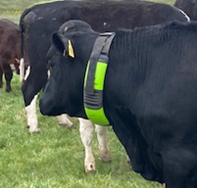
Figure 1 Teaser Bulls have been fitted with Moocall heat detection collars and cows have been tagged with an electronic tag. When a cow is in heat a text message detailing the tag number of the cow in heat will be sent to a nominated mobile phone number.
Once-a-day AI is being practiced, with cows inseminated at midday each day. That means if a cow is inseminated at 12 noon and is still showing signs of standing heat that evening, she will be inseminated again the following day at 12 noon.
Currently, 64 cows are holding to first service, 15 cows to second service, and 2 cows have been inseminated three times.
Based on these figures, this should contribute to a compact calving and drafting period for all animals in 2028.
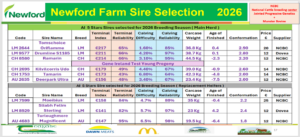
Figure 2 Newford Farm Sire Selection 2026
Replacement Heifers
There are 27 replacement heifers for breeding, and they were synchronised on the 17th of April and AI on Friday the 18th of April ( 8-day synchronisation programme). Breeding of the heifers has now concluded after a 6-week period ( 29th May).The heifers are scheduled to be scanned in early July.
Grassland
Paddock utilisation is excellent at present, with all paddocks being well grazed out. Current farm cover stands at 800 kg DM/ha, with a growth rate of 53 kg DM/ha and a demand of 44 kg DM/ha.
The farm skipped one round of fertiliser. Over the past week, 15–18 units of Protected Urea (38N + S) were applied to paddocks containing clover, while paddocks with lower clover content received 23 units following grazing.
First-cut silage was harvested on 14th June, later than desired due to weather conditions. Depending on DMD results, this silage will likely be allocated to suckler cows pre-calving. The farm will then target a high-quality second cut for weanlings, aiming for high DMD. For the second cut, two bags of 0-7-30 and one and half bags of Protected Urea (38N + S) will be applied, with harvesting planned in approximately 32 days.
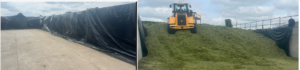
Figure 3 The empty and then filled silage pit from first cut.
Performance
2026 Calves
- All calves are currently thriving, with no health issues reported.
- Calves were weighted on 5th June, recording an average daily gain (ADG) from birth of 1.22 kg/day at approximately 3.5 months of age.
- Male calves average 176 kg, with an ADG of 1.31 kg/day . These calves were castrated using a rubber ring shortly after birth.
- Heifer calves average 163 kg with an ADG of 1.16 kg/day
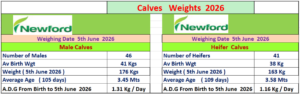
Figure 4 2026 Calves Weights as of June 5th 2026
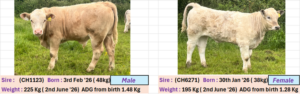
Figure 5 CH sired 2026 calves
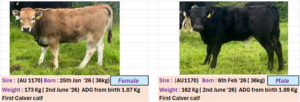
Figure 6 AU sired 2026 calves
Yearlings
- All the beef animals were weighed on the 18th of May.
- The average weight of the (40) bullocks was 483 kg and the heifers ( 36) was 463 Kg.
- The bullocks ADG since turnout (6th March ) was 0.84 Kg / day.
- The heifers ADG since turnout ( 3rd March) was 0.72 Kg/day.
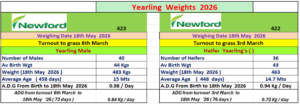
Figure 7 Yearling weights 2026 males & heifers
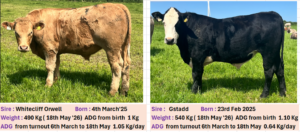
Figure 8 Yearlings
Health and Safety
Newford Handling Unit
Since Newford relocated to Athleague in late 2023, one of the key gaps identified on the farm was the absence of a high-quality handling facility. With labour availability increasingly scarce, there was a clear need for a handling system that could be efficiently operated by a single person.
The new handling facility addresses this requirement and comprises a series of holding pens, a forcing pen, a calf chute, a main animal race, and a Clipex crush unit. The unit includes five holding pens of varying sizes, providing flexibility for different groups of stock, and can be accessed via three separate entry points to ensure smooth animal flow and ease of operation.
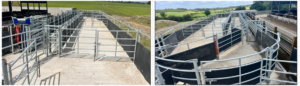
Figure 9 New handling unit on Newford Farm
The unit is designed to comfortably handle up to 45 cows and their calves, allowing for easy grouping and segregation within the yard.
One of the key features of the facility is the calf chute. Measuring 600 mm in width, it is specifically designed to facilitate the safe and efficient handling of calves, particularly for routine tasks such as vaccination and weighing of the Newford herd.
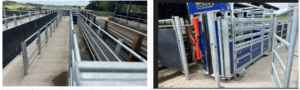
Figure 10 New Clipex Crush on Newford Farm
The Clipex crush consists of a manual single squeeze cattle crush and it’s in front of the handling unit , so once animal enters the crush , a guillotine gate can be closed behind the animal easily. A manually operated head locking gate that can be operated from the head or the rear of the crush holds the animals head in place , with a head scoop also fitted for ease of dosing etc.
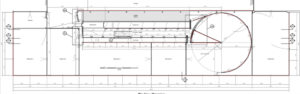
Figure 11 Technical plans of the new yard and crush
Women in Agriculture visit Newford Demonstration Farm
Members of the Women in Agriculture group recently visited Newford Demonstration Farm, Scrine , Co Roscommon, where they received an insightful overview of the farm’s operations. The visit provided an opportunity to gain experience about best practices in sustainable beef production, grassland management, and efficient farm systems. Attendees engaged in open discussion, sharing experiences and ideas in a supportive environment. Newford Farm was delighted to host the group, fostering collaboration, education, and a continued commitment to innovation within the agricultural community.
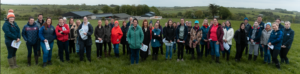
Figure 12 Women in Agriculture members visiting Newford Demonstration Farm