Calving and Breeding
Calving went well overall this spring. Cows calved down fine, the calves were lively, got up quickly and sucked well from the start. I always try to get cows and calves out to grass as soon as possible, but the weather made that difficult at times this year, with ground conditions slow to improve.
We did have three calf losses, which takes the shine off the calving season. One later-born calf developed a swollen navel. I always keep the sheds well bedded and spread sanitiser weekly, so hygiene would always be a big focus. The calves were lively and sucking well and I feed soya pre-calving to make sure cows have enough protein for good-quality colostrum. I noticed the swollen navel early and the vet treated him, but the infection must have spread internally and we lost him.
Another calf went down with scour, similar to some of the issues I had last year. Again, the vet treated him but he didn’t pull through. The third calf was one I found dead out in the field.
Even with the three losses, we were nowhere near the stage we were at last year with calves going down three weeks after calving. As I mentioned in an earlier update, we blood tested the cows and found selenium levels were very low. The cows were treated pre-calving this year and that seems to have solved the problem, so that has definitely been an improvement. It just shows the value of getting to the root of an issue instead of guessing. Next year, I’ll still be putting an even bigger focus on hygiene around calving and young calves.
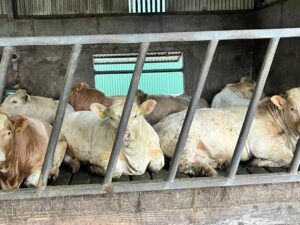
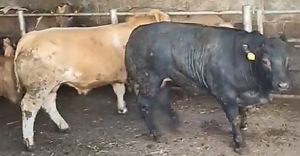
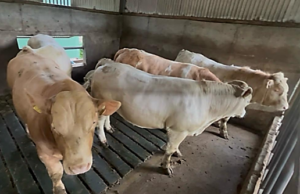
Breeding started on the 12th of April and thankfully things have gone well so far. I have the cows and heifers split into two groups. The first-calved heifers and maiden heifers are running with the Limousin bull, while the mature cows are with the Charolais bull.
I am really delighted with the first calved heifers and their calves, see a selection of them below. I was looking at them and their calves last week and can’t understand why more farmers don’t calve their heifers at 24 months. The calves are smashers and the heifers themselves are still powering on. They were the first cattle out to grass this spring and it really stood to them. Within a few weeks at grass they were bulling strongly. There was plenty of activity early on and things have gone quiet since, so hopefully that’s a sign most of them are back in calf already.
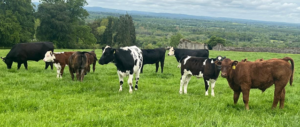
Figure 1 Selection of first calvers, their calves and maiden Heifers
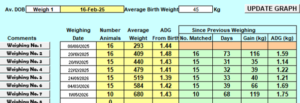
The maiden heifers have also done very well over the winter, averaging 0.91kg/day gain. I weighed them on the 14th of May and they were on average 408kgs – 60% of their mature body weight and ideal for breeding.
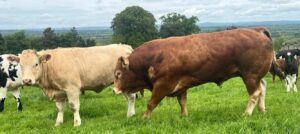
Figure 2 LM bull with a maiden heifer
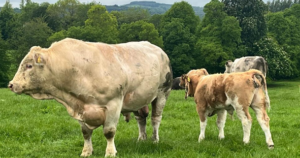
Figure 3 CH bull with progeny
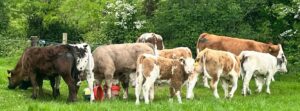
Figure 4 Selection of 2026 born calves
I buy in dairy-beef cross heifers as replacements and rear them myself. The big advantage is the milk they bring into the herd. In 2025, my suckler calves averaged 1.48kg/day up to weaning, which I’m very happy with. The downside can be lighter carcass weights in the cows, so last year I bought a Limousin bull to try and breed a more balanced replacement female with extra carcass while still keeping milk and fertility.
I have the first of those calves on the ground now and I’m very happy with them so far. They are definitely adding more shape and carcass into the heifer calves, which is important from a future cull cow value point of view as well. You can see it already in the Eurostar figures below, with the average carcass figure increasing from +13kg in the 2025 maiden heifers to +19kg in the heifers born this year.
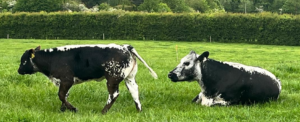
Figure 5 Second Calver with progeny from LM bull
Last year I also worked with a local dairy farmer where he used LM9379 (Shannon Stan) on part of his herd and I bought the heifer calves. The heifers have an average figure of 15kg for carcass and 12kg for milk. My own Limousin bull is carrying +32.6kg for carcass and +2.4kg for milk, so he should help balance things out well by adding more shape and carcass without losing the milk performance I want in the cows.
Between those heifers and my own homebred replacements, I should have a great selection of breeding heifers coming through for 2026.
| Tag Number |
Replacement index (€) |
Breed |
Weight 14/05/2026 |
Carcass |
Milk |
Daughter calving |
| 2026 maiden Heifers |
| 430 |
92 |
BB (50%), HO (41%) |
385 |
+5.8 |
+12.6 |
+1.56 |
| 465 |
149 |
BB (50%), NR (25%) |
470 |
+21.2 |
+12.9 |
+3.35 |
| 750 |
153 |
LM (44%), HO (28%) |
375 |
+2.1 |
+11.7 |
-2.14 |
| 752 |
150 |
LM (44%), HO (22%) |
380 |
+4.7 |
+12.4 |
-1.39 |
| 1201 |
111 |
SP (50%), HO (38%) |
475 |
-8.1 |
+12.2 |
-2.76 |
| 1594 |
160 |
AU (50%), HO (25%) |
400 |
+5.4 |
+11.42 |
-3.9 |
| 1611 |
160 |
AU (50%), HO (25%) |
395 |
+5.1 |
+11.7 |
-3.4 |
| 5421 |
68 |
MO (50%), BB (50%) |
330 |
+9.5 |
+13.3 |
+2.44 |
| 1060 |
87 |
CH (50%), LM (25%) |
420 |
+16.3 |
+2.8 |
-2.47 |
| 1062 |
163 |
CH (50%), AA (25%) |
440 |
+25.7 |
+2.7 |
-3.32 |
| 1069 |
143 |
CH (50%), SH (25%) |
415 |
+26 |
+6 |
-2.89 |
| Average (1+) |
132 |
|
408 |
+13 |
+8.2 |
-1.91 |
| A selection 2026 born heifers to LM bull |
|
Breed |
Terminal Index (€) |
Replacement Index (€) |
|
|
|
| LM bull |
LM(100%) |
165 |
128 |
32.6kg |
2.4kg |
3.31 days |
| 1095 |
LM(50%)
AA(25%) |
|
124 |
+18 |
+7.5 |
+0.85 |
| 1096 |
LM(50%) BB(25%) |
|
144 |
+22 |
+7.1 |
+1.76 |
| 1102 |
LM(50%) SA(25%) |
|
161 |
+21 |
+6.8 |
+0.17 |
| 1106 |
LM(72%)
HO(22%) |
|
157 |
+23 |
+7.1 |
+0.45 |
| Average (0-1) |
|
|
154 |
+19 |
+6.7 |
-1.31 |
Figure 6 Euro Star values for 2025 maiden heifers for breeding 2026 and selection of heifers born 2026
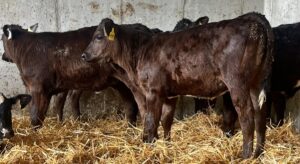
Figure 7 Purchased LM calves from LM9379 (Shannon Stan)