
Benefits of paddock grazing in beef systems


Summary
- Increased number of days at grass and high-quality pasture drive performance in beef systems.
- Rotational paddock grazing systems can increase quality (digestibility and energy content) and quantity of pasture produced.
- Well-planned paddock systems offer flexibility to adapt to changes in stock numbers and pasture availability.
- Roadways and paddocks make it easier to manage and move cattle.
- PastureBase Ireland can help with management decisions to improve pasture and animal performance.
Grazing infrastructure is the farm layout and physical structures (roadways, fencing and water system). Optimal grazing infrastructure facilitates good pasture management practices to maximise days at grass and increases pasture utilisation in a rotational grazing system. Target pasture management practices:
- Enter paddocks at a pre-grazing herbage yield of 1,250-1,500 kg dry matter (DM)/hectare (ha) (9-10 cm).
- Exit paddocks at a compressed sward height of 4 cm before re-growth occurs (target 3 days grazing per paddock).
In particular, optimum grazing infrastructure will allow more grazing in the ‘shoulders’ of the season, facilitate easier management of pasture at times of peak growth and make grazing less weather dependent. In a 40-cow spring calving suckler herd, one extra day at grass in spring is worth €51/day in feed cost savings. This does not include associated slurry handling cost and labour savings. These factors generate greater profitability in beef systems compared to a set stocking system.
Understanding the grass plant
Matching grazing to plant growth is central to efficient pasture-based systems; cattle enter paddocks for grazing at optimum pasture yield, graze for 3 days or less and are removed completely from pasture. This results in greater pasture and animal performance than in a set stocking system where cattle continually graze pastures. The perennial ryegrass plant should be grazed at 2.5-3 leaves the equivalent of 1,250-1,500 kg DM/ha or 9-10 cm, as it has the highest amount of leaf at this point. The higher the leaf content, the higher the energy content, resulting in greater animal performance. During the main growing season, it takes roughly 18-21 days for the plant to reach this stage, growing about one leaf per week. Once the first leaf is growing, the plant can convert light energy from the sun through photosynthesis using it to grow more leaf and restore energy reserves in the roots. The second leaf is larger than the first and the third leaf is larger than the second resulting in the growth rate increasing as the plant grows, often referred to as “grass grows grass”. After the grass plant has been grazed it will immediately grow a new leaf (regrowth) from the point it was grazed to, which is ideally 4 cm (the residual).
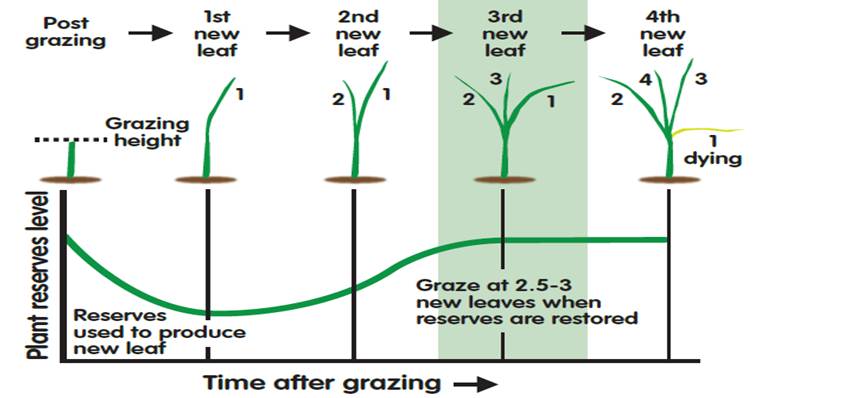
Figure 1. Growth pattern of the perennial ryegrass plant.
Target rotation is between 18-21 days. Exceeding this duration means that:
- The perennial ryegrass plant grows the fourth leaf leading to the first leaf dying as it can only sustain three live leaves at any time.
- Stem begins to form and is a lot less digestible than leaf.
- Perennial ryegrass is lower in energy and animal performance suffers.
- There is difficulty achieving 4 cm post-grazing sward height as cattle choose to eat leaf over stem and dead material.
- Root recovery is slower – the plant requires energy from the roots to produce a new regrowth.
Grazing residency time over 3 days means plant regrowth is re-grazed before it can replenish reserves. Root reserves are fully recovered when the plant reaches the 2.5–3 leaf stage. Continuously grazing low pre-grazing yields, or over-grazing, means the plant is not allowed the opportunity to grow to its potential, hence the total annual yield will be lower.
Paddock systems
Careful consideration needs to be given in deciding how to subdivide the farm into a rotational paddock system to maximise pasture utilisation to ensure the best performance and financial benefits. Paddocks permit a high level of control over cattle movement, compared to set stocking, and allow for simple implementation of a rotational grazing system. Pasture growth is most efficient when animals graze for a maximum 3 days and are then moved. Farmers can graze when pasture quality – digestibility and energy content, is at its highest. This combination means the farm will grow more pasture overall and cattle will be consuming a higher quality diet. In a rotational paddock system, outcomes are achieved through grazing control and pasture management, not by increasing supplementary feed and fertiliser inputs. The difference in live weight gain of beef cattle grazing high-quality pasture, and poor-quality pasture, achieved with the control of paddocks, is up to 0.25 kg per day. Over 200 days, this is an additional 50 kg live weight per animal, which at current prices (~€5/kg live weight) results in earning an additional €250 per animal over the grazing season.
Creating paddocks
Getting the design of a paddock system right is not always simple. If you are unsure where to set paddocks it is recommended to try them first with temporary fences before committing to permanent infrastructure to allow for easy changes to designs/layout. However, to make the initial plan:
- Map the farm on PastureBase Ireland (see below)
- Use farm map to consider several different ways of laying out the farm and consider the positives and negatives of each one.
- Decide on the number of paddocks required.
- Minimising the number of grazing groups reduces the number of paddocks needed.
- Identify the most appropriate water trough(s) position in each paddock. Where possible, share a trough between paddocks but, more importantly, position the troughs to allow further, possibly temporary, subdivision of paddocks.
- Keep paddocks square if possible.
Paddock layout
Proper subdivision of grazing land into paddocks is essential to be able to successfully manage pastures and achieve desirable rotation intervals. The target should be to design a paddock for 3 days grazing followed by a 21-day recovery period during typical mid-season peak growth. This requires establishing what size cattle group is usually run on the farm during mid-season and establishing what the total feed requirement is for the number of cattle in the group (Table 1). Due to physical restrictions on the farm, some paddocks may have to be made smaller. For example, two 2-day paddocks from one small field.
Table 1. Paddock size based on livestock feed demand
| Animals | Live weight (LW) | Herbage demand/head/ day (2% LW) | Herbage demand/ head/ 3 days | Total demand over 3 days |
| 40 suckler cows | 700 kg | 14 kg DM | 42 kg DM | 1680 kg DM |
| 40 suckler calves | 200 kg | 4 kg DM | 12 kg DM | 480 kg DM |
| Target pre-grazing yield | Total demand/ 3 days | |||
| 1450 kg DM/ha | 2160 kg DM | 1.5 ha required |
Paddocks should ideally be connected in a way so that cattle can move between paddocks efficiently. Roadways should be designed to allow animals to be returned to housing during inclement weather in the spring and autumn as easily as possible and by one person. Where possible incorporate the following design ideas for easier management:
- Alter paddock shape to facilitate stock movement into and out of the paddock i.e. stock move down-hill to exit paddocks.
- Locate roadways on the sunny, windy side of a ditch, hedge or tree line.
- Plan for multiple access points from the roadway for paddocks on wet ground. Have several access points between adjacent paddocks.
- Electrified fences divided into sections with easy to access cut-off switches.
- Can be split (at least in 2) with temporary electric fence to cater for variation in stock group sizes. Water troughs should be located centrally to facilitate this.
Avoid long narrow paddocks as they result in too much walking over ground to graze the end of the paddocks creating an excessive risk of poaching in difficult grazing conditions and a build-up of poorer quality grass at the back of paddocks.
What size and number of paddocks?
Although normally a three-day grazing duration per paddock should be the target in mid-season, in spring and autumn the area of grass allocated may be less to allow paddocks to be fully grazed out. For example, in spring the numbers of cattle grazing may be low as not all cattle are turned out to grass. Spring and autumn are also the two periods of the year when grazing conditions are likely to be most challenging and walking over previously grazed areas must be avoided to minimise soil damage and subsequent regrowth. For most of the grazing season, seven to eight grazing paddocks should be the target. Where paddocks are too big, cattle spend longer in a paddock, emerging regrowth will be eaten, less grass will be available at the next rotation, and overall grass production will be lower.
Flexible paddocks
An alternative to a fixed paddock system is to adopt a flexible paddock system whereby large fields are grazed using temporary wire divisions for all grazings. The area available for grazing and the size of the paddock at any grazing can easily be adjusted throughout the year. Larger paddock sizes can be allocated where grass covers are low or the cattle group size is bigger, and smaller paddock sizes can be given when grass covers are higher, or the group size is smaller. Surplus grass is easily harvested, usually as baled silage. For the best success a permanent electric fence around the field boundary should be in place. From this, temporary electric fences are used to allocate pasture with a temporary electric back fence used to prevent stock going back to graze the previous area. Again, appropriately located water troughs are critical to paddock flexibility.
PastureBase Ireland (PBI)
PastureBase Ireland, a free pasture management decision support tool, contains a series of tools that can help to make the best grazing management decisions on farm.
Tools included:
- Farm mapping
- Recording pasture measurements and graze/silage dates
- Fertiliser recording
- Fodder available budgets
- Rotation planners
- Current and predicted growth rates
Practically PBI can help identify upcoming pasture surpluses and shortages so timely decisions can be made to ensure the best quality feed is available to stock. Through regular use, annual paddock performance can be tracked, and action can be taken to improve paddocks with poor herbage growth.
PastureBase Ireland is available to all grassland farmers in Ireland free of charge.
If you wish to sign up or require more information, please call our dedicated help centre on 046-9200965 or email support@pbi.ie or contact your Teagasc advisor.
Compiled and edited by Mark McGee and Paul Crosson, Teagasc, Grange Animal & Grassland Research and Innovation Centre, and first published in BEEF2026 – Driving Sustainable Performance, additional reading from BEEF2026 is available here.