Best Practice in Farmyard Design and TAMS


Summary
- Average herd size is no longer growing but there is still investment required at farm level
- Costs of developing infrastructure in your farm have increased dramatically
- Slurry capacity regulations are increasing from 0.33m3/cow/week to 0.4m3/cow/week in October 2028.
- 50% of farmers surveyed do not have sufficient slurry storage when new regulations are taken into consideration.
- Use Teagasc guidelines to help design any future investment.
- Nutrient Storage Scheme was added to TAMS to help farmers with increasing slurry capacity with a grant rate of 60%
Since 2015 we have seen significant expansion in cow numbers but over the last 2-3 years the national herd has stabilized and is no longer growing at the same pace. However, there is still significant investment required on farms to bring the facilities up to match the herd size currently on farms. Also, in this same period we have seen significant inflation in the cost of investment in farmyards. This makes it all the more important that any future farm investments are planned and designed using best practice guidelines to ensure you are future proofing your farm and getting the best return from your investment.
Table 1: Housing Investment Costs (ex VAT, guideline figures)
| Item | Quantity | Cost (€) | Total/cow (€) |
| Cubicles | 1 | 2,310 | 2,310 |
| Slurry (m3) | 7.26 | 165 | 1,200 |
| Silage Pit | 1 | 500 | 500 |
| Calving pens | 0.02 | 5,000 | 100 |
| Calf Housing | 0.33 | 1,200 | 396 |
| Total/cow | 4,506 |
Table 2: Milking Parlour Investment Costs (ex VAT, guideline figures)
| Item | Quantity | Cost (€) | Total/cow (€) |
| Shed | 1/8 | 10,000 | 1,250 |
| Plant | 1/8 | 10,000 | 1,250 |
| ESB | 500 | 5,500 | 69 |
| Bulk tank | 60 | 3 | 180 |
| Total/cow | 2,749 |
On farm Investment Needs
John Moriarty from Teagasc Cork East, recently completed a survey of discussion group members in the cork area to establish their future development needs.
The average herd size of the farms surveyed was 163 cows currently with plans to increase by 13 cows by 2030.
The survey was split into 3 main areas, milking facilities, housing, slurry capacity and calving/calf sheds.
On the milking facilities the average number of rows per milking was 10 rows with a range of 7-14 rows on farm. When asked 35% of the farmers intend on investing in their milking facilities. Twenty % of the farmers intend to construct a new parlour over the next 5 years. There are insufficient holding yards on 20% of the farms where the holding yard did not have 1.5m2/cow currently. Over half the farmers surveyed do not have automatic drafting currently installed on their farms.
On slurry storage, 85% have enough slurry capacity for the current regulations regarding slurry storage. However, when asked if they have enough capacity when the regulations change from 0.33m3/cow/week to 0.4m3/cow/week in October 2028 only 50% of the farmers will be compliant and will need to invest in slurry capacity to be able to retain their current cow numbers. Worryingly, only 20% of the farmers who require additional slurry storage have started the process of planning permission and TAMS applications.
There was an average of 198 cubicles/farm reported in the survey.
The final area the survey focused on was calving area and calf sheds. On average the farms have enough area to hold 14% of the herd in the calving area on farm based on 8m2/cow floor area available. However, 60% of the farms were under 15% available and will require additional investment. The target is to have a calving area that can cater for 10% of your herd with 15% deemed to be best practice.
On calf sheds 25% of the farmers don’t have enough space in their calf sheds to allow for all calves at 2m2/calf and require further investment. On the feeding systems 40% of the farms use an automatic calf feeder to feed their calves.
Based on the results of the survey, there is still significant investment required on farms and this will have to be planned properly to future proof the farm.
Farmyard layout – guidelines
“Good design fixes all problems”
Most of our farmyards have developed over time with a new feature added typically every other year often without consideration for the overall flow and design of the yard.
Now is the time to step back and have a hard look at your yard as there are many aspects we have to take into consideration but if we can design it right it will minimise soiled water issues, reduce labour and improve lameness in the herd.
Your farmyard should always be designed with a larger herd in mind. It does not cost anything to leave space behind a shed for potential future development even if the herd never grows.
Based on this, Teagasc have developed some design principles you should consider when planning your yard.
Design Principles for designing a farmyard:
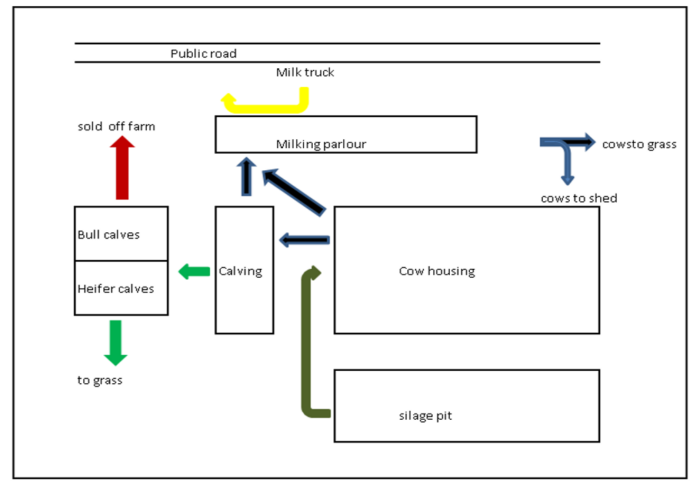
- 3 Main movements on a dairy farm
- Milk lorry
- Cow movement
- Machinery
- They should not cross over – allow each to operate individually
- Allow for future expansion. Develop the farm in streets rather than courtyards
- Locate silage and other feed storage facilities close to the feeding area.
- Do not locate silage pits or drystock housing between cow wintering unit and milking shed.
- Locate the exit from the main housing in close proximity to the holding yard entry (5-10m) to reduce movements across open yards.
- Separation of soiled water, clean water and slurry.
- Calving boxes associated with cubicle shed and close proximity to the milking parlour
- Minimise turns from paddock to holding yard entry. Plan for 3 turns maximum and use bends rather than 90 degree turns on farm roadways
- Face open sided sheds towards sheltered side as 70% of wind/rain comes from South-West.
- Locate cattle crush and holding pen adjacent to the milking parlour and winter accommodation.
- Have an appropriately sized handling facility with good animal access.
- Allow for expansion of milking facilities, winter accommodation and slurry storage
- Divert surface runoff from higher ground and divert roof water to clean drains
To access plans and ideas of well-designed sheds please click here. This will bring you to a series of virtual tours show casing best practice in all aspects of farmyard design.
TAMS 3 – Nutrient Storage
The Targeted Agricultural Modernisation Scheme (TAMS) was first launched in 2010 with an initial focus mainly on Animal housing, Silage bases, Dairy equipment and facilities as well as LESS equipment and certain items relating to farm safety. Since its initial inception TAMS has been updatedand extended covering successive Rural Development Programmes with the latest TAMS 3 launched in 2023 spanning twelve schemes covering a broad spectrum on farm investments mainly focussed on Water quality, Farm safety and Animal welfare. The standard grant rate allowed is 40% while Young trained farmers, organics and Women farmers can avail of an enhanced rate of 60%. All applicants are eligible for a 60% grant on certain investments relating to Solar and LESS equipment as well as Farm safety and Nutrient storage.
The Nutrient Storage Scheme was the latest addition to the TAMS 3 portfolio. It provides 60% grant rate to all successful applicants regardless of age or gender. Nutrient storage investments are prioritised under TAMS 3 as they play a vital role in Irelands quest to improve water quality. The following points should be noted in relation to this scheme.
• Independent TAMS ceiling of €90,000 for individuals, companies and joint ventures and €160,000 ceiling for Registered farm partnerships all at 60% rate.
• Eligible investments include mass concrete tanks and approved tank covers, manure pits, Circular and Geo-membraned lined stores
• Full planning / Planning exemption must be granted prior to application
• Applicants must be nitrates compliant for the most recent completed winter
• Nutrient storage investments are prioritised under Ranking and selection and attract an additional 40 points which should almost guarantee progression to final stages of approval.
• Approvals last for 12 months but applicants can apply for a 6-month extension subject to certain conditions
• All investments must be up to the relevant specification, and it is important that any contractor employed is familiar with same.
• If you apply as a Registered farm partnership, the partnership must remain in place for 5 years post payment of claim otherwise there may be a liability to clawback of claims over the €90,000 individual ceiling.
As with all investments it is important to shop around to obtain best value and maximise TAMS grant return especially in relation to concrete and contractor prices. Grant spec concrete must be specified with the supplier when ordering same otherwise certification may not be forthcoming.
Conclusions
There is still investment required on Irish farms to “catch up” with the increased herd size. The cost of investment in farmyard infrastructure has increased dramatically over the last number of years. Careful planning and consideration are required to make sure you are designing your farm correctly and future proofing your farm. Start the process early as it takes significant time to move from the design phase, planning, TAMS application and finance approval before you can commence building.
The above first appeared in the proceedings from the Teagasc National Dairy Conference 2026 ‘Developing Resilient Dairy Farming Systems’, additional reading from the National Dairy Conference 2026 is available here.