
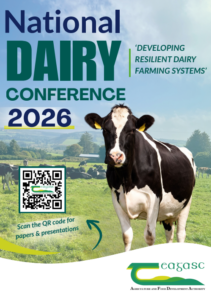
National Dairy Conference 2026
Wednesday, 25th November 2026 | Radisson Blu Hotel, Little Island, County Cork
Examining the key issues in detail and centred on the theme of ‘Developing Resilient Dairy Farming Systems’, the Teagasc National Dairy Conference 2026 focused on the latest developments and research in the Irish dairy sector to assist dairy farmers create robust enterprises.
The Teagasc National Dairy Conference also seen the publication of an event proceeding ‘Developing Resilient Dairy Farming Systems’, available to download of view digitally below,
Welcome from Teagasc Cork East Advisory Region
Majella Moloney
Regional Manager, Teagasc Cork East Advisory Region
On behalf of the Teagasc Cork East Region, together with my staff, I am happy to welcome attendees to the 2026 National Dairy Conference. ‘Developing Resilient Dairy Farming Systems’ is the theme for this year’s event. Cork remains the undisputed dairy capital of Ireland. With over 394,000 dairy cows across approximately 4,200 farms, this accounts for nearly a quarter of the national dairy herd. This scale reinforces the county’s long-standing role as one of Ireland’s leading dairy producing regions.
Teagasc very much appreciates our collaboration with the dairy co-ops in the county. Our Joint programmes with these industry partners, enables us to extend world class Teagasc Dairy research and advisory onto our dairy farms. Following a demanding year marked by challenges in grass growth and market volatility, this conference brings togethers researchers, industry experts and innovative farmers to explore practical strategies for building financial, environmental, and operational resilience. From optimising grass utilisation and herd genetics to managing labour and market shifts, our goal is to equip you with actionable insights for 2027 and beyond.
The main conference in the morning, complemented by the after-lunch workshops can assist dairy farmers in creating a robust enterprise, which will be well placed to withstand the undoubted challenges of the years to come. Finally, we are very pleased to be this year’s host and that this year’s conference provides you with a learning opportunity to help you prepare for the future.
Welcome from Teagasc Dairy KT Department
Joe Patton
Head of Dairy Knowledge Transfer, Teagasc
On behalf of the Teagasc Dairy team, I would like to welcome you to this year’s National Dairy Conference. Our theme ‘Developing Resilient Dairy Farming Systems’, is appropriate given the challenging year just gone due to lower milk price, cost pressures and mid-season drought in many areas. This followed a very good year in 2025 when favourable pasture growth and milk markets combined to return strong profits and helped to build feed and cash reserves on farm.
Such variation over a relatively short time frame underlines the need to maintain very resilient models of production. As we have seen, market conditions will fluctuate faster than any farming system can adjust so the challenge is to find the key technical and financial practices that can deliver consistency across a range of circumstances. These will be covered in detail today.
On a positive note, this year saw continued progress on uptake of technologies on dairy farms. We have seen for example a continued shift to sexed semen and greater use of high dairy beef merit AI bulls. This adds to early-season revenue on dairy farms and addresses a key sustainability issue for the sector. Renewed focus on the EBI itself is needed- its benefits to dairy farm profit will be explored today. In addition, the number of farms measuring grass and completing feed budgets through PastureBase is growing which gives very valuable information both for real-time management and longer-term planning decisions. We will discuss how farmers can get more value from their data.
Long-term challenges for the sector need to be addressed, in particular on how high performing dairy systems can incorporate best-practice water quality and environmental measures into their routine management. This must be achieved while maintaining progress on farm profitability. Good engagement is occurring through joint industry initiatives such as the Better Farming for Water Campaign. Implementation of mitigation is underway; progress can be accelerated in the coming year. We welcome the perspective of Michael Harte, CEO Dairygold, on how industry is supporting efforts in this space.
Our conference today will take a forward look at these key issues in detail. Attendees will hear from a mix of researchers, advisers and leading farmers. The workshops have an informal style to allow for plenty of questions, debate and discussion. We encourage you to take full part. New science is always of interest, but nothing beats hearing the experience of farmers who have been putting ideas and technologies into practice. Teagasc are delighted to have Cork farmers John McAuliffe, Fachtna Collins & David O’Leary presenting at the conference. We also welcome Matt Pilkington, who farms across Warwickshire/ Northamptonshire in the UK. Their input and insight will be a highlight of the day and we sincerely thank them for their participation.
Dairy farm resilience – are we moving in the right direction?
Session one featured contributions from Michael Harte, CEO of Dairygold Co-Operative, who offered a milk processor’s perspective on supporting farm resilience; Professor Laurence Shalloo, Head of the Teagasc Animal and Grassland Research and Innovation Programme, who examined the farm KPIs that drive long-term resilience; and John Lancaster, Head of EMEA Dairy and Food Consulting at StoneX, who provided an update on international dairy market trends. This session was moderated by Dr. Grainne Hurley, Teagasc Cork West Regional Manager.


Farming in challenging years – building contingency into our systems
After a challenging year for grass growth and farm finances, session two, moderated by Dr Deirdre Hennessy of University College Cork, explored ways to build greater contingency into Irish dairy farming systems. The session featured contributions from John McAuliffe, a dairy farmer from Kiskeam, Cork; Matt Pilkington, a grass-focused dairy farmer from the UK; and Mark Treacy, Teagasc Dairy Specialist.


Creating robust dairy enterprises – workshops
Providing an opportunity to engage with Teagasc researchers, specialists, advisors, farmers and industry representatives on topics relevant to their farms, delegates at the Teagasc National Dairy Conference had the opportunity to participate in timely workshops during the afternoon session. Workshop topics included EBI, best practice in farmyard design, dry cow nutrition, grass growth targets, rostering people and balancing workloads, and using key financial metrics to improve farm profit.


Conference Programme
9:15am
Registration
9:35am
Opening Address
Liam Herlihy, Teagasc Chairperson
Conference Programme
9:15am
Registration
9:35am
Opening Address
Liam Herlihy, Teagasc Chairperson
9:50am
Session 1 – Dairy farm resilience – are we moving in the right direction?
Moderated by Dr. Grainne Hurley, Teagasc Cork West Regional Manager
- Supporting farm resilience – a Milk Processor perspective
Michael Harte, CEO, Dairygold Co-Operative
- Farm KPI’s that drive resilience for the long term
Professor Laurence Shalloo, Teagasc - Update on international dairy market trends
John Lancaster, StoneX
10:50am
Tea/Coffee
11:20am
Session 2: Farming in challenging years – building contingency into our systems
Moderated by Dr. Deirdre Hennessy, University College Cork
- John McAuliffe, dairy farmer, Kiskeam, Cork
- Matt Pilkington, grass-focussed dairy farmer, UK
- Mark Treacy, Teagasc Dairy Specialist, Clonakilty
12:40pm
Lunch
2pm
Interactive Workshops
Attendees can choose to attend 3 out of the 6 workshops below
Workshop 1
EBI: Proven technology breeding the cow of the future?
Facilitator: Stuart Childs, Teagasc Dairy Specialist
Contributors: Kevin Downing, Dan O’Riordan and Margaret Kelleher, Irish Cattle Breeding Federation (ICBF)
Workshop 2
Best practice in farmyard design
Facilitators: Patrick Gowing, Teagasc Dairy Specialist; Seamus Nolan, Teagasc Schemes Support Specialist; and John Moriarty, Teagasc
Workshop 3
Troubleshooting dry cow nutrition for a better calving season
Facilitator: Dr. Aisling Claffey, Teagasc Ruminant Nutritionist
Farmer: Fachtna Collins, Cork
Vet: Maresa Sheehan, Veterinary Research Officer, Department of Agriculture, Food and the Marine (DAFM) RVL
Workshop 4
Is 14 tonnes DM grass grown still a realistic target?
Facilitators: Grass10 Team and Professor Michael O’Donovan, Teagasc
Workshop 5
Matching people and rostering to farm workload, getting the balance right
Facilitators: Martina Gormley, Teagasc Dairy Specialist & Liz Duffy, Teagasc Advisor
Workshop 6
Using key financial metrics to improve farm profit
Facilitators: James Dunne, Teagasc Dairy Specialist & Adrian O’Callaghan, Teagasc Advisor
Farmer: David O’Leary, Cork and member of the 3C South of Lee Discussion Group
4pm
Conference close