
Farming in challenging years – building contingency into our systems


Summary
- Changing weather patterns inevitably mean changes to pasture production curves over time. Measuring pasture growth across years helps identify mitigation steps
- While pasture growth may increase on average over time, some regions of the country are predicted to experience mid-season drought while others will have more challenging grazing conditions early and late in the grazing season.
- A reserve of high-quality forage (>400kg DM per cow) over and above normal requirement is a simple first step in building contingency
- Careful consideration should be given to the cost and utility of potential contingency measures including feed sources, stocking rate, median calving date, infrastructure etc. Prioritise simple and repeatable options over novelty and risk.
It may sound obvious, but no two years are the same. Variability is an integral part of farming and is difficult to avoid, but it does pose challenges in our dairy systems. We are all aware of the variations experienced at farm level such as fluctuations in output and input prices, and differences in ground conditions and grass growth caused by weather changes. There is little we can do to prevent these fluctuations, and therefore we must increasingly look at ways in which we can build resilience into our systems to allow us to successfully deal with these challenges when they occur.
Changes in climate – effects on annual grass growth patterns
Increases in global temperatures are already driving changes in our weather patterns, with rainfall pattern changes predicted to increase levels of winter rainfall and cause more frequent occurrences of dry summer periods. This will lead to changes in both annual and seasonal growth patterns of grass in Ireland.
Modelling carried out as part of the Agri Adapt Project shows an increase in global temperatures of 1.5oC temperature would increase annual grass production by about 3.5%, while a 3.0o C temperature rise would increase grass production by close to 5%. While increases in annual grass production sound positive, the impacts of changes in seasonal grass patterns also need to be considered.
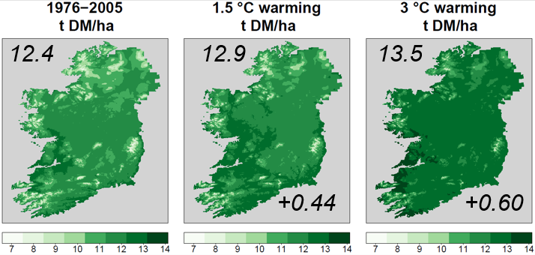
Figure1: Predicted changes in annual grass production (t DM/ha) resulting from increases in average global temperatures
Predicted changes in monthly grass production resulting from rises in average global temperatures are shown in Figures 2 and 3. While overall grass production is projected to increase, it is clear that much of this increased growth will occur over winter, with a decline in summer grass production predicted for the majority of the country. This effect will be largest in traditionally drier areas of the country such as the midlands and South-East. Furthermore, modelling also indicates that year to year variation in summer grass production is likely to increase.
While models show increased production potential due to changes in climate, it is important to note that at farm level data from Pasturebase Ireland shows a decrease in annual grass production when the average annual production between 2021 to 2025 (12.36 t DM/ha) is compared to average annual production for the previous 5-year period, 2016 to 2020 (13.34 t DM/ha). Farm management practice has a large influence on grass production and the effects of changes in nitrogen fertiliser application rates, soil fertility and reseeding also need to be considered when looking at the appropriate stocking rate of individual farms in the future.
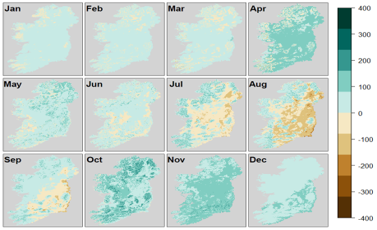
Figure 2: Predicted changes in monthly grass production (kg DM/ha) resulting from a 1.5oC increase in average global temperatures
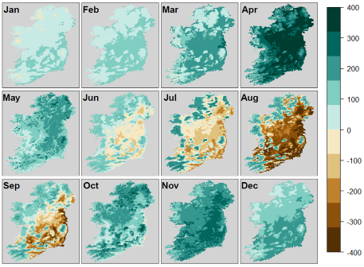
Figure 3: Predicted changes in monthly grass production (kg DM/ha) resulting from a 3oC increase in average global temperatures
Feed Reserves – quantities and options
Considering the level of variation now occurring in mid-season pasture production, it is recommended that farms should carry a reserve of 400 to 500 kg DM of high-quality forage. Similar reserves will also be required for less drought prone farms as these are more likely to suffer from trafficability challenges in spring.
In practical terms, the feed reserve needed on many farms is equivalent of just over 2 silage bales per cow, or about 35 days’ feeding for a mature cow. It is important to note that this reserve is additional to normal annual silage requirements i.e. in an average pasture-growing year, the reserve will sit unused and will roll into the subsequent year. In terms of quality, forage reserves should be equal or greater in feed value to 75 DMD grass silage, so that it can fed to replace grazed pasture with minimum increase in concentrate feed. For farms stocked >2.5 cows per ha on the grazing platform, at least 40% of normal feed reserve requirement should also be at this level of quality. For example, a typical dairy farm stock stocked at 2.5 to 3.0 cows per ha on the milking platform on a dry soil type, will need at least 1tDM of high quality silage, plus a standard 0.6 to 0.7tDM of dry cow feed on hand.
Where not currently in place, putting such a reserve in place will cost approximately €130 per cow, however once established the cost of maintaining this reserve is expected to be substantially lower as it is unlikely that the reserve will be fully used in most years. It also adds to inventory value of the farm from a profitability perspective.
Costing feed reserve options
Table 1 outlines the estimated production costs of a range of commonly used feeds. Grazed grass/clover swards are the cheapest feed source available and therefore where their availability is limited it is inevitable that the cost of feeding the herd will increase. Zero grazed grass or red clover, where available from out blocks, may be an option for filling short term feed deficits. However, it is of limited use during prolonged dry periods as its supply will also be affected by the low growth conditions and may also be impractical during periods of challenging grazing conditions as field conditions will likely also be unsuitable for the operation of farm machinery.
The variation in costs of various options such as silages is relatively small and therefore much of the decision-making surrounding which is the best option on a farm will come down to practicalities and farm location. On dedicated silage out-blocks, a combination of maize silage and red clover crops could be considered as these crops will benefit from being rotated between sites and are less drought prone options than grass silage. Grass silage, while more drought prone, offers the flexibility of being able to cut the crop at various stages depending on the quality of silage required, and offers the added benefit of potentially being available for zero grazing or grazing with youngstock. Overall, high-quality grass silage (75+ DMD) will be the most attractive option on the majority of farms due to its ease of feed out, the ability to store for multiple years if unused, flexibility in diets and a reduced requirement for additional protein in the diet when compared with alternative feeds such as maize silage.
Where alternative grazing crops such as stubble turnips are being considered on the milking platform, careful consideration is required on how the availability of grazing grass for the herd will be impacted. These crops are unlikely to result in an increase in overall dry matter production on the platform and will result in the need to operate at a higher stocking rate on the remaining grassland area while the summer crop is growing. On a dry matter basis these crops are similarly expensive relative to silage options, however the cost difference is reduced when compared on a UFL basis, and when feed-out costs are included. To provide the required level of feed reserve, 0.1 ha of these grazing summer crops would be required per cow. For a herd operating with a milking platform stocking rate of 3 cows/ha, removal of the required area for a summer grazing crop would result in an increase in grassland stocking rate to 4.34 cows/ha while the area was unavailable for grazing, both while the crop is growing and while the area is returned to grass after being grazed. A growth rate of 73 kgDM/day would be required to sustain such a stocking rate with a grass allocation of 17 kgDM/cow/day. Where summer grazing fodder crops are grown on the milking platform they are of little benefit in years where summer growth is unaffected by moisture deficits but will increase overall feed costs.
Table 1: Feed Assumptions and Cost of Production of Feeds (Peter Doyle, Teagasc)
| Grazed grass | Grass + white clover | Multi-species | Zero-grazing grass all-year1 | First + second cut pit silage2 | First + second cut bale silage2 | 3-cut grass silage (pit) | 3 cut red clover silage (pit)3 | Maize silage (open)4 | Maize silage closed | Fodder beet4 | Winter whole crop whear | Grazed Kale | Stubble Turnips | Dairy nut @ €370/t | Purchased rolled barley @ €290/t | |
| Feed Assumptions | ||||||||||||||||
| DM yield (t/ha) | 13 | 13 | 13 | 13 | 6 + 4.7 | 6 + 4.7 | 6 + 4.7 + 3.3 | 5.6 + 4.0 + 3.5 | 13 | 16 | 15 | 12.5 | 6 | 3.5 | – | – |
| DM (%) | 17.4 | 17.4 | 16.4 | 17.4 | 21.7 | 32.4 | 30 | 30 | 30 | 19 | 37.5 | 16.2 | 75 | 86 | – | |
| UFL/kg DM | 1.03 | 1.02 | 1.02 | 1.03 | 0.82 | 0.82 | 0.81 | 0.81 | 0.8 | 0.8 | 1.12 | 0.77 | 1.05 | 1.10 | 1.08 | – |
| DM digestibility (%) | 82 | 81 | 81 | 82 | 73 | 73 | 73 | 73 | 70 | 70 | 86 | 69 | – | – | ||
| Inorganic fertiliser N kg/ha5 | 225 | 100 | 100 | 225 | 87 + 69 | 87 + 69 | 87 + 69 + 70 | 112 | 112 | 114 | 184 | 0 | 40 | – | – | |
| Total fertiliser N kg/ha | 250 | 125 | 125 | 250 | 115 + 82 | 115 + 82 | 115 + 82 + 70 | 0 | 145 | 145 | 145 | 200 | 0 | 40 | – | – |
| Feed costs October 2026 | ||||||||||||||||
| Total costs/ha (incl. land charge) (€) | 1455 | 1262 | 1298 | 2977 | 2496 | 3105 | 3483 | 3194 | 3439 | 4190 | 4069 | 3337 | 1538 | 1352 | ||
| Total costs/ha (excl. land charge) (€) | 714 | 521 | 557 | 2236 | 1996 | 2605 | 2842 | 2550 | 2698 | 3449 | 3328 | 2596 | 1167 | 982 | ||
| Total costs/t DM grown (incl. land charge) (€)6 |
112 | 97 | 100 | 229 | 233 | 290 | 249 | 226 | 269 | 266 | 271 | 271 | 256 | 386 | ||
| Total costs/t DM grown (excl. land charge) (€) |
55 | 40 | 43 | 172 | 186 | 243 | 203 | 181 | 211 | 219 | 222 | 211 | 195 | 281 | ||
| Total costs/t DM utilised (incl. land charge) (€)6 |
140 | 121 | 125 | 286 | 300 | 341 | 318 | 299 | 309 | 306 | 336 | 315 | 320 | 515 | 449 | 352 |
| Total costs/t DM utilised (exc. land charge) (€) |
69 | 50 | 54 | 215 | 240 | 286 | 259 | 239 | 242 | 252 | 275 | 245 | 243 | 374 | 449 | 352 |
| Relative cost to grazed grass per energy utilised (UFL) including land charge6 |
1.0 | 0.9 | 0.9 | 2.0 | 2.7 | 3.1 | 2.9 | 2.7 | 2.8 | 2.8 | 2.2 | 3.0 | 2.2 | 3.4 | 3.1 | 2.2 |
| Relative cost to grazed grass per energy utilised (UFL) excluding land charge |
1.0 | 0.7 | 0.8 | 3.1 | 4.4 | 5.3 | 4.8 | 4.4 | 4.5 | 4.7 | 3.7 | 4.8 | 3.5 | 5.1 | 6.2 | 4.6 |
| Cost per 1000 UFL (inc land charge) (€) | 136 | 119 | 122 | 278 | 365 | 421 | 389 | 366 | 385 | 381 | 300 | 409 | 305 | 468 | 416 | 304 |
| Cost per 1000 UFL (exc land charge) (€) | 67 | 49 | 52 | 209 | 292 | 353 | 318 | 292 | 302 | 313 | 246 | 318 | 232 | 340 | 416 | 304 |
1Zero-grazing does not include the cost of handling extra slurry vs. grazing
2First- and second-cut silage were assumed to be cut on 29 May and 17 July, respectively
3Slurry + the cost 0-7-30 for the remainder of K requirements, does not include grazings in the back end of the year. 6 year persistence
4The extra cost of feed protein supplementation required for maize and fodder beet is not included
5Remainder of nitrogen requirement was fulfilled via slurry (organic N) application.
6Land charge of (€741/ha) €300/acre
All feed costs include VAT
Protected urea = €740/t; 0-7-30 €540/t, 18-6-12 = €600/t
Herd and grazing management decisions
Grass clover swards are the cheapest available feed source, and every effort must be made to maximise their use in our dairy cow diets, with increasing pasture utilised shown to be worth an additional €221 per tonne of pasture utilised per hectare. Regular grass measurement allows for both long-term and short-term informed management decisions to be made, however its uptake is still relatively low in Ireland. Management tools such as spring and autumn rotation planners, grass budgets and winter fodder budgets within Pasturebase Ireland are a valuable resource and should be used to aid decision making.
The correct stocking rate for a milking platform, and indeed a whole farm, is largely governed by the quantity of grass which can be produced from it and will vary between farms. It is important to establish what the 5-year average grass production is and to use in the calculation of target stocking rate. Consideration needs to be given to both the overall tonnage which can be produced, as well as weekly growth rates. Excessive stocking rates will lead to a requirement for increased levels of supplementary feeding, increasing the cost of production.
Table 2: Supplementary feeding rates (kg DM per cow) required at varying milking platform stocking rates and daily growth rates
| Milking Platform Stocking Rate (cows/ha) | |||||||||
| 2.75 | 3 | 3.25 | 3.5 | 3.75 | 4 | 4.25 | 4.5 | ||
| Growth Rate (kg DM/ha/day) | 50 | 0.8 | 2.3 | 3.6 | 4.7 | 5.7 | 6.5 | 7.2 | 7.9 |
| 55 | 0 | 0.7 | 2.1 | 3.3 | 4.3 | 5.3 | 6.1 | 6.8 | |
| 60 | 0 | 0 | 0.5 | 1.9 | 3.0 | 4.0 | 4.9 | 5.7 | |
| 65 | 0 | 0 | 0 | 0.4 | 1.7 | 2.8 | 3.7 | 4.6 | |
| 70 | 0 | 0 | 0 | 0 | 0.3 | 1.5 | 2.5 | 3.4 | |
| 75 | 0 | 0 | 0 | 0 | 0 | 0.3 | 1.4 | 2.3 | |
| 80 | 0 | 0 | 0 | 0 | 0 | 0 | 0.2 | 1.2 | |
| 85 | 0 | 0 | 0 | 0 | 0 | 0 | 0 | 0.1 | |
For farms operating on heavy soils in particular, a further strategic response to changing weather patterns and soil trafficability may be to adjust planned start of calving date (PSC). While the principle of matching calving date to pasture growth and availability holds across all farms, in practice this may mean altering PSC, for example for 10-14 days, to better align pasture availability with demand. As herd fertility and 6-wk calving rates continue to improve, herd managers have better capacity to align grass supply with early lactation herd demand without suffering the penalty of excess numbers calving into late April. Previous work conducted both in Curtin’s Farm (Cork) and Ballyhaise Farm (Cavan), showed minimal penalty to annual milk solids productivity but a reduced reliance on silage and concentrate in early lactation. Instead, supplement feeding was shifted to some extent to the late lactation period where feeding management tended to be more straightforward. Decisions on changing calving date should not be made lightly however and require a comprehensive analysis of the individual farm’s soil type, spring pasture growth pattern, and herd feed demand.
Farm Infrastructure investments to increase resilience
Strategic investment in farm infrastructure is a key tool for reducing the impacts of weather events on dairy farms. Predicted increases in winter rainfall will likely make spring grazing more challenging, particularly in higher rainfall areas. Analysis by Elodie Ruelle in Teagasc Moorepark shows changes in weather patterns have so far caused little change in the possible first turnout dates in areas such as Moorepark and Oakpark, however, the average date when ground conditions were suitable for turnout in areas such as Ballyhaise has moved 12 days later when weather data for the periods 2005-2014 and 2016-2025 were compared. Year to year variation in suitable turnout dates in higher rainfall areas has also substantially increased. As global temperatures rise, these effects are likely to continue to increase and will also begin to impact more on drier farms as well. The adequacy of grazing infrastructure should be examined on every farm, with investment required on many. Investment in such facilities has a good payback as increasing spring grazing is estimated to return around €3.30 per cow per additional day at grass. While some of these investments may be substantial, such as the provision of additional roadways, spur roadways, and additional water troughs, many others can be quickly achieved with relatively small investments such as the provision of additional access points to paddocks, automatic paddock gap opening systems, and a good supply of temporary fence posts and reels.
Much investment has been, and continues to be, made in additional slurry storage. While much of this investment has been driven by changes in regulatory requirements, it is prudent that all farms assess their storage facilities not only from a regulatory perspective, but also from a practical perspective. The actual location of storage facilities within a farm can a have a large effect on labour efficiency. Having storage located where it is required rather than having to transfer slurry between storage facilities has a substantial time saving at a time of year when there often doesn’t seem to be enough hours in the day. When constructing new facilities careful planning is required to ensure the facilities are located where they will be of most practical benefit. Consideration should also be given to including additional storage capacity to future proof the farm and reduce the chances of having to spread slurry in sub optimal conditions. Return on investment in these facilities will come from increased labour efficiency and a higher recovery of nutrients from the slurry collected. For a 100-cow herd spreading slurry in optimal conditions can result in a difference of over €3,000 in the value of nutrients recovered from the slurry collected over an 18-week period.
Adequate feed space is an important consideration for the future. Many of the current facilities available on farm are designed with adequate feed space for feeding stock over the winter period with unrestricted ad lib access to feed. However, where feed space is required for supplementary feeding during periods of challenging grazing conditions or restricted grass availability sufficient space for the entire herd to feed at once is required with an allowance of 650mm of feed space per cow recommended. Solutions such as splitting the herd into groups and feeding at different times, or the provision of additional feed space using temporary feeders may suffice in the short term, however they are likely to substantially increase workload and are unlikely to be a suitable long-term solution. Where additional slurry storage is being constructed on farm, consideration should be given to how additional feed space could be integrated into the project.
As previously outlined, a reserve of high-quality feed is essential on all farms. Therefore, having adequate fodder storage space is critical. Investment in such facilities has been relatively low in recent years, despite substantial increases in herd size on many farms. From a practical viewpoint, separate storage facilities are required to allow for the segregation of silages of differing qualities to ensure access is always available to the most appropriate feed.
The above first appeared in the proceedings from the Teagasc National Dairy Conference 2026 ‘Developing Resilient Dairy Farming Systems’, additional reading from the National Dairy Conference 2026 is available here.