
EBI: Proven technology breeding the cow of the future


Summary
- Higher EBI delivers higher profit. Every €1 increase in EBI is worth approximately €2 in profit, with the relationship holding across different production systems.
- EBI drives milk solids through more than yield alone. Better fertility, survival, health and calving performance increase days in milk, herd maturity and ultimately saleable lifetime output.
- EBI balances dairy and beef value. The Maintenance and Beef sub-indices account for both the energy cost of cow size and its potential beef return.
- DNA-based registration strengthens EBI. Verified parentage and genomic information improve data quality and deliver more reliable evaluations earlier in life.
- Balanced genetics build resilience. Future cows must cope with less predictable seasons, helping reduce exposure when grass growth and grazing conditions differ from expectations.
Introduced in 2001, the Economic Breeding Index (EBI) has transformed dairy cattle breeding in Ireland by providing farmers with a scientific and economically focused method of selecting the best animals for the next generation. Rather than concentrating on individual production characteristics, the EBI combines genetic information from multiple traits into a single monetary value, allowing farmers to identify animals with the greatest potential to improve overall farm profitability.
After more than 25 years of development and implementation, the EBI has established itself as a proven breeding technology. However, an important question remains: can EBI deliver the dairy cow for the dairy systems of the future?
What is the EBI?
The EBI is a genetic selection tool designed to identify the most profitable bulls and cows for breeding dairy herd replacements. It combines estimated genetic merit for a range of economically important characteristics into one overall figure, expressed in a euro value.
EBI works. The evidence is in profit and performance
A major strength of the EBI is that it is supported by both extensive research and practical evidence from commercial dairy farms. Over the past 25 years, average herd EBI has increased by approximately €191, with the cumulative value of this genetic improvement to the Irish dairy industry estimated at €5.5 billion.
At farm level, the relationship is clear: each €1 increase in herd EBI is associated with approximately €1.96 additional net profit per cow. Higher-EBI herds also perform better across the traits that drive profitability. In 2025, the top 20% of manufacturing herds for EBI produced more milk solids, had better fertility and udder health, and had lower emissions intensity than the herd average.
Table 1. Relationship between EBI and dairy herd performance in Irish manufacturing herds (2025)
| Top 20% EBI advantage over herd average | 2025 result |
| Milk solids | +52 kg/cow |
| Six-week calving rate | +12 percentage points |
| Calving interval | 13 days shorter |
| SCC | 39,000 cells/ml lower |
| Emissions intensity | 0.09 kg CO2e/kg FPCM lower |
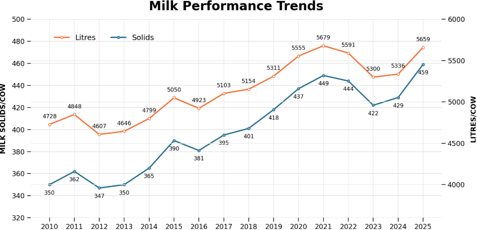
Figure 2: Milk litres and milk solids (kg) per cow from 2010 to 2025 (Source: ICBF, 2026)
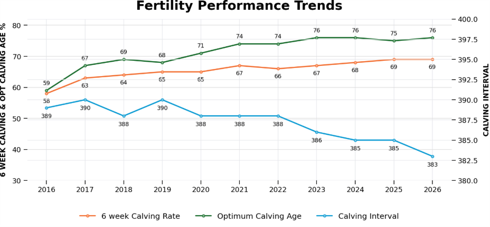
Figure 3: Trends in six-week calving rate, optimum calving age and calving interval. (Source: ICBF, 2026)
More milk solids, without losing sight of the whole cow
EBI increases milk solids through several routes. Direct improvement in fat and protein yield and concentration remains important, but better fertility means more days in milk, better survival allows more cows to reach mature production, and improved health and calving performance increase saleable milk while reducing intervention costs.
Because these traits work together to determine overall performance and profitability, they cannot be considered in isolation. Selecting only for milk can create costs elsewhere through poorer fertility, reduced survival, poorer health or higher maintenance requirements. EBI assigns an economic value to each and combines them into one overall measure, ensuring that gains in production are balanced against their impact on fertility, survival, health and maintenance costs. Two bulls can have the same overall EBI but arrive at it through different combinations of strengths and weaknesses. The overall EBI identifies economically attractive animals, while the sub-indexes allow farmers to fine-tune selection to the needs of their own herd.
Farmer chooses the system: EBI captures what the cow costs and what she delivers
Cow size creates both costs and returns. The Maintenance and Beef sub-indexes therefore account for both the input costs and potential outputs delivered.
- MAINTENANCE: THE COST SIDE
- A larger heifer requires more energy to reach mature size, and a larger cow requires more energy simply to maintain herself each year. When milk, fertility, health and other functions are held constant, that additional energy is an economic cost.
- BEEF: THE VALUE SIDE
- Size can also create value. A larger cow may produce progeny with greater beef merit and can have a higher value herself when she leaves the dairy herd. The Beef sub-index captures this contribution to the dairy enterprise.
Read together, the objective is clear: EBI is not trying to breed the smallest cow, nor is it rewarding size for its own sake. It is seeking the economically optimum cow when the cost of rearing and maintaining her and the beef value from her and her progeny are considered together. Sexed semen and use of better-quality beef bulls (i.e. high DBI beef bulls) negate some of the impact of poor beef characteristics of the dairy dams.
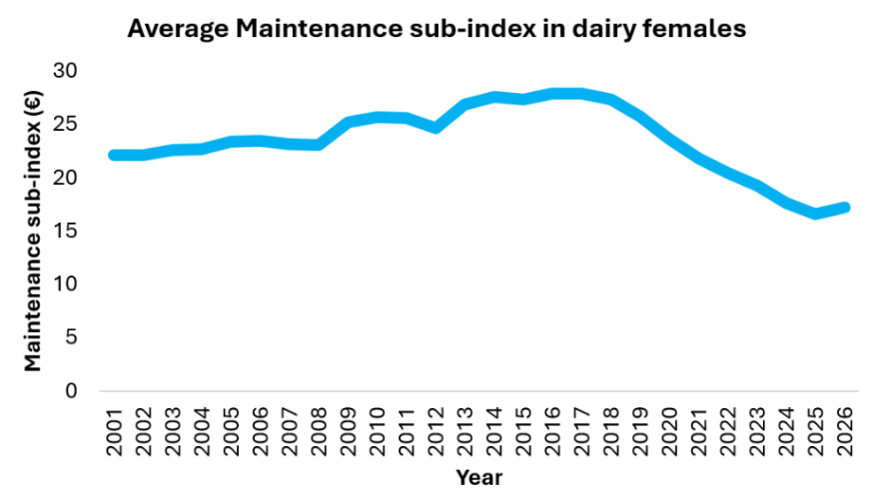
Figure 4. Average Maintenance sub-index in dairy females, 2001–2026. (Source: ICBF, 2026)
EBI does not ask whether a bigger or smaller cow is better. It asks which cow leaves more profit behind when all her costs and outputs are counted.
DNA-based registration and connected national data strengthen EBI
Ireland’s breeding programme is supported by a connected national data infrastructure. Animal identity, pedigree, genotypes, milk recording, fertility, calving, health, movements, slaughter and carcass information can be linked across the life of an animal and across the dairy and beef sectors. This allows the economic consequences of breeding decisions to be followed well beyond the milking herd.
DNA-based calf registration strengthens that system further. Through the National Genotyping Programme, parentage can be verified before registration and passport issue. This prevents incorrect sire or dam information from becoming embedded in the national database and gives greater confidence that records are assigned to the correct animal and family. The genotype can then be combined with pedigree and performance information in genomic evaluations, providing a more reliable EBI earlier in life.
The practical impact is significant. Farmers can identify superior replacement females sooner, breeding programmes can screen more young animals, and parentage corrections can flow into routine weekly genomic evaluations. DNA-based registration is therefore more than an identification tool: it improves data quality at source and strengthens the accuracy, timeliness and usefulness of EBI.
EBI is breeding a cow for a less predictable grass-growing season
The cow selected today will enter a different operating environment. Weather has always influenced grass supply, but farmers are increasingly managing sharper contrasts across the year: wet springs that delay turnout and reduce utilisation, dry summer periods that restrict growth, and milder but wetter autumns and winters that may extend biological growth while limiting grazing access because of soil conditions. The timing of grass growth can become less predictable even where annual production remains strong.
This places greater value on fertility, survival, health, moderate maintenance requirements and the ability to recover from short-term nutritional or environmental pressure. A compact-calving, fertile cow can make better use of early-season grass when conditions allow. A healthy, long-lived cow reduces the replacement burden when feed is challenged. A cow with an appropriate maintenance requirement leaves more available feed for productive output. EBI cannot predict the weather, but balanced genetic improvement can breed a herd that is less exposed when the season does not follow the expected curve.
Genetic gain is cumulative and permanent. Bulls selected now will have daughters entering the herd several years from now, and those daughters may remain there well into the 2030s. EBI is therefore breeding the next decade’s cow, not merely next year’s heifer.
What should farmers do?
- Use overall EBI to drive balanced genetic gain. Do not let a single trait dominate the entire breeding programme.
- Use the sub-indexes to address herd priorities. Protect what is working and put added emphasis on genuine weaknesses.
- Think in lifetime milk solids. Fertility, survival, health and calving performance all influence the amount ultimately sold.
- Read Maintenance and Beef together. Cow size carries both a lifetime energy cost and a potential beef return.
- Use DNA information and keep recording. Verified parentage, genotyping, milk recording and health data strengthen evaluations for every herd.
- Match genetics with management. EBI identifies potential; grassland, nutrition, health and reproductive management determine how much is realised.
Conclusion
EBI has moved Irish dairy breeding beyond the pursuit of one trait or one type of cow. It is a proven, balanced and adaptable breeding objective that works across dairy systems because it counts the major sources of income and cost associated with the animal. The farmer chooses the system. EBI helps provide the genetics to make that system more profitable, efficient and resilient.
The cow of the future will not simply be the animal with the highest EBI. She will be an animal who has the genetic potential to produce high value, high solids milk from a predominantly grass based diet, will go in calf efficiently, while remaining healthy and productive for multiple lactations, and maintaining a low environmental footprint.
The unique incorporation of both the Maintenance and Beef sub-indices shows the whole-enterprise thinking of EBI in practice. Its value is strengthened further by DNA-based registration and Ireland’s ability to connect genomic, performance and lifetime animal data. These foundations allow EBI to continue breeding cows that deliver more saleable milk solids, remain productive for longer and cope with increasingly variable grass-growth and grazing conditions.
The EBI is not just a tool for selecting the next generation of dairy cows; it is a proven technology shaping the future of profitable, efficient and sustainable dairy farming.
The above first appeared in the proceedings from the Teagasc National Dairy Conference 2026 ‘Developing Resilient Dairy Farming Systems’, additional reading from the National Dairy Conference 2026 is available here.