
Newford suckler demonstration farm update


Summary
- Establishment: Set up in 2015 by Teagasc and Dawn Meats to demonstrate profitable, sustainable, grass-based suckler beef production.
- Relocation: Herd moved from Athenry, Co. Galway to Athleague, Co. Roscommon in 2023.
- Herd profile: 90 Angus × and Hereford × dairy cows mated by artificial insemination (AI) to high Terminal Index sires.
- Key targets: Heifers calve at 24 months of age; 10-week calving season commences 1 February to match spring grass turnout.
- Progeny performance: Steers and heifers are finished at approximately 21-22 and 20-21 months of age, respectively, to meet strict market specifications.
- Finances: Gross margin of €2,261/hectare (€1,969/cow) achieved in 2025, largely driven by strong beef prices.
- Sustainability: Active in ‘Signpost’ and ‘Future Beef’ programmes; secured Farming for Water European Innovation Partnership (EIP) funding in 2025.
The Newford Demonstration Farm was established in 2015 as a joint initiative between Teagasc and Dawn Meats, with support from the Irish Farmers Journal and McDonald’s. Its primary objective is to operate as a stand-alone suckler herd under commercial conditions, demonstrating best-practice technologies to the wider beef industry. A key focus is placed on maximizing the use of grazed forage to drive profitability and environmental sustainability.
Farm layout and relocation
In 2023, the 90-cow herd was successfully relocated from its original base in Athenry, Co. Galway, to a new home in Athleague, Co. Roscommon. The farm structure is strictly commercial. All variable, fixed and capital costs must be funded directly by the farm’s output, alongside its Basic Income Support for Sustainability (BISS) payment. To reflect a true commercial model, the only exceptions excluded from the farm accounts are land rental costs and the farm manager’s salary (although additional, ‘casual’ labour costs are included). Furthermore, a separate, stand-alone beef finishing unit is operated with its own independent set of accounts.
Herd management and breeding strategy
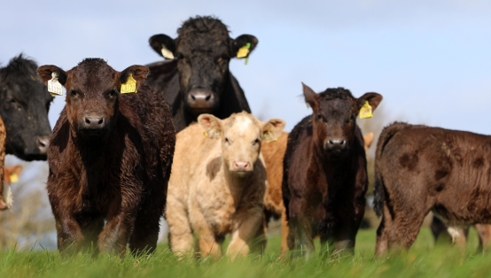
The herd consists entirely of crossbred Angus and Hereford cows sourced from the dairy herd. This beef × dairy crossbred has excellent maternal traits – milk and high fertility – as evidenced from the cow performance and calf pre-weaning growth summarised in Table 1.
- Breeding: 100% artificial insemination (AI) is utilised, selecting high Terminal Index sires to maximize carcass performance of the progeny.
- Heifer replacement: A strict 24-months of age calving policy is enforced for all replacement heifers.
- Calving profile: A compact, 10-week calving period begins on 1st Calving aligns with the onset of the spring grass growing season, thereby reducing the requirement for grass silage plus supplementary concentrate feeding of lactating cows indoors.
Table 1. Newford cow numbers and herd performance from 2019 to 2025
| 2019 | 2020 | 2021 | 2022 | 2023 | 2024 | 2025 | |
| Cows (number) | 110 | 100 | 94 | 93 | 89 | 91 | 86 |
| Calving interval (days) | 366 | 360 | 366 | 359 | 364 | 377 | 366 |
| Breeding season (weeks) | 10 | 10 | 10 | 10 | 10 | 10 | 10 |
| Weaning weight (kg) | 289 | 314 | 316 | 328 | 315 | 285 | 327 |
| Weaning date | 17/9 | 12/9 | 17/9 | 16/9 | 14/9 | 13/9 | 26/9 |
| Calf mortality 28 day (%) | 5.3 | 5 | 4.3 | 5.3 | 4.4 | 4.5 | 4.9 |
| Non-pregnant cows (%) | 13 | 10 | 6 | 9 | 8 | 14 | 12 |
Progeny performance post-weaning and market specifications
All progeny are finished as steers or heifers (Table 2). The management system focuses on optimizing slaughter age from a grass-based diet:
- Heifers: Finished at approximately 20-21 months of age.
- Steers: Finished at approximately 21-22 months of age.
Both groups are managed closely to ensure carcasses consistently meet retail market specifications for fat cover and weight.
Financial and environmental sustainability
Financially, 2025 marked a milestone for Newford, delivering its highest financial return since establishment (Table 3). Driven by strong factory beef prices, gross output rose significantly, culminating in a gross margin of €2,261 per hectare (€1,969 per cow).
On the environmental front, Newford acts as a focal point for the industry through its integration into the Signpost and Future Beef programmes. In 2025, the farm successfully secured funding through the Farming for Water EIP (European Innovation Partnership). This funding has enabled the farm to implement a suite of targeted, on-farm initiatives aimed at protecting and improving local water quality.
Table 2. Carcass traits of steer and heifer progeny between 2018 and 2025
| 2018 | 2019 | 2020 | 2021 | 2022 | 2023 | 2024 | 2025 | |
| Steers | ||||||||
| Conformation score | R = | R + | R = | R = | R = | R = | R = | R = |
| Fat score | 3 + | 3 = | 3 – | 3 – | 3 – | 2 + | 3 – | 3 = |
| Slaughter weight (kg) | 685 | 642 | 647 | 663 | 653 | 675 | 670 | 695 |
| Carcass weight (kg) | 367 | 350 | 350 | 357 | 358 | 365 | 353 | 372 |
| Finishing age (months) | 21.3 | 21.4 | 20.3 | 21.1 | 20.5 | 21.5 | 21.5 | 21.8 |
| Carcass value | €1,434 | €1,315 | €1,389 | €1,611 | €1,776 | €1,905 | €2,035 | €2,797 |
| Price, €/kg carcass | €3.90 | €3.76 | €3.96 | €4.51 | €4.96 | €5.22 | €5.77 | €7.50 |
| Heifers | ||||||||
| Conformation score | Sold | R = | R = | R = | R – | R = | R = | R = |
| Fat score | Live | 3 = | 3 = | 3 – | 3 = | 3 + | 3 = | 3 = |
| Slaughter weight (kg) | – | 569 | 570 | 583 | 564 | 588 | 594 | 624 |
| Carcass weight (kg) | – | 299 | 299 | 311 | 296 | 320 | 306 | 331 |
| Finishing age (months) | 16.0 | 19.7 | 20.0 | 19.9 | 17.9 | 19.3 | 21.1 | 20.7 |
| Carcass value | €1,035 | €1,117 | €1,188 | €1,396 | €1,507 | €1,602 | €1,753 | €2,554 |
| Price, €/kg carcass | €2.251 | €3.74 | €3.97 | €4.49 | €5.06 | €5.01 | €5.72 | €7.70 |
1Live weight price
Streamlined labour strategy
Newford Farm optimizes operational hours and costs by applying targeted genetics, strict herd management, and high-efficiency infrastructure:
- Genetics: Selecting docile, highly fertile cows that calve easily within a compact timeframe.
- Sires: Using terminal bulls that maximize carcass weight with minimal calving assistance required.
- Culling: Instantly removing cows that do not fit the system or demand individual handling time.
- Audits: Reviewing daily farm tasks continuously to identify, quantify, and eliminate wasted labour.
- Grouping: Organizing stock into fewer, larger grazing groups driven by compact breeding blocks.
- Facilities: Upgrading grazing layouts and handling units so a single operator can manage large herds alone.
Labour-saving strategies will form an integral part of future plans at Newford.
Table 3. Profit and loss account for Newford farm 2025
| Total (€) | € / Hectare | € / Cow | |
| Gross output | 285,816 | 3,816 | 3,323 |
| Variable costs | |||
| Purchased concentrate | 23,004 | 307 | 267 |
| Straw forage | 3,500 | 47 | 41 |
| Fertiliser | 16,166 | 216 | 188 |
| Lime | 5,779 | 77 | 67 |
| Veterinary | 15,203 | 203 | 177 |
| AI/breeding | 7,638 | 102 | 89 |
| Contractor – silage cutting | 25,331 | 338 | 295 |
| Seed and spray | 5,675 | 76 | 66 |
| Silage additive and polythene | 875 | 12 | 10 |
| Levies and transport | 3,847 | 51 | 45 |
| Sundry variable costs | 9,437 | 126 | 110 |
| Total | 116,454 | 1,555 | 1,354 |
| Gross margin | 169,362 | 2,261 | 1,969 |
| Fixed costs | |||
| Hired labour | 22,777 | 304 | 265 |
| Mach running | 11,585 | 155 | 135 |
| Mach leases | 8,982 | 120 | 104 |
| Loan interest | 6,052 | 81 | 70 |
| E.S.B | 3,334 | 45 | 39 |
| Depreciation | 16,198 | 216 | 188 |
| Repairs and maintenance | 7,645 | 102 | 89 |
| Insurance | 2,150 | 29 | 25 |
| Professional fees | 1,500 | 20 | 17 |
| Sundry fixed costs | 1,807 | 24 | 21 |
| Total fixed cost | 82,030 | 1,095 | 954 |
| Net profit | 87,332 | 1,166 | 1,015 |
| Premia: SCEP | 15,722 | 210 | 183 |
| Net profit including SCEP | 103,054 | 1,376 | 1,198 |
Newford farm is open to all beef and student discussion groups during the year.
Contact Michael Fagan: 086 3809358
Compiled and edited by Mark McGee and Paul Crosson, Teagasc, Grange Animal & Grassland Research and Innovation Centre, and first published in BEEF2026 – Driving Sustainable Performance, additional reading from BEEF2026 is available here.