
Soil carbon on agricultural soils


Summary
- The Signpost Programme and the National Agricultural Soil Carbon Observatory (NASCO) represent a national carbon monitoring network in Ireland, that aim to improve inventory refinement of soil organic carbon emission factors and land management factors in Ireland.
- Findings from the Signpost Programme suggest that Irish farms have good soil quality, with higher carbon stocks in deep soil layers in intensively-managed production systems.
- Carbon balance results from a NASCO site under a grazing management show a net sink of carbon at a rate that exceeds the national inventory default value for managed mineral soils.
What is soil carbon and carbon sequestration?
Soil carbon refers to the carbon stored within soils, mainly as soil organic matter (SOM), which is derived from decomposed plant material and microbial biomass. It is a vital component of healthy soils, helping to maintain fertility, support biodiversity, and sustain ecosystem functions. As the largest terrestrial carbon reservoir, soils contain more than twice as much carbon as the atmosphere and almost three times the amount stored in living vegetation, making them a key part of the global carbon cycle. In Ireland, grassland soils represent an important carbon store, holding approximately 440 tonnes carbon dioxide equivalents (CO2e) per hectare and an estimated 1,800 million tonnes carbon dioxide (CO₂e) across all mineral soils. Effective soil carbon management therefore has considerable potential to reduce atmospheric CO₂ levels while enhancing agricultural performance.
Soils with high carbon content provide numerous benefits, including increased crop and pasture productivity, improved water-holding capacity, and greater resistance to erosion. Conversely, declines in soil carbon caused by land-use change, deforestation, or unsustainable farming practices can result in the release of stored carbon into the atmosphere, accelerating climate change and reducing soil quality.
Soil carbon sequestration is the process of removing carbon dioxide from the atmosphere and storing it in vegetation and/or the soil. In agricultural systems this process is mediated by plants through photosynthesis. Over time, soil carbon sequestration can enhance the soil carbon stock which is the amount of carbon stored in a unit of area and is often expressed as tonnes of carbon per hectare (t C/ha). Carbon sequestration, and its potential to address global warming and climate change mitigation, is sometimes confused with other terminology that describe carbon in soils or the removal of greenhouse gases (GHG) from the atmosphere (Figure 1). For example, an increase in a soil organic carbon (SOC) stock, i.e. SOC accrual, a result of additional nitrogen fertiliser applications to promote greater biomass production and therefore carbon inputs through roots, may also result in increases in gaseous nitrogen losses. As a result, this measure, while good for increasing the SOC stock, does not equate to climate change mitigation, as the benefit from the net carbon sequestered is partially offset by the nitrogen emissions. Therefore, measuring the net CO₂ emissions from livestock systems is essential when trying to quantify the role of these systems towards climate neutrality.
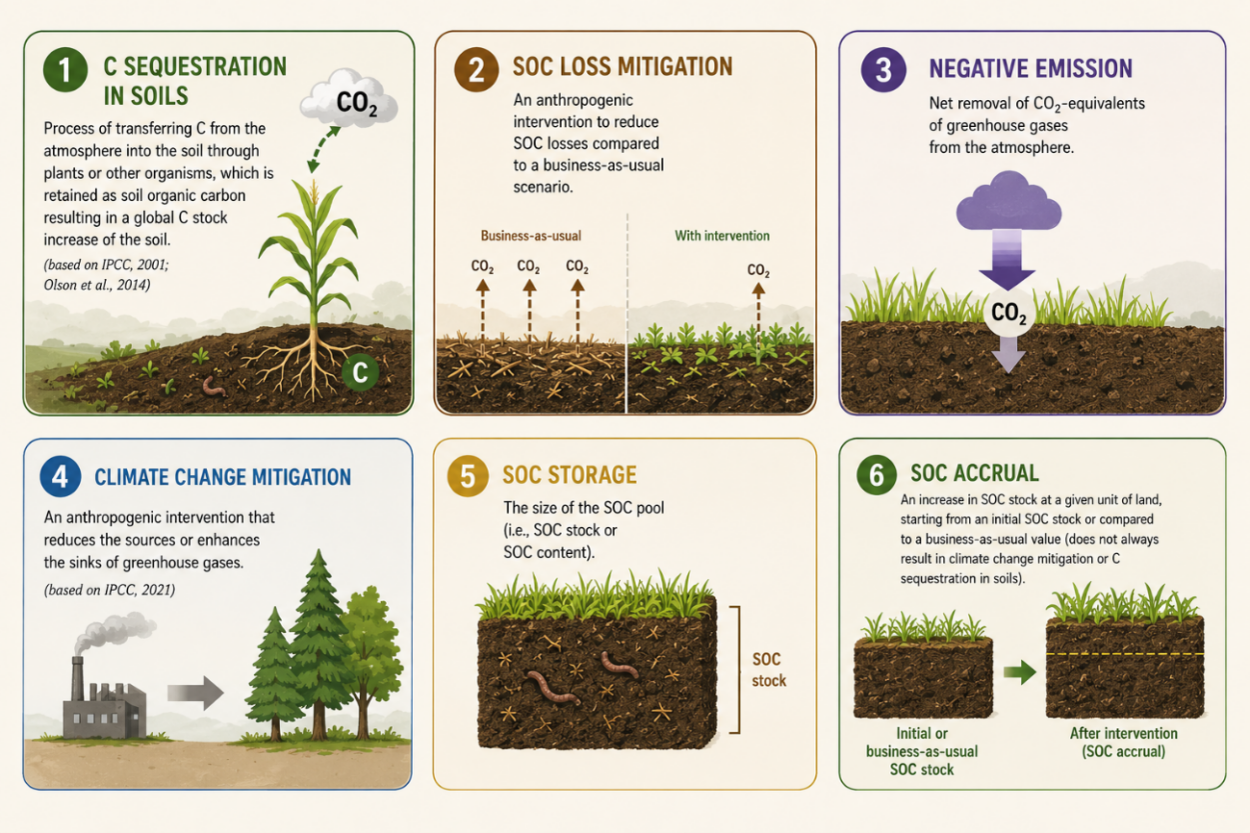
Figure 1. Schematic explaining common terminology used to describe carbon (C) in soils including 1. Carbon sequestration 2. Soil organic carbon (SOC) loss mitigation 3. Negative emissions 4. Climate Change Mitigation 5. SOC storage and 6. SOC accrual. Source: Schematic is adopted from Don, A., Seidel, F., Leifeld, J., Kätterer, T., Martin, M., Pellerin, S., Emde, D., Seitz, D. and Chenu, C. (2024). Carbon sequestration in soils and climate change mitigation—Definitions and pitfalls. Global Change Biology 30: e16983. https://doi.org/10.1111/gcb.16983
How can we measure soil carbon sequestration and soil organic carbon stocks?
Measuring carbon sequestration in mineral soils at a national scale is challenging because soil carbon stocks vary annually, making it difficult to detect precise changes in carbon sequestration or loss across farming systems. To address this, Ireland has developed a national roadmap for soil carbon accounting that combines multiple scales of assessment and methodologies.
The National Agricultural Soil Carbon Observatory (NASCO) and the Signpost Programme are working together to establish Ireland-specific emission factors and land management factors for changes in SOC stocks. Together, these national carbon monitoring networks are creating one of Europe’s largest infrastructures for measuring and reporting agricultural emissions, and soil and biomass carbon storage. Their combined datasets will support inventory refinement to future Tier 2 and Tier 3 carbon accounting approaches, replacing the current Tier 1 methodology and enabling more detailed assessments of carbon sources and sinks in Irish agriculture.
This integrated approach combines real-time measurements of carbon fluxes with detailed soil carbon stock assessments to produce a comprehensive national carbon budget. NASCO uses eddy covariance towers to measure CO₂ exchange between the atmosphere and ecosystems, providing continuous field-level data on carbon uptake and release. Meanwhile, the Signpost Programme conducts standardised soil sampling to capture spatial variability and establish a robust baseline of soil carbon stocks across Irish farming systems.
Accurate soil carbon assessment depends on consistent sampling and analytical methods. Carbon stock estimates can be overestimated if bulk density is not corrected for rock fragments, or if soil core volumes are measured inaccurately. The field-based method used by Teagasc is the bulk density approach adjusted for stones larger than 2 mm. Other approaches, such as equivalent soil mass methods, are also used internationally but require further validation under Irish conditions.
Including soil sampling below the top 30 cm as recommended by the Intergovernmental Panel on Climate Change (IPCC) is important because deeper soil layers can store substantial amounts of carbon. Accounting for these deep carbon stocks improves the accuracy of national inventories and strengthens climate change mitigation strategies. Reliable assessments must also consider landscape variability, soil type, land use, and the greater carbon persistence typically found in clay-rich soils, which can stabilise carbon more effectively over time.
What are the soil carbon stocks on Irish farming systems?
The SOC to clay ratio is a recognised soil quality indicator for European soils and it provides an understanding of the carbon that is bound to finer minerals such as clay. This ratio was calculated for topsoil data across all Signpost farms to assess the quality status of different farming systems. Preliminary results indicate that most Irish farms have good soil quality with both land use and soil type affecting the quality of the topsoil. In deeper soil layers, more intensive farms show higher carbon stocks. This suggests the importance of considering subsoil carbon beyond the IPCC depth of 30 cm. Teagasc research has flagged the presence of significant carbon amounts below this depth in Irish soils (up to 40 t C/ha), and the Signpost Programme has confirmed that carbon stocks below 30 cm ranged from 18% to 30% depending on soil type, climatic conditions and land use. While soil type, and in particular clay content, set the potential size of the sink, land use has an overriding effect on the permanence of carbon.
Results from a NASCO site in Johnstown Castle showed that a dairy grazing system operated at 3.2 livestock units/hectare was a net sink of carbon due to high net carbon uptake from plant photosynthesis (as inferred by flux tower measurements) and carbon returns through animal excreta (Figure 2). This sink was quantified at 1.38 t C/ha, which is substantially larger than the inventory’s default value of 0.1 t C/ha sequestered on managed mineral soils. Carbon returns through animal excreta help to retain the net carbon sink despite large carbon losses from biomass removals and dissolved organic carbon (DOC). Findings from the Signpost Programme and NASCO suggest that managed mineral soils have higher C stocks and are sequestering more carbon than previously estimated.
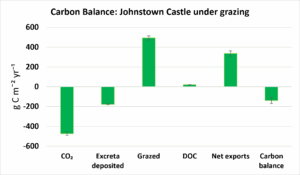
Figure 2. The carbon balance from a one-year study in Teagasc, Johnstown Castle under a dairy cow grazing regime operated at 3.2 livestock units per hectare. Positive values represent carbon emissions, negative values represent carbon uptake. The carbon balance includes carbon dioxide (CO2) measurements, carbon imports from animal excreta, carbon exports from biomass grazed and dissolved organic carbon (DOC). The sum of these imports and exports represents the net carbon export. The carbon balance is the difference between CO2 measurements and net carbon exports.
Recommendations for enhancing net carbon sequestration on livestock pastoral systems
| Measure to increase carbon sequestration | Sequestration potential |
| Avoid soil compaction | ✓ |
| Increase the proportion of grazing | ✓ to ✓✓ |
| Allow existing hedgerows to be taller and wider | ✓ to ✓✓ |
| Improve soil fertility | ✓✓ |
| Establish clover/multi species swards | ✓✓ |
| Planting extra hedgerows | ✓✓ |
| Slurry applications | ✓✓ |
Compiled and edited by Mark McGee and Paul Crosson, Teagasc, Grange Animal & Grassland Research and Innovation Centre, and first published in BEEF2026 – Driving Sustainable Performance, additional reading from BEEF2026 is available here.