
Using AgNav to review the performance of the Future Beef suckler demonstration farms


Summary
- Progress has been made on Future Beef farms to adopt technologies to reduce greenhouse gas emissions.
- NBPT protected urea made up 78% of the chemical nitrogen fertiliser applied on these farms in 2025.
- The Replacement Index for these suckler cow herds is on average €127 and 77% of heifers are calving at 22-26 months of age.
- Sign up to Signpost Advisory and AgNav to view the emissions and technology adoption figures for your farm.
Demonstration farmers are signed up to the Signpost Advisory Programme and AgNav.
AgNav is a digital sustainability platform that helps Irish farmers measure, understand, and reduce their farms environmental impact by tracking emissions and guiding sustainability improvements. These farmers use AgNav to review their progress in adopting emissions-reducing technologies and to track their farm emissions metrics. To commence this monitoring, demonstration farmers needed to complete their Bord Bia Sustainability Survey. This is the survey that all ‘quality assured’ livestock farmers complete for their Bord Bia audits every 18 months, although farmers also have the option of submitting it in non-audit years. This survey forms the basis of the information in AgNav. It is important to ensure that the survey is completed accurately, as the value of the information coming out of AgNav is only as good as the data entered.
Farm performance
Stocking rate and beef output
In the first year, average stocking rate increased by 14% on these farms, and has remained unchanged since (Table 1). There was a high level of technical performance on the Signpost suckler farms with an average beef live weight output of 635 kg/hectare (ha) in 2025. For comparison, according to the Teagasc Profit Monitor, the average beef liveweight output on beef farms nationally was 581 kg/ha in 2024.
Lime
Applying lime to correct low soil pH, will release nitrogen from the soil thereby reducing the need to apply inorganic nitrogen fertiliser. The Signpost farms were extensively soil sampled in late 2021 and early 2022, and again in 2023/2024. The farmers have used the results to target lime applications to increase soil pH. Forty percent of soils on these suckler farms were optimum for pH (6.5+) in 2024. Nationally, just 13% of soils on drystock farms have a pH of 6.5 or greater.
Soil fertility
On Signpost cattle farms, 23% of all soils sampled were optimum for pH, phosphorus (P) and potassium (K). This compares with a national average on drystock farms of 15%.
Low emissions slurry spreading (LESS)
In 2025, 99% of the slurry produced on Signpost cattle farms was spread using LESS (Table 1). Furthermore, 58% of all slurry was spread during the spring, optimising its nitrogen value. In a recent EPA report, the use of this technology was credited with making a significant impact in reducing agricultural ammonia emissions.
Clover
Fourteen Signpost cattle farms were ‘clover-scored’ to establish the white and red clover content in the grazing and silage swards, respectively. On average, 31% of swards assessed had medium (20-30%) or high (30+%) clover content. Ten of the 16 demonstration farmers incorporated on average 5.4 hectares of grass-red clover for silage production.
Nitrogen fertiliser use
Average chemical nitrogen fertiliser use across these suckler beef farms was 110 kg N/hectare in 2025 (Table 1). Progress was made in reducing chemical nitrogen use through 2022 and 2023, but inputs increased again in 2024 and 2025. This can be attributed to 2024 being a difficult grass-growing year and the subsequent necessity to build silage stocks in 2025.
Protected urea
Seventy-eight percent of chemical nitrogen fertiliser applied was in the form of NBPT protected urea (urea nitrogen fertiliser with a urease inhibitor – NBPT – added) (Table 1). Significant progress has been made on these farms to increase NBPT protected urea use over the past five years, such that the proportion of total chemical nitrogen applied as protected urea has almost doubled.
Genetics & breeding
Progress has been made by the demonstration suckler farmers to improve the beef genetics on their farm and improve breeding performance. The Replacement Index of the breeding herd increased from €106 to €127 between 2021 and 2025, while the percentage of heifers calving at 22-26 months has increased from 71% to 77% (Table 1). Nationally, just 19% of suckler heifers are calving at 22-26 months. Demonstration farmers are producing 0.94 calves per cow per year, compared to a national average of 0.85 calves per cow per year.
Age at finish
Age at finish on these demonstration farms was already very good at the start of the programme (Table 1). In 2025, heifers were finished at 22.3 months, compared to the national average of 27.3 months, and steers were finished at 24.3 months, considerably lower than the national average of 28.5 months of age. Likewise young suckler bulls finished over 3 months earlier (15.5 months) on these demonstration farms compared to the national average. This progress has been achieved through a combination of better breeding, better grassland management and improved health planning.
Biodiversity
Demonstration farmers have increased the level of biodiversity on their farms. This has been achieved by planting on average 232 metres of hedgerow, creating 1,374 metres of new margins as well as planting 46 trees.
Table 1. Performance of Signpost cattle farms over five years
| Metric | 2021 | 2022 | 2023 | 2024 | 2025 |
| Number of farms | 16 | 16 | 16 | 16 | 16 |
| Hectares farmed | 53.4 | 47.9 | 49.4 | 50.1 | 50.8 |
| Stocking rate (LU/hectare, ha) | 1.55 | 1.77 | 1.75 | 1.78 | 1.79 |
| Beef output (kg live weight/ha) | 651 | 676 | 635 | ||
| Slurry spread using LESS (%) | 46 | 88 | 94 | 99 | 99 |
| Chemical nitrogen fertiliser applied (kg/ ha) | 106 | 96 | 90 | 105 | 110 |
| Total chemical nitrogen as protected urea (%) | 41 | 51 | 73 | 75 | 78 |
| Replacement Index (€) | 106 | – | 118 | 123 | 127 |
| Calves per cow per year | 0.92 | 0.92 | 0.96 | 0.95 | 0.94 |
| Heifers calved at 22-to-26 months (%) | 71 | 64 | 82 | – | 77 |
| Days at grass | 239 | 224 | 228 | 233 | 241 |
| Age at finish (suckler animals) (months) | |||||
| Heifers | 22.3 | 22 | 22.1 | 22.4 | 22.3 |
| Steers | 23.5 | 22.5 | 23.2 | 23.2 | 24.3 |
| Bulls | 15.3 | 15.3 | 15.4 | 15.3 | 15.5 |
Gaseous emissions on Signpost Future Beef suckler farms
Total greenhouse gas (GHG) emissions in 2025 for the Signpost cattle farms was 306 tonnes CO2 equivalents (CO2e) per farm, corresponding to an emissions per ha of 6.09 tonnes CO2e (Figure 1). The carbon footprint for these farms was 11.2 kg CO2e / kg LW gain in 2025, compared to 11.6 kg CO2e / kg LW gain in 2021. This metric is an indicator of the efficiency of production and compares well to the national figure of 11.9 kg CO2e / kg LW gain (AgNav, 2025).
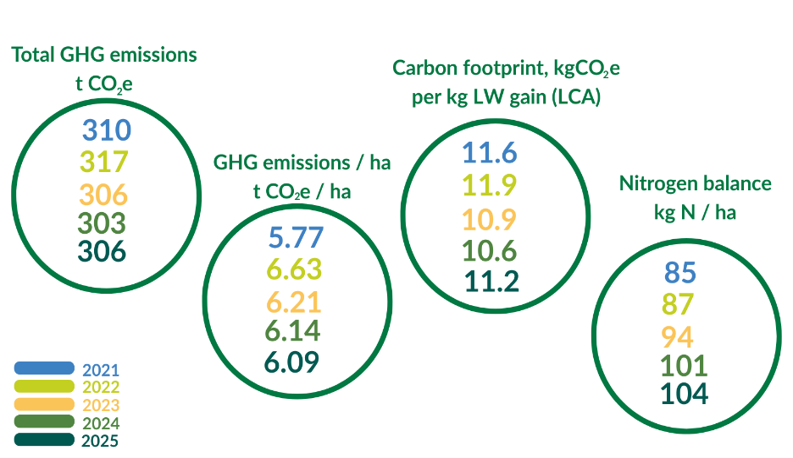
Figure 1. Greenhouse gas emissions and nitrogen balance for Signpost suckler farms (2021-2025).
Soil carbon sequestration
In AgNav, farmers have the option to fill out a short soil carbon survey, which requires information on their farm’s land area, soil types, and land use types. Once completed, AgNav can calculate the amount of carbon sequestered in the soil and offset his farm’s carbon emissions by that amount.
Ruairi Cummins, Signpost Future Beef demonstration farmer from south Kilkenny had total greenhouse gas emissions of 222 tonnes CO2e for 2025. A soil survey was completed for Ruairi in AgNav based on his land area, soil type and land use. AgNav calculated that 15.3 tonnes CO2 eq. was sequestered on his farm in 2025, offsetting his total emissions by almost 7% and reducing his carbon footprint from 10.59 to 9.98 kg CO2 eq./kg LW gain. In the future, AgNav is expected to expand its capabilities to include above-ground carbon sequestration, such as forestry. This could be beneficial under potential carbon farming programmes.
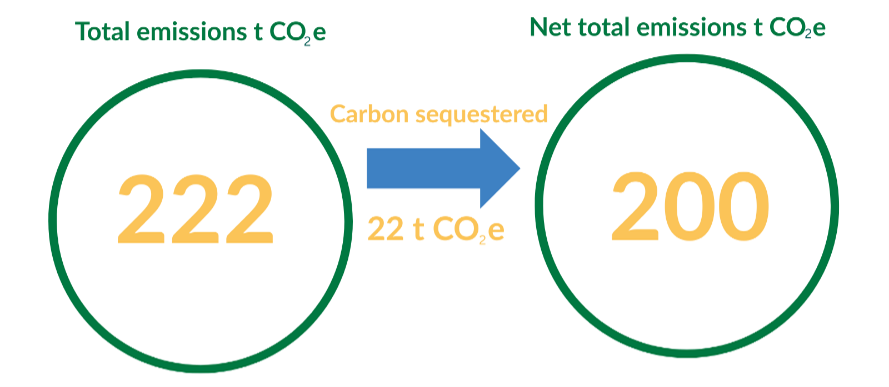
Figure 2. Net total emissions on the farm of Ruairi Cummins in 2025
Recommendations
- Sign up for the Signpost Advisory Programme
- Benchmark (or measure) your farm’s environmental sustainability using AgNav and with the assistance of your Teagasc Advisor. Beef farmers do not need to register for AgNav, as access is available at agnav.ie, using your ICBF login details.
- Understand your farm’s GHG emissions profile and nitrogen balance.
- Identify areas for improvement.
- Make a plan and take the first steps to reducing the impact of your farming activities on the environment.
Compiled and edited by Mark McGee and Paul Crosson, Teagasc, Grange Animal & Grassland Research and Innovation Centre, and first published in BEEF2026 – Driving Sustainable Performance, additional reading from BEEF2026 is available here.