
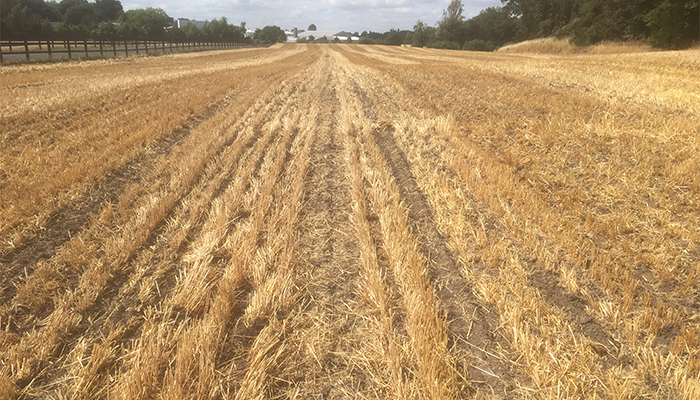
This week’s broken weather has brought a lull in harvest 2025 activity. Now’s a good time to refresh on the regulations pertaining to stubble cultivation and glyphosate use.
As part of this month’s Teagasc Tillage Advisory newsletter, Tillage Specialist at Teagasc, Ciaran Collins shared key information on stubble cultivation and glyphosate label changes.
Stubble cultivation
The Nitrates Directive is designed to prevent pollution of surface waters and groundwater from agricultural sources, and to protect and improve water quality. As part of the Nitrates Directive, tillage farmers are now required to take measures to establish green cover as soon as possible post harvest to prevent the pollution of waters caused by nitrates.
Shallow cultivation or sowing of a crop/catch crop must take place within 10 days of the baling of straw or, where straw is chopped, within 10 days of harvest. In all circumstances, shallow cultivation or sowing of a crop/catch crop must take place within 14 days of harvesting.
Shallow cultivation is not required where land is destined for winter combinable crops, which are sown before October 31.
Shallow cultivation is only applicable to counties: Carlow; Cork; Dublin; Kildare; Kilkenny; Laois; Louth; Meath; Offaly; Tipperary; Waterford; Westmeath; Wexford; and Wicklow. Where shallow cultivation is required, a minimum of 20% and a maximum of 25% of cereal land must not be subject to shallow cultivation after harvest – to provide a winter foraging habitat for seed-eating birds and mammals. However, it is allowable to have less than 20-25% retained stubble due to winter crops or catch crops.
More from Teagasc Daily: In pictures: Catch crop options
Glyphosate label changes
Glyphosate can no longer be used for harvest management. This applies to all crops, including oilseed rape. This was one of the key changes when glyphosate was reregistered last year.
Summary of main changes (rates based on 360g/L product):
- Pre-harvest application on beans not allowed in any circumstances,
- Use for harvest management of oilseed rape not allowed – now only to be used as weed control, same as cereals,
- Pre-harvest weed control only allowed when cereal crop is >BBCH 87 and grain/seed moisture <30%,
- Grassland destruction maximum rate now 4L/ha, was 6L/ha,
- Post planting and pre-crop emergence – maximum rate now 1.33L,
- Maximum rate for non-crop areas now 5L/ha, was 6L/ha.