
Building more resilient farming systems at Johnstown Castle
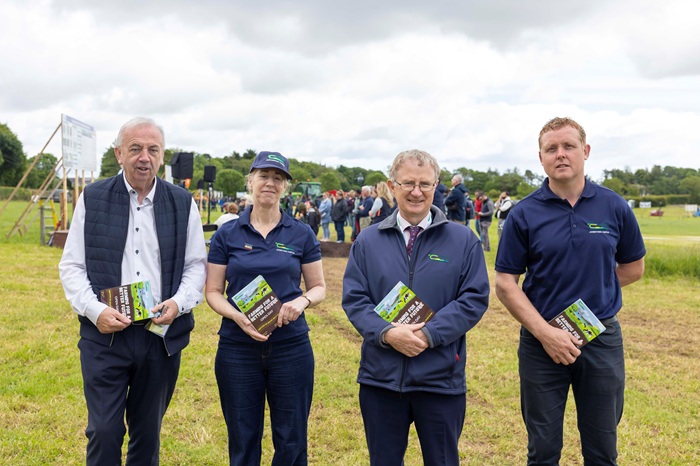
Attendees at today’s Farming for a Better Future Open Day, hosted in Teagasc, Johnstown Castle, Co. Wexford, were made aware of the numerous challenges along with the opportunities available to build more resilient farming systems.
“Competitiveness and resilience are critical to the future of our farming system and agri-food industry and both healthy soils and clean water are necessary building blocks for sustainable farm systems,” Professor Frank O’Mara, Director of Teagasc said from the event which centred on the themes of innovating for healthy soils and clean water
“The latest research and innovation that Teagasc has to offer is on display today,” Professor O’Mara added. Showcased at the event were actions and measures to encourage farmers to protect soil health and water quality. Existing technologies for reducing gaseous emissions, protecting biodiversity and building carbon were demonstrated at the event.
Displays on grassland management in dairy, dairy-beef and organic systems were also present, providing practical demonstrations and tips for maximising productivity and remaining sustainable, and new technologies for slurry and manure management were demonstrated.
“Teagasc strives to be a global leader in innovating for sustainable farm systems, and our research is constantly developing new information that we translate into actions that will improve the sustainability of the sector in Ireland,” Professor O’Mara added.
Challenges and co-benefits
The challenges facing the farming sector were discussed by Dr. David Wall, Head of Enterprise at Teagasc Johnstown Castle, who said: “Farmers face challenges such as rising costs, climate, volatile markets and changing policy demands and today’s event is an opportunity to look at how we can build more resilience into farm systems to deal with these pressures.’’
As to the potential outcomes from implementing some of the technologies displayed at the event, Dr. Karen Daly, Head of the Teagasc Environment, Soils and Land Use Department, said: “Many of the actions on display here today will have co-benefits for water, soils, gaseous emissions and biodiversity and we really encourage farmers to take one or two actions from today’s event that they can One action with multiple benefits”
There are many technologies that farmers can adopt that will have multiple benefits:
- Liming soils to optimise soil pH is an example of a technology that improves nutrient cycling, crop growth, soil health and reduces gaseous emissions.
- Well managed healthy soils have multiple benefits, not just for production, but for water quality, biodiversity and reducing gaseous emission.
- Avoiding compaction in soil supports good crop yields, leaves air space for microbes and bacteria, allows water infiltration and reduces runoff risk to protect water quality. adopt on their farm system.
Local knowledge is key to building resilience
The event emphasised the importance of local knowledge of soils and water quality with ‘Know your Soils’ signposted as a key message at the soil health stop along the route, and knowledge and awareness of local water quality as one of the objectives and messages from the water quality stop at the open day.
Knowledge of local water quality is essential for farmers in a catchment to select the right measure to protect water quality in their local rivers and streams.
Soils are one of the most important resources around farms, local knowledge of soils is the first step to good soil management and getting to know what soils you have on your farm and where they are located is a good guide to planning how to manage them. Looking for visual clues in soils such as texture; clay, sand and silt are good indicators of soil drainage and organic matter that help avoid compaction and store carbon.
All of the information presented at the Farming for a Better Future event is available here.
Photo caption: Pictured at the open day at the Teagasc Environment, Soils and Land Use Research Centre, Johnstown Castle, County. Wexford, on Wednesday, 10th June, were (left to right): Professor Pat Dillon, Director of Research, Teagasc; Dr Karen Daly, Head of Department, Environment, Soils and Land Use, Teagasc Johnstown Castle Research Centre; Professor Frank O’Mara, Director, Teagasc, and Dr David Wall, Head of Enterprise, Crops, Environment and Land-Use Research Programme, Teagasc, Johnstown Castle, Research Centre.
More from Teagasc Daily: Farming for Soil Health: Assess your soil health
More from Teagasc Daily: Understanding how nitrogen management affects climate and water quality
More from Teagasc Daily: The latest from Johnstown Castle on calf rearing