
Enhancing biodiversity and productivity on an intensive farm
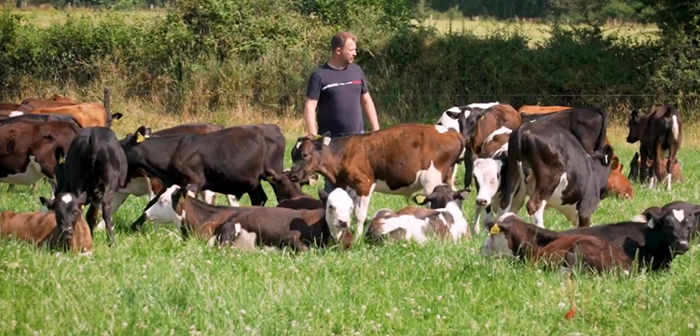
Demonstrating how biodiversity enhancement, new biodiversity measures and precision technology can enhance wildlife and water quality while supporting a productive farm, Siobhán Kavanagh & Aoife Leader tell us more about award-winning dairy-beef farmers, Peter and Thomas O’Hanrahan.
Biodiversity enhancement, which involves improving the quantity and quality of flora, fauna and wildlife habitats on a farm, can often be viewed as being at odds with farm productivity. However, Thomas and Peter O’Hanrahan, winners of the Enhancing Biodiversity Category at the Teagasc FBD Environmental Sustainability Awards 2026, demonstrate how biodiversity enhancement can be successfully integrated into a productive dairy-beef enterprise.
The farm system – balancing production with performance
Peter and Thomas purchase approximately 200 calves each year from local dairy farmers, selecting stock based on Commercial Beef Value (CBV) to ensure genetic merit.
Currently, all cattle are slaughtered between 23 and 25 months, with a target to reduce slaughter age below 24 months for all animals.
In 2025, they operated at a stocking rate of 2.43 LU/ha (191kg organic N/ha) with a gross output 1,221kg/ha and 503kg / LU and a gross margin of €4,499 / ha.
A key strength of the O’Hanrahan farm is how this production performance is balanced with biodiversity enhancement.
Their Space for Nature figure, which represents the proportion of the farm dedicated to non-productive areas and landscape features, is currently 16.7%.
On the O’Hanrahan farm, habitats include groves of trees, hedgerows, watercourses, riparian zones and margins. It was Peter and Thomas’ strategic and practical approach to retaining existing habitats, enhancing their quality and creating new biodiversity features, that stood out to the judges.
For more on the measures being implemented and Peter and Thomas O’Hanrahans’ farm, watch the video below:
Improving the quality of habitats
Peter and Thomas place a particular focus on improving the quality and connectivity of their hedgerows. Peter and Thomas work closely with their contractor to ensure that management retains hedge height, density and flowering potential, supporting wildlife while also delivering other important benefits such as protection from wind, rain and heat stress for livestock.
Peter and Thomas have also carried out hedge enhancement through coppicing, where appropriate, with these targeted hedges now developing into taller and denser features that will benefit both wildlife and farm productivity.
To complement the enhancement of existing hedges, Peter and Thomas have also planted 500 metres of new native hedgerow. Strategically located to subdivide a large field, this new hedge strengthens habitat connectivity across the farm.
As it matures, this hedge will further enhance biodiversity, contribute to carbon sequestration, and provide additional shelter and shade for livestock.
Together, the retention, enhancement and creation of hedgerows demonstrate a clear commitment to integrating biodiversity into the everyday management of the farm.
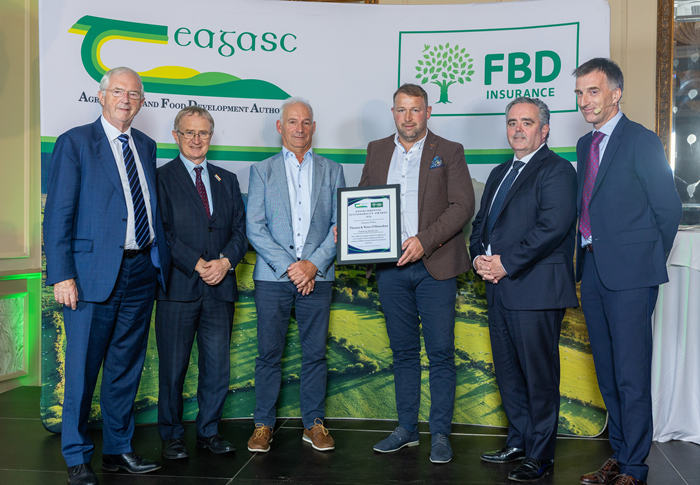
Pictured (from left to right): Michael Berkery, Chair of FBD Trust; Professor Frank O’Mara, Director of Teagasc; Thomas and Peter O’Hanrahan, winners of the Enhancing Biodiversity Category at the Teagasc FBD Environmental Sustainability Awards 2026; Tomás Ó Midheach, Chief Executive Officer of FBD; and Tom O’Dwyer, Head of Climate and Biodiversity, Knowledge Transfer, Teagasc.
Protecting and enhancing watercourse habitats
While hedges are a key feature of the farm’s biodiversity network, Peter and Thomas have also focused on protecting and enhancing watercourse habitats.
By making effective use of agri-environment schemes, they have established grassland and arable riparian buffer zones and implemented the ACRES intensive grassland management adjacent to a watercourse measure across just over 12 hectares, helping to protect water quality and support biodiversity. By locating these measures in strategic areas of the farm, they have provided a resource for wildlife while also protecting and improving water quality.
Technology uptake and practical management approaches
Thomas and Peter have also adopted technologies and management approaches that support both production goals and biodiversity. Their investment in GPS guided fertiliser application technology in recent years has delivered multiple benefits, improving nutrient-use efficiency and minimising waste. It also ensures fertiliser is applied more accurately, reducing the risk of nutrients entering hedgerows, tree groves and watercourses, and thereby protecting valuable habitats and water quality.
Another example of how practical management approaches can deliver benefits for both productivity and biodiversity are the wide grassy tracks found on the farm. Although established primarily for livestock movement, these three to five-metre-wide grassy strips receive no fertiliser or pesticide applications and experience minimal traffic. This has allowed them to develop greater diversity than the surrounding grazing paddocks and serve as wildlife corridors while also facilitating the efficient movement of cattle and reducing labour demands.
As DairyBeef 500 demonstration farmers and active participants in both the Signpost Programme and ACRES, Peter and Thomas are committed to the continuous improvement of their environmental and productive efficiency.
Future plans include further reducing slaughter age, increasing clover incorporation, introducing rainwater harvesting systems and installing solar PV.
The O’Hanrahans also have a clear vision for further biodiversity enhancement, with plans to establish an additional 1,500 metres of native hedgerow in strategically identified locations that will further improve habitat connectivity across the farm. Their willingness to continually improve demonstrates how productive farming and biodiversity enhancement can go hand in hand.
Gordon Peppard is the DairyBeef500 programme advisor while Matt Murphy is the local Teagasc advisor to Peter and Thomas O’Hanrahan.
For more on the Teagasc FBD Environmental Sustainability Awards 2026, visit here.
For more from the Teagasc Signpost Programme, visit here.
Also read: The winning balance – why William Dennehy’s farm stood out