
Hedgerows and our heritage
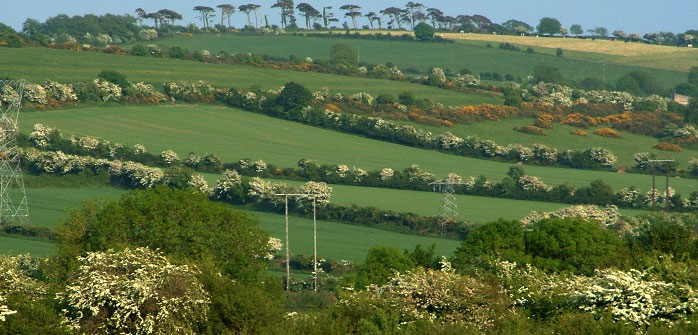
To celebrate National Hedgerow Week 2026, a partnership between the Heritage Council and Teagasc, we examine how hedgerows are more than field boundaries are interwoven with Ireland’s heritage.
The native hedgerow is one of the more iconic features of Ireland. Found on almost every rural road and farmland, a patchwork quilt landscape of fields bordered by hedgerows is a familiar sight here.
Ireland (and Britain) are unique in this heritage; hedgerows are very unusual in mainland Europe and beyond. Hedgerows evoke history and folklore: references to the Táin, booleying of cattle, estates and landlords, hedge schools, fairy bushes and more.
Most hedgerows were planted between 1750 and 1850 but woven through this landscape tapestry are older hedgerows which date from Gaelic Ireland, in the age before colonisation by England. These ‘ancient’ hedgerows would have developed on top of banks, such as raths, which were dug to mark townland boundaries and to provide an additional barrier to hostile forces.
There is lots of fascinating history and folklore related to these old hedgerows, some of which has been carried through to today. The whitethorn, which in fact is still the mainstay of our hedgerows, was associated with spring and marriage. It was widely regarded as a sacred tree in ancient times and, even to this day, it is considered unlucky to cut down the ‘lone thorn’, May or fairy bush or sceach.
The hazel was regarded as the tree of knowledge and the nuts were especially sought after as the repository of ancient wisdom.
Holly protected people during the dark winter months, while crab apple was symbolic of the giving of love. These ancient hedgerows are vital to keep identifying and protecting.
As noted above, much of Ireland’s hedgerow landscape as we know it today was established between 1750 and 1850. English landowners in Ireland were obliged by law to erect “fences”, as in England, to “enclose” former commonage and form fields. This led to our hedgerow landscape but was unpopular with the small Irish tenant farmers because it deprived them of the use of common land on which they had traditional grazing rights. Ultimately, enclosure increased poverty for the Irish.
Today, agriculture still uses hedgerows to contain and demarcate its various activities (a thick, thorny hedge will equally serve the same purpose today), and we carry through much of the folklore related to ancient hedgerows. They are a core part of our heritage.
Sadly, most recent figures by the Environment Protection Agency estimate that around 1,400km of hedgerows are being removed each year. This is a loss not just for biodiversity and climate, but for our cultural and historical heritage.
We need to take responsibility for protecting our wonderful heritage. Much is already being done from organisations including Teagasc, the Heritage Council, Hedgerows Ireland, Biodiversity Officers and the National Biodiversity Data Centre to raise public awareness and highlight the significant role hedgerows play in Ireland’s biodiversity and heritage. National Hedgerow Week each year also puts a positive spotlight on hedgerows.
The above was published as part of National Hedgerow Week 2026, a partnership between the Heritage Council and Teagasc.
Click here for more information on National Hedgerow Week 2026.
More from Teagasc Daily: Hedgerows – a lifeline for birds and insects
More from Teagasc Daily: Maintaining and improving water quality and mitigating climate change – the role of hedge rows