
‘Irish farmers make an important contribution to food and nutrition security’
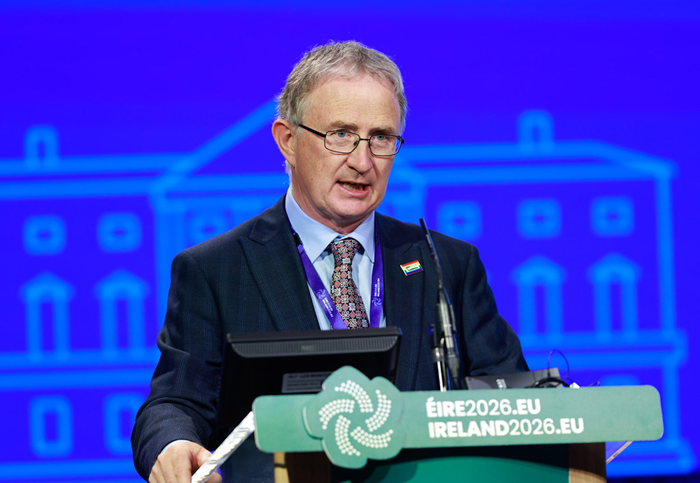
When combined, Irish dairy, tillage, cattle and sheep farmers produce enough protein to meet the requirements of approximately 30 million people, according to Director of Teagasc, Professor Frank O’Mara.
Addressing the Interparliamentary Conference on Securing the Future of Farming, from Policy to Practice earlier this summer, Professor O’Mara highlighted the important role Irish farmers play in food production, not only nationally but also at a European and global level.
Presenting data based on National Farm Survey data and compiled by Teagasc colleagues, Professor O’Mara noted that, for every hectare farmed, dairy, tillage, cattle and sheep enterprises have the capacity to meet the protein requirements of 15.5, 13.6, 3.8 and 2.8 people, respectively.
“These figures take into account the human edible protein that may be fed to animals within these enterprises, so they represent net figures. When aggregated, they show that Irish land-based farming produces enough protein to meet the requirements of approximately 30 million people, which is a very significant contribution,” Professor O’Mara explained.
For further details on this study, read: Associating climate change mitigation with protein security
Despite the significant contribution to nutrition security, Professor O’Mara told the gathered assembly that many Irish farmers are challenged by low incomes and income volatility.
“In relation to food security, Ireland is highly self-sufficient in most meats, except poultry, and is also very sufficient in dairy products,” Professor O’Mara explained, but the primary challenge facing the producers of these produces are low incomes and income volatility.
Highlighting some of the volatility witnessed, Professor O’Mara used the example of dairy, a sector which experienced a very good year in 2025 but a sector where farm incomes are forecast to halve in 2026.
“Farmers with low incomes, which are the majority of our farmers, have a high dependency on the Common Agricultural Policy payments.
“On average, last year, payments from the Common Agricultural Policy made up 40% of Family Farm Income. That’s lower than previous and we have seen years where that is up as high as 80-90% of Family Farm Income, thus illustrating the real importance of the Common Agricultural Policy to our farmers.”
While Ireland is a major producer of meat and dairy, it remains heavily reliant on imports of fruit and vegetables, with self-sufficiency below 30% for some products including tomatoes, onions and apples. Professor O’Mara noted that the increasing concentration of food production among a small number of excellent and efficient large growers could pose a risk to the resilience of Ireland’s food system. He noted that although Ireland produces most of its own carrots, more than 90% of production comes from just 9 or ten growers, while three producers account for the vast majority of Irish grown onions.
For further details, Professor O’Mara’s full presentation to the Interparliamentary Conference on Agriculture is available to view in the below video:
More from Teagasc Daily: Women in Agriculture: 80% of farm successors are male
Featured image source source: PARLEU2026.ie