
Lime plan delivers an extra 80t of grass on a Limerick dairy farm

Siobhán Kavanagh, Teagasc Signpost, and John Maher, Teagasc Grass10, visit John Leahy in Co. Limerick to see how taking every opportunity to apply lime has delivered additional grass and a reduced fertiliser bill.
John Leahy had an average soil pH of 5.5 on his 40ha dairy farm, with some fields as low as pH 4.7. Over five years, and with most of the progress made in the first three years, John shifted the farm pH to 6.2 on average and produced an extra 80 t DM grass, valued at almost €13,800.
John Leahy runs a 120-cow dairy farm in Athea, Co. Limerick. The land is quite heavy and that, combined with a high rainfall area, made building soil pH more challenging.
John first realised something was wrong when he drained and reseeded a field, only for it to continue performing poorly and failed to respond to fertiliser.
That’s when he started doing soil samples on an annual basis. Soil sampling every year in November/December has allowed John to prioritise the paddocks needing liming and to track progress.
Taking every opportunity
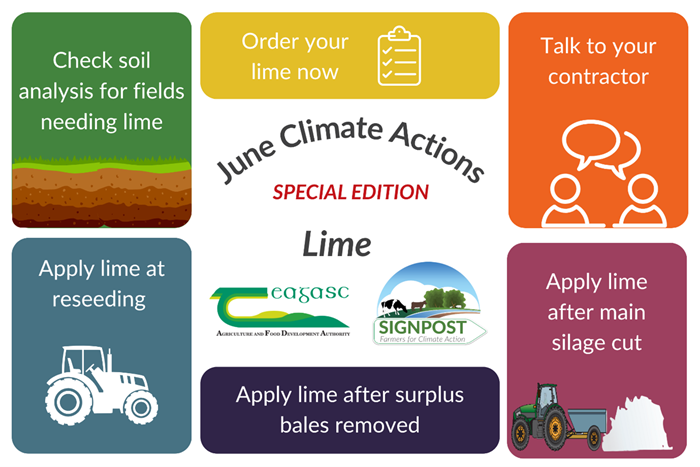
John took advantage of all seasons to get out lime. He had the lime in the yard to take advantage of every opportunity right throughout the year – Spring, Summer and Autumn.
In Spring, he applied lime on well grazed paddocks in April. He applied lime after surplus bales are removed in late Spring and during the summer. Rather than letting a field on his priority list be topped, he let it up for bales and was able to come in with lime afterwards.
“After bales, you should be able to come in with the lime spreader and top up fields that need extra lime.”
Lime was applied after the main silage cuts, when reseeding and when closing up paddocks in the autumn.
Basically, John took advantage of every opportunity to get out lime – after grazing, after surplus bales, after main cut silage and at reseeding. He didn’t wait until the Autumn to apply all his lime; if the weather came bad, he just wouldn’t get it out and another year would have passed without making progress on soil pH.
Lime applications
John applied 120 tonnes of lime on average per year over five years or a total of 500 tonnes, applying 2.5-3.0 tonnes of ground limestone per acre. The 3 tonne per application is a lot and it can make ground soft, but John knew what he was doing. Working off the soil analysis, he could apply higher rates on very low pH soils. He has, on occasion, applied up to 5 tonnes per acre. This, however, was only done on paddocks with a very low pH and only when reseeding, where he could plough it in and dilute it over 5-6 inches of soil.
John found it easier in the early years to make progress. Much of the farm was below optimum. As time move on, it required more organisation to ensure he got lime applied to the low pH fields. It was then that the ‘list’ and the plan became really important.
Costs and benefits
The lime cost John €3,000 per year over 40ha including spreading, or just 10% of his total fertiliser and lime spend each year. He grew an extra 2.5 tonnes per hectare or utilised an extra 2 tonnes per ha.
Over 40ha, that’s 80t DM, worth €13,800. This value is coming from the 70kg of N/ha being released or made available because of applying lime, the chemical N saving, the increased availability of the P and K and the increased grass growth.
Because of improving soil pH, John has gone from 27 units of N every round to 20 units of N every round. The improved soil pH means he doesn’t need P and K every round and can use straight N in the form of NBPT protected urea.
“Grass growth turned around on the farm, even in the absence of reseeding. Grass has a healthier appearance and responds much quicker to nitrogen fertiliser application.
“I think it has also improved the drainage on the heavier soils on the farm. It has made the soil more trafficable, particularly during bad grazing conditions. Animals clean out the swards much better, an additional benefit from lime application,” John Leahy explained.
Applying lime has been a win-win on this farm – growing more grass from lime application is good for the bottom line on the farm but also good from an emissions and water quality perspective.
For a relatively small spend, a large financial return is achieved over time. Once the target pH is reached, about €15/acre/year will go a long way towards keeping the farm at the right lime status.
The above first appeared in the Farming Independent as part of a Signpost Programme update.
Find out more about the Teagasc Signpost Programme here.
More from Teagasc Daily: Measuring what matters – Using AgNav to boost profit and cut emissions
More from Teagasc Daily: ‘A no brainer’ – Brian Nicholson’s agroforestry journey