
Measuring What Matters: Using AgNav to Boost Profit and Cut Emissions
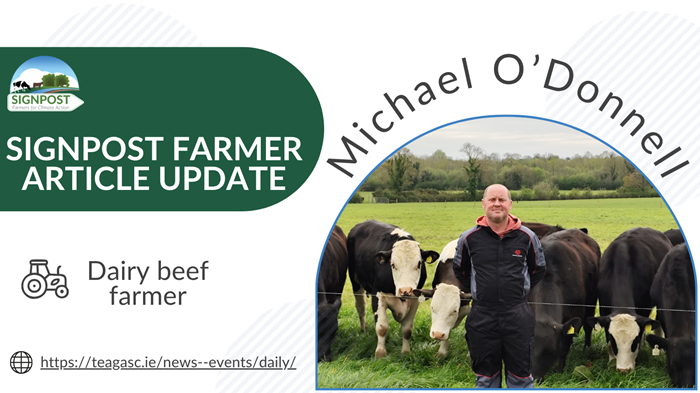
Michael O’Donnell, a farmer in the Dairy Beef500 Programme from Clerihan, Clonmel, Co. Tipperary, was out of the traps early this year to update his farm’s AgNav. Leonard Betts and Sarah McPherson, Teagasc, outline some of the result benefits.
AgNav is a free digital sustainability platform developed by Teagasc, Bord Bia and ICBF, with support from the Department of Agriculture, Food and the Marine (DAFM), that helps Irish farmers measure, understand and improve their farm’s sustainability.
Like Profit Monitor, Michael finds it useful to update AgNav early in the year so he can assess how his farm has performed the previous year and to make a plan for the year ahead.
To have the previous production year’s figures shown on AgNav, Michael needed to complete his Bord Bia Sustainability Survey. This is the survey that all Quality Assured livestock farmers complete for their Bord Bia audits every 18 months, although farmers also have the option of submitting it in non-audit years. This survey forms the basis of the information in AgNav. While many view it with dread, farmers like Michael see the value in completing it to help him assess their farm. He takes great care to complete it accurately, knowing that the value of the information coming out of AgNav is only as good as the data entered.
In the video below, Michael O’Donnell explains how AgNav is helping him make decisions on his farm:
Useful metrics
On AgNav’s Forecaster page, in addition to his farm’s sustainability metrics, Michael can also see many production metrics that impact profitability. These include stocking rate, beef output, age at finish, days at grass, concentrate usage and fertiliser use, including protected urea and lime. Having this information in the one place allows Michael to evaluate performance and make informed decisions for 2026.
Fertiliser choice
In 2025, Michael’s farm produced 384 tonnes CO2 eq. and 8.8 kg CO2 eq./ kg LW gain. He used 100% NBPT protected urea and low-emitting 18-6-12 fertiliser. Protected urea was cheaper than CAN in 2025 so in addition to lowering his emissions, Michael also saved money, although 2026 prices are slightly different. He has had no issues using protected urea and finds it performs well.
Age at finish
Age at finish is an important metric for profitability and reducing emissions. According to AgNav data, Michael finished steers at 21.5 months and heifers at 22 months in 2025. This reduces his total emissions by at least 10%, compared to the national average finishing age of 26.5 months. Michael is a big believer in finishing animals as young as possible without compromising carcass weight.
Priorities for the year ahead
After reviewing his AgNav output and profit monitor for 2025, Michael worked closely with his local advisor, Sean Cooney, Teagasc, Clonmel and DairyBeef 500 Programme Advisor Gordon Peppard to identify priorities for 2026.
Michael currently operates at a stocking rate of 2.13 LU/ha and applies 101 kg chemical N/ha. There is limited scope to reduce this further. However, improving soil fertility through lime application would help support sustainability and grass growth on the farm, something that Michael is focussing on in 2026.
Higher Commercial Beef Value calves
He sources reared and vaccinated calves from his sister, Joan, and works closely with her on breeding decisions. They focus on selecting bulls with a high Dairy Beef Index (DBI), a good beef sub-index and good carcass weight traits whilst also ensuring Joan is satisfied with calving difficulty and gestation length. This helps produce higher Commercial Beef Value (CBV) calves with greater carcass weight potential. Buying good quality healthy well reared calves is helping to reduce his age at finish.
Animal performance
Improving animal performance over the first winter is another priority. This includes maintaining a good vaccination plan, feeding high quality silage with 1.5 to 2 kg concentrate. Protein levels are matched to silage protein levels to meet the protein requirements of growing animals. Ensuring adequate lying and feeding space for all animals in pen etc is also essential to support performance.
Carbon sequestered
In AgNav, Michael had the option to fill out a quick soil carbon survey, which required information on his farm’s land area, soil types and land use types. Once completed, AgNav calculated the amount of carbon sequestered in the soil and offset his farm’s carbon emissions by that amount.
AgNav calculated that 19.4 tonnes CO2 eq. was sequestered on his farm in 2025, offsetting his total emissions by 5% and reducing his carbon footprint from 8.8 to 8.5 kg CO2 eq./kg LW gain. In the future, AgNav is expected to expand its capabilities to include above-ground carbon sequestration, such as forestry. This could be beneficial under potential carbon farming programmes.
All the information in this article is taken from Michael’s AgNav account. Dairy and beef farmers can review their own figures by visiting www.agnav.ie, click ‘Login’ and enter their ICBF login details (email or herd number and password). Tillage farmers must register for AgNav, even if they already have a dairy and beef account, by selecting ‘Tillage Registration’ and following the steps provided. Talk to your local Teagasc Signpost advisor for assistance with this.
The above first appeared in the Farming Independent as part of a Signpost Programme update.
For more from the Teagasc Signpost Programme, visit here.
Related reading:
‘A no-brainer’: Brian Nicholson’s agroforestry journey
Driving farm profitability through effective nutrient management