
ICONICA
 Impact of long-term phosphorus additions on Carbon sequestration and Nitrogen Cycling in Agricultural soils
The EU Green Deal through the Farm to Fork and Biodiversity 2030 strategies aims to make Europe a climate-neutral continent by 2050 while ensuring food security. Achieving this objective will require the adoption of sustainable agricultural soil management practices. Management of agro-ecosystems to enhance both soil and subsoil organic carbon storage is a strategy for mitigating climate change by helping to stabilise atmospheric carbon dioxide concentration.
Long-term soil organic carbon (SOC) storage is dependent on many factors, especially the interactions with other nutrients. Soil phosphorus (P) is a key nutrient for crop growth and P limitation can reduce plant and soil microbial biomass affecting SOC sequestration. Soil P concentrations impact microbial composition and activities, which are predicted to control specific transformation pathways within the C and N cycles in soil. The effects of soil P concentrations on other soil processes are uncertain, particularly in relation to GHG emissions and N and C cycling.
Aims & Objectives
Across the world P fertilisation recommendations have been optimised for achieving agronomic targets such as maximising crop yield. Under the EU Farm to Fork strategy, fertiliser use will be reduced by 20% in order to reduce nutrient losses to water. The effect of reducing inputs of fertilisers containing P and the consequence of declining soil P fertility on soil C and N cycling and GHG emissions is unknown. The need for a soil specific understanding of the effects and fate of added P fertiliser to agricultural soils is critical for developing sustainable P fertilisation advice that considers both agronomic and environmental outcomes.
ICONICA aims to identify optimal P fertilisation:
- to underpin sustainable production
- to enhance nutrient efficiency
- for profitability
- for environmental sustainability
- for marketability of primary production giving farmers, land managers and society the necessary knowledge to manage their soils appropriately.
Overarching Aim
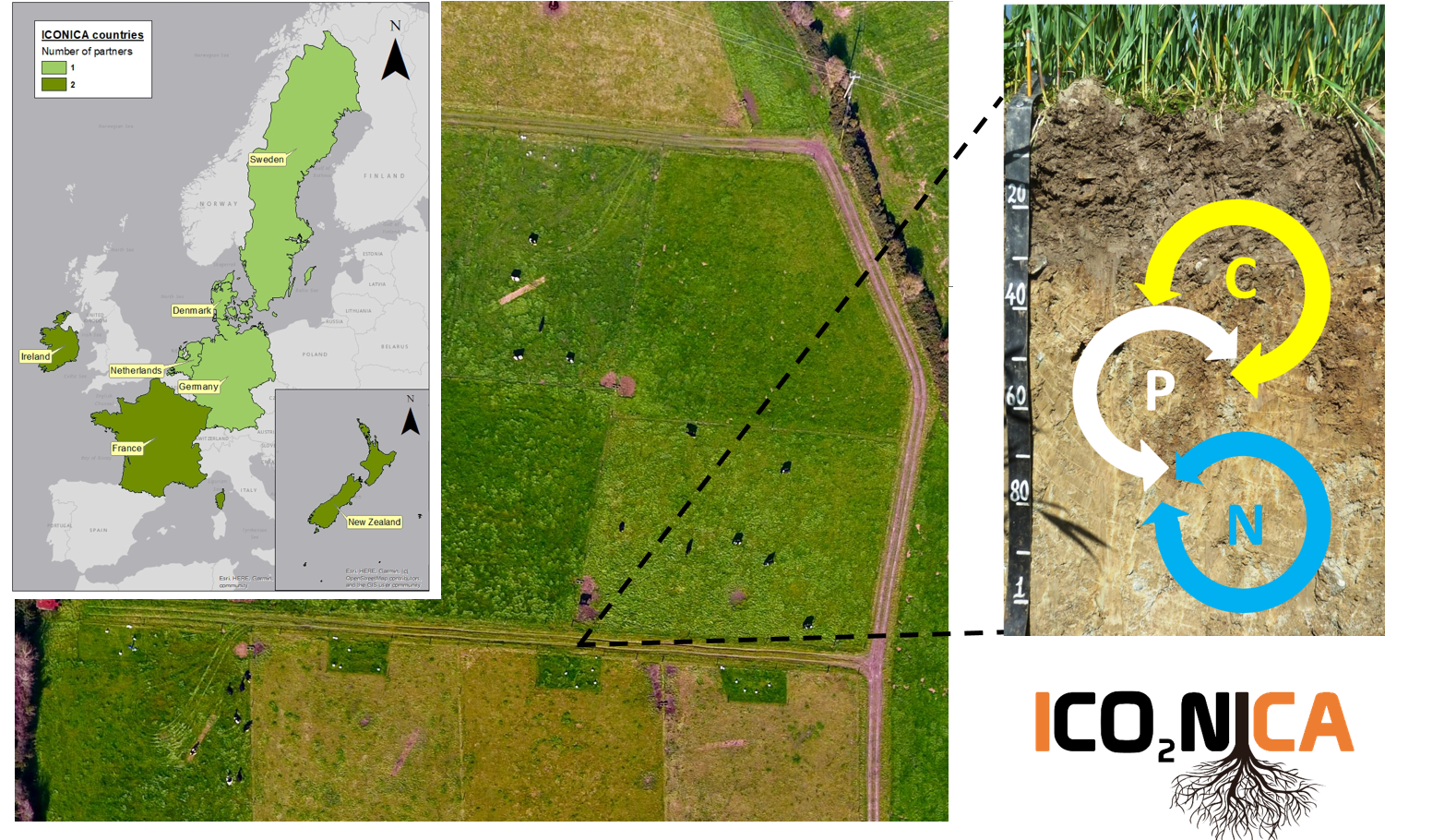
ICONICA will, for the first time, apply state-of-the-art research tools to identify optimal long-term P management practices on CNP cycling in grassland and arable soils. The project will combine soil CNP characterisation with soil biological characterisation, stable isotope tracing and modelling and soil microbial functioning. The data will be used to identify the optimal soil P level able to improve soil carbon sequestration and at the same time reduce GHGs maintaining optimum yields.
Specific objectives
ICONICA will employ a unique set of research experiments and bio-geochemical modelling across a range of soil P treatments, to establish the relationship between long-term P availability and
- soil C:N:P stoichiometry
- SOC stocks (SOC fractions, OM decomposability)
- microbiologically mediated gross nutrient transformations in grassland and arable soils.
Actions
The scientific research in ICONICA focuses on a unique set of long-term P fertiliser experiments in grassland and arable systems from across EU and New Zealand (NZ). These experiments have been running continuously for 25 to 85 years and avail of historical data such as soil nutrients, fertiliser inputs, and management data. Utilising these LTEs resources and modern scientific methodologies ICONICA will develop in-depth knowledge on C stabilization, C sequestration, C & N cycling and GHG emissions for grassland and arable agricultural systems under different pedo-climatic conditions.
Measurement and Modelling Approach
This multidisciplinary programme of research will consist of measurement and modelling approaches. Based on existing data, scenarios will be classified according to soil C:N:P stoichiometry to map the initial nutrient status. A suitable soil sampling strategy across the range of scenarios will ensure that the impact of P management on soil C sequestration and stabilization can be evaluated. We hypothesise that functional relationships to predict nutrient cycling and supply for grassland production can be derived as a function of the genetic potential of soil microbiota, C, N and P management, and pedo-climatic factors. These will be used to aid the development of soil nutrient advice.
Work Programmes
- WP1: Characterisation of C stocks across C:N:P stoichiometry senarios – Macroscale. Leader – Teagasc
- WP2: Understanding the role of long-term P management on the dynamic interactions of SOc and GHG emissions – Mesoscale. Leader – Lincoln University NZ
- WP 3: Quantifying impacts of long-term P management on microbiomes, microbial carbon use efficiency, C cycling and GHG emissions. – Microscale. Leader University of Otago, NZ
- WP4: Effect of long-term P management on agronomic yield and GHG emissions. – Field Scale. Leader – Teagasc
- WP5: Modelling the relationships between P management, soil fertility and GHG balance. Leader – Paris-Saclay University, France
- WP 6: Communication and Dissemination. Leader – Justus Liebig University, Giessen
- WP 7: Coordination and Management. Leader – Teagasc
Project Partners
Professor Timothy Clough, Lincoln University Lincoln, New Zealand
Dr Sergio Morales, University of Otago, New Zealand
Dr Naoise Nunan CNRS, France
Prof Christoph Müller, University College Dublin, Ireland
Dr Kristina Kleineidam, Justus Liebig University Germany
Dr Daniel Goll, University Paris Saclay, France
Dr Lars Elsgaard, Aarhus University, Denmark
Professor Anke Herrmann & Sabina Braun, Swedish University for Agricultural Sciences Sweden Dr Mart Ros, Wageningen University, the Netherlands


