
Methane-reducing feed additive research in beef cattle


Summary
- Enteric methane from ruminal fermentation of ingested feed by cattle and sheep is Ireland’s most abundant agricultural greenhouse gas.
- Research at Teagasc Grange has shown that dietary supplementation with a range of natural or synthetic compounds reduced daily methane emissions from cattle by up to 30% in housed systems.
- None of the compounds that successfully reduced methane had an effect, positive or negative, on daily live weight gain.
- With successful methane mitigation indoors, the next primary challenge is reducing methane emissions in grazing cattle.
The microbial ecosystem residing in the rumen or forestomach of ruminant animals facilitates the conversion of human-inedible plant material into high-quality meat protein. However, this fermentation process results in methane production as a metabolic by-product. Methane is the second most important greenhouse gas (GHG) after carbon dioxide and accounts for approximately 74% of Irish agricultural emissions, with the majority originating from enteric fermentation in cattle and sheep. The quantity, dietary composition (e.g. forage: concentrate ratio) and digestibility of feed consumed strongly influences methane output. As feed intake increases, ruminal fermentation increases, elevating the supply of the ‘building-blocks’ of methane (hydrogen and carbon dioxide) to the microbes (methanogens) responsible for its production, leading to an increase in enteric emissions. Across a wide range of diets and production systems studied at Teagasc Grange, beef cattle produce on average 22–27 g methane per kg of dry matter (DM) intake.
Reducing the quantity of methane emitted by beef cattle will help achieve the current GHG mitigation targets for the Irish agricultural sector. Over the past decade, Teagasc has carried out laboratory screening of promising feed additives, with the best-performing candidates further investigated in animal trials (Figure 1). To date, most of the feed additive research in Teagasc Grange has been studied in housed cattle due to difficulties in administering such technologies to cattle at pasture. Nonetheless, research is currently underway to develop more practical on-farm delivery mechanisms for methane-reducing feed additives in grazing cattle. The aim of this paper is to summarise the recent Teagasc Grange research evaluating dietary-based methane-reducing feed additives (plant-based and synthetic) in beef finishing systems (Table 1), as well as providing a brief overview of some of the future work in this area.
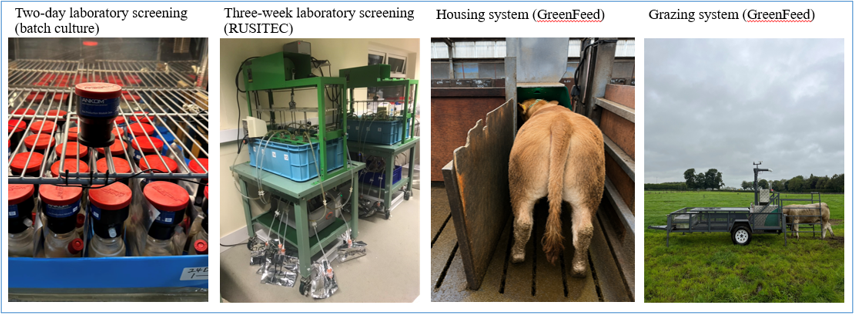
Figure 1. Laboratory methods (Batch culture and RUSITEC) for screening methane emissions from the fermentation of feed, and GreenFeed units for measuring methane emissions from cattle indoors and grazing, at Teagasc Grange.
Methane-reducing feed additive research
Synthetic feed additives
The synthetic compound, 3-nitrooxypropanol (3-NOP) or Bovaer® (developed by DSM) is a well-proven methane-reducing feed additive. Bovaer® reduces methane near instantaneously after consumption and actively targets the key enzymes responsible for methane production. However, the compound is rapidly metabolised within the rumen and its effectiveness (~30% reduction in daily methane across dairy and beef studies) shown to decreases when supplementation has ended, such that methane output returns to original levels within three hours. Previous research at Grange observed a 30% reduction in the methane output of young bulls, with no adverse effects on feed intake and daily live weight gain, where Bovaer® was supplemented (150 mg/kg DM) as part of a partial mixed diet consisting of grass silage, straw and a concentrate mix (50:50 forage to concentrate ratio).
Calcium peroxide (CAP), otherwise known as RumenGlas (developed by Glasport Bio, Co. Galway), is another synthetic feed additive that has undergone intensive research at Grange. When CAP is fermented in the rumen, a small amount oxygen is produced which is toxic to the rumen microbes leading to a subsequent reduction in methane. A dietary inclusion of CAP at 2.25% as part of a concentrate pellet offered twice daily, was shown to reduce enteric methane emissions by up to 29% without any effect on animal performance. However, a reduction in overall nutrient digestibility, as well as a varied methane mitigation response to different inclusion levels, has been reported. This compound is still in the early stages of research, with further refinement to dosage and the development of a slow-release bolus required.
Plant-based feed additives/supplements
The dietary supplementation of lipids (fats), particularly those high in polyunsaturated fatty acids (PUFA), has been shown to reduce enteric methane emissions across numerous international studies. While effective at reducing methane, including lipids at a level above 5-6% of the overall daily DM intake has been shown to adversely affect diet digestibility and consequently, feed intake and live weight gain. Linseed (flaxseed) oil is one of the most effective lipids at reducing enteric methane, due to its high content of PUFA, particularly linolenic acid. Research at Grange has shown that when linseed oil was fed to young bulls at a dietary inclusion rate of 4% in a 60:40 grass silage: barley-based concentrate (DM basis) total mixed ration, daily enteric methane emissions were reduced by 19% without any effect on animal feed intake and live weight gain. While lipids can be effective at reducing enteric methane emissions, their high cost, due to their usage in other high-value markets, may be a barrier to widespread adoption. Cheaper sources of lipids, mainly in the form of by-products from other industries, were investigated as potential alternatives. Inclusion of rapeseed cake (14.5% dietary DM) as part of a concentrate offered twice daily alongside ad libitum grass silage was shown to have similar methane mitigation potential in comparison to the raw rapeseed oil form (~8% reduction in daily enteric methane), with no effects on cattle feed intake or live weight gain. Alternatively, for a more direct approach, the potency of the individual fatty acids that compose these lipids were screened in the Grange laboratory with a grass silage: concentrate diet (50:50 DM basis) using the in vitro batch culture technique. The unsaturated fatty acids abundant in linseed oil and rapeseed oil (oleic acid, linoleic acid and linolenic acid) and lauric acid from coconut oil have shown promising methane reductions of up to 16% when included at 5% of DM and up to 43% at an inclusion of 10% of DM. Furthermore, when combined with synthetic feed additives (Bovaer and RumenGlas) the most potent fatty acids, linoleic and lauric acid, led to reductions in methane of up to 68%.
Table 1. Summary of experiments carried out at Teagasc Grange evaluating the effect of synthetic or natural enteric methane-reducing additives/ supplements in mixed forage-concentrate diets on methane emissions and performance of growing/finishing cattle
| Additive/ supplement | Delivery method | IR (DM) | F:C | DMR | DMI | ADG |
| Synthetic | ||||||
| 3-NOP | PMR | 0.02% | 50:50 | 30% | No effect | No effect |
| CAP | Pellet | 0.4% | 60:40 | None | No effect | No effect |
| CAP | Pellet | 2.0% | 60:40 | 10% | Increase | No effect |
| CAP | Coarse ration | 1.25% | 60:40 | 16% | No effect | No effect |
| CAP | Coarse ration | 2.25% | 60:40 | 29% | Reduced | No effect |
| CAP | Pellet | 2.25% | 60:40 | 27% | No effect | No effect |
| Plant-based | ||||||
| LSO | Coarse ration | 4% | 60:40 | 19% | No effect | No effect |
| RSO | Coarse ration | 2.5% | 40:60 | 8% | No effect | No effect |
| RSC | Coarse ration | 14.5% | 40:60 | 9% | No effect | No effect |
| BS | Coarse ration | 2% | 60:40 | None | No effect | No effect |
| BSE | Coarse ration | 2% | 60:40 | 8% | No effect | No effect |
3NOP = 3-nitrooxypropanol; CAP = calcium peroxide; LSO = linseed oil; RSO = rapeseed oil; RSC = rapeseed cake; BS = brown seaweed; BSE = brown seaweed extract; IR = dietary inclusion rate; F:C = forage: concentrate ratio; PMR = partial mixed ration; DMR = daily methane reduction; DMI = dry matter intake; ADG = average daily live weight gain.
Interest in the role of seaweeds as a natural methane-reducing dietary supplementation strategy has expanded globally. International research has shown red seaweed (Asparagopsis taxiformis) to exhibit methane reductions of more than 80% when fed to cattle at low inclusion rates (0.5% of total DM intake). Despite this, both cost and a readily available supply of large quantities of red seaweed, may limit usage in Ireland. As a result, the role of native seaweeds as a locally derived plant-based methane suppressant, were investigated. Over 30 species of seaweed harvested throughout Europe were initially screened through in vitro rumen simulation experiments in the laboratory. The brown seaweed, Ascophyllum nodosum, as well as a treated form of the seaweed which resulted in concentrated bioactive compounds (extract), had the most promising methane mitigation potential. Subsequently, this brown seaweed and the extract were evaluated in young bulls at Grange. The additives were mixed into concentrate feed, which was offered twice daily. Only the extract was observed to reduce methane (-8%), with neither form having any impact on animal intake or live weight gain.
Future research
As described, to date the majority of methane feed additive research on beef cattle in Ireland has been conducted on housed growing-finishing animals, offered individual additives over a relatively short feeding duration (2-3 months). As part of a new DAFM-funded project, RU-MIT-LESS, a collaboration between Teagasc, UCD and AFBI, the mitigation potential of some of the most effective additives identified to date, will be investigated further. The role of early-life and long-term supplementation, and the cumulative effects of combining multiple additives on lifetime methane emissions, growth performance and health of beef cattle, will be evaluated. Moreover, the societal acceptance of feed additives as a methane mitigation strategy, will be investigated. Coinciding with this, the CliBeef project, supported by PEACEPLUS, a programme managed by the Special EU Programmes Body (SEUPB), will look to identify novel delivery mechanisms at pasture (mineral licks, water) for the best performing feed additives, as well as testing these technologies across commercial farms. Additionally, the Methane Abatement in Grazing Systems (MAGS) project will use life cycle assessment (LCA) to evaluate the potential of methane-reducing feed additives and genomic improvement on the biotechnical, economic, and environmental performance in Irish beef systems. Life cycle assessment is a whole-farm modelling approach commonly used to assess new technologies and management practices in livestock farming. In the MAGS project, LCA will be used to estimate the impact of feed additives on overall farm GHG emissions, while also examining effects on animal performance, farm productivity, and economic sustainability.
Conclusions
Many dietary mitigation options for reducing enteric methane emissions in growing-finishing cattle indoors have been evaluated at Teagasc Grange, with decreases ranging from 0 to 30%. Natural dietary options can be readily implemented now, whereas research on synthetic additives contributes towards a decision on approval for use in beef cattle diets by the European Food Safety Authority. A focus of future work will be on strategies to mitigate methane emissions at pasture.
Acknowledgements
The information summarised here has been generated within projects supported by Teagasc, the Department of Agriculture, Food and the Marine (DAFM), the Global Research Alliance (GRA) and ERA_NET co-fund under Horizon 2020 – RSF2019R479 (METHABATE); 2021EN907 (Integrity); RMIS1409 (Sustainable Beef); 696231 (SeaSolutions); 2022 CSSGRA854.
Compiled and edited by Mark McGee and Paul Crosson, Teagasc, Grange Animal & Grassland Research and Innovation Centre, and first published in BEEF2026 – Driving Sustainable Performance, additional reading from BEEF2026 is available here.