
Profitable pasture-based dairy-beef systems


Summary
- Pasture-based dairy-beef systems have been shown to achieve profits in excess of €1,000 net margin/hectare at both research and commercial farm level.
- The inclusion of clover or clover + herbs in grass swards can further improve profitability by reducing nitrogen fertiliser inputs and improving animal performance.
- In respect of breed-types, early-maturing systems were more profitable due to lower calf purchase price, fewer finishing days and the ‘early-maturing breed carcass bonus’ compared to late-maturing breed systems.
Dairy-beef is an integral part of Irish beef production, with its contribution to beef output increasing in recent years in line with the 40% increase in dairy cow numbers since 2015, and dairy-beef now accounts for 62% of beef cattle processed in 2025. The current stabilisation of the dairy herd has led to a reduction in the number of dairy heifer replacements required. Coupled with the increased use of technologies such as dairy female sexed semen, this has led to 63% of calves born to dairy cows in 2025 to be beef sired. Early-maturing (Angus and Hereford) beef breeds account for the highest number of calf registrations, followed by Holstein-Friesian and late-maturing (Limousin, Belgian Blue, etc.) beef breeds (Figure 1). The national average age at finish for dairy-beef steers and heifers in 2025 was 27.0 and 25.5 months, respectively, at an average carcass weight of 329 kg and 282 kg (Further information: Growing-finishing beef cattle: national performance data and growth targets).
The operation of successful dairy-beef systems requires knowledge of calf rearing and cattle health, in addition to high levels of technical management expertise. Recent data from commercial dairy-beef farms has reinforced that opportunities exist to establish profitable and environmentally sustainable beef systems from a predominately grass-based diet. National farm survey data from 2024 shows the top third of dairy-beef farmers in Ireland achieved a net margin of €811 per hectare, compared to €402 for the average dairy-beef farmer. Participants within the Teagasc DairyBeef500 programme achieved a net margin of €1776 per hectare in 2025, an increase of €1025 compared to 2024, showing the profit potential within dairy-beef systems (Further information: An analysis of the 2025 Teagasc DairyBeef 500 Profit Monitor results).
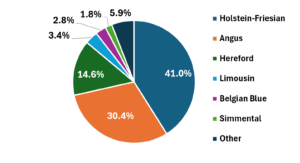
Figure 1. Sire breed profile of calves registered from the dairy herd available for beef production. Source: AIM (2025)
Key performance periods and growth targets for dairy-beef cattle
When aiming to reduce finishing age in grass-based systems it is essential that animal growth is maximised throughout its life, but this must be done in a cost-effective manner during each stage of the animal’s life.
Calf rearing
Calf rearing is the most labour-intensive period in dairy-beef systems. This is a critical time period, as the nutritional and health status of calves during this phase can influence overall lifetime animal performance. To ensure a successful calf-rearing period, purchasing healthy calves is vital. Calves should be sourced from herds of known high health status with a good colostrum management programme (ensuring calves get sufficient high-quality colostrum in the first few hours of life). Specialist dairy-beef producers are focused on minimising the number of source herds to reduce possible disease challenges. Calves should be housed in a well-ventilated, draught free environment, with calves grouped by source, age and weight. The calf rearing protocol at Teagasc Grange and Teagasc Johnstown Castle research farms and the Tipperary Dairy Calf-to-Beef Demonstration farm is outlined in detail elsewhere (Further information: The principles of successful calf rearing).
First grazing season
After weaning, calves are turned out to pasture from May onwards. They continue to receive 1 kg concentrate/day and have access to roughage (straw) for the first three weeks of the grazing season to ease the transition onto a grass diet, after which supplementation ceases (Further information: Understanding summer scour syndrome). Recent research at Teagasc Grange and Johnstown Castle found no benefit from supplementing February/March-born calves with concentrates for the entirety of their first grazing season but later born (April/May) calves should be supplemented throughout the first grazing season. Calves should be offered high-quality leafy pasture throughout the first grazing season, with a target pre-grazing herbage mass of 1200 kg dry matter (DM)/ha early in the grazing season, increasing to 1400-1600 kg DM/ha as calves become more accustomed to grazing. Due to declining pasture energy content in the autumn, concentrates are reintroduced from mid-September until housing to maintain energy intake of calves. Typically, calves are offered silage aftermath as these swards have the longest ‘rest’ period and the lowest parasite burden. In dairy-beef system experiments at Teagasc, Grange and Johnstown Castle, a post-grazing residual sward height of ~5 cm is targeted for calf and cattle grazing. During the grazing season it is advised to monitor parasite burden through faecal egg counts and follow a targeted parasite control plan, developed with a veterinary practitioner (Further information: Calf health from birth to the end of the first grazing season in dairy-beef calves). The target average daily live weight gain during the first grazing season for calves is 0.7 to 0.8 kg, resulting in a housing weight of approximately 200 kg for heifers and 230 kg for steers.
First-winter indoors
To avail of compensatory growth at pasture during the following grazing season, weanling cattle need to achieve a moderate growth rate over the first winter, 0.6 to 0.7 kg live weight/day. Where silage DM digestibility (DMD) is high (e.g. 75% DMD), this can be achieved with less than 1.0 kg concentrate/day, whereas when silage DMD is low (e.g. 65%), 1.5 to 2.0 kg/day of concentrate supplement is required (Further information: First winter nutrition: silage digestibility and concentrate supplementation to maximise compensatory growth). Grass-red clover silage has been shown to increase the average daily live weight gain of dairy-beef steers by 20% during the first winter period compared to perennial ryegrass silage, albeit at a cost of increasing total silage intake by 28% (Further information: Producing beef from grass-forage-based systems). Therefore, farmers utilising such swards for silage production must be aware of the need for extra silage provisions for the winter period. Furthermore, it should be noted that the 9 kg live weight advantage at the end of the first winter for the weanlings offered grass-red clover silage no longer existed by the end of the second grazing season, due to compensatory growth in the steers fed perennial ryegrass silage.
Second grazing season
Typically, yearling heifers and steers are turned out to pasture in mid-March weighing approximately 280 kg and 310 kg, respectively. Over the second grazing season, a daily live weight gain of 0.9 kg is targeted from a grass-only diet. To achieve this, cattle need to be offered high-quality leafy pasture in a rotational grazing system, achieved through targeting a pre-grazing herbage mass of 1400 to 1600 kg DM/ha or a sward height of 8–10 cm, and removing excessively heavy grass ‘covers’ as surplus baled silage. Cattle should receive a new grass allocation every two to three days, and be grazed to a residual height of approximately 5 cm. The priority of grazing management during the summer months is to ensure that there is enough grass available to ensure animal feed intake is not restricted, which would limit growth performance. The incorporation of white clover into the grazing sward can improve sward nutritive value and increase animal performance, while maintaining sward production from lower nitrogen fertiliser inputs (see later). Dairy-beef heifer and early-maturing steer systems can draft cattle off pasture if desired fat levels are achieved. Heifers and steers destined for indoor finishing are typically housed by early-October, weighing approximately 480 kg and 500 kg, respectively, to reduce grass demand, allowing weanlings to avail of an extended grazing season into late-autumn.
Finishing
The selection of ‘finished’ cattle (drafting) is primarily dependent on their ability to meet market specifications for carcass fat score, which is between 2+ and 4=. Nationally, a relatively high percentage of animals are being finished at excessively high fat scores, with 18% of dairy heifers being out of ‘spec’ for fat, which means additional days on finishing concentrate feed and associated economic and environmental costs. Across Teagasc dairy-beef herds, most early-maturing heifers achieve the target fat scores from pasture during the second grazing season, avoiding the need for an indoor finishing period. For early-maturing steers and late-maturing heifers this level of fatness can be achieved after a 60 to 80 day finishing period (indoors or at pasture), while Holstein-Friesian and late-maturing steers will require 100 to 120 days of indoor finishing. Finishing diets should consist of high-quality pasture or grass silage (>75% DMD) ad libitum, and typically 5 kg of concentrate daily. The concentrate level required to optimise growth is determined by silage DMD (Further information: Nutritional management of finishing beef cattle). As finishing periods increase in duration, the conversion of feed into carcass reduces, and ultimately a point is reached where feed costs exceed carcass gain benefits. It is essential that live weight gain and the level of fatness of finishing cattle are monitored regularly, allowing for timely drafting. Physically determining the body condition score (BCS) of each animal is essential, paying particular attention to the tailhead, rump, loin, ribs and the level of fat deposited between folds of skin. The ‘fleshing’ ability of animals will determine the frequency of drafting; this is generally completed every 10 days during the finishing period.
Recent performance of dairy-beef steer and heifer research systems
Steer system performance
The performance of early-maturing breed (Angus and Hereford) and dairy breed (Holstein-Friesian) sired dairy-beef cattle has been well researched in recent years, but there is a lack of comparable up-to-date recent information on late-maturing breeds (Limousin and Belgian Blue). Current research in Teagasc, Grange is investigating the growth, carcass traits and economic performance of male calves born to spring-calving Holstein-Friesian dams and either Angus and Hereford (Early-maturing, n=60), or Limousin and Belgian Blue (Late-maturing, n=60) sires, the four main beef sire breeds used on the Irish dairy herd. The early- and late-maturing breed categories are being managed in two separate grass-based calf-to-steer beef system farmlets. Finishing occurs indoors at about 21-22 months of age on a diet of grass silage ad libitum and 5 kg concentrate fresh weight per head daily. Finished steers are drafted based on meeting a BCS of 3.75 (5-point scale), deemed to be equivalent to a carcass fat score of 3+. The first production cycle of this study has been completed.
Provisional results show that, on average, early- and late-maturing steers had similar lifetime live weight gains of 0.84 and 0.82 kg/day, respectively (Table 1). Growth rate during the calf rearing period and the first summer at grass was similar for both genotypes. Live weight at housing (26 November) was 246 kg and 250 kg, respectively, for early- and late-maturing breed animals. Yearling steers were turned out to pasture on 20 February at an average live weight of 307 kg. During the second grazing season, early-maturing steers had a higher live weight gain than late-maturing steers, culminating in early-maturing steers being 6 kg heavier at second housing. Early-maturing steers were finished 21 days earlier than late-maturing steers, which represents a saving in feed costs; however, late-maturing steers produced 18 kg more carcass and had a greater conformation score (and lower fat score) than early-maturing steers.
Table 1. Provisional intake, growth and carcass performance of early- and late-maturing breed sired dairy-beef steers born in 2024
| Early-maturing | Late-maturing | |
| Calf arrival weight (kg) | 55 | 60 |
| Calf rearing live weight gain (kg/day) | 0.7 | 0.7 |
| Turnout weight (kg) | 114 | 118 |
| First grazing season live weight gain (kg/day) | 0.80 | 0.80 |
| First housing weight (kg) | 246 | 250 |
| First winter live weight gain (kg/day) | 0.64 | 0.62 |
| First winter period – days | 87 | 87 |
| Silage intake – first winter (kg DM) | 447 | 435 |
| Concentrate intake first winter (kg fresh weight) | 131 | 131 |
| Live weight at second turnout (kg) | 305 | 309 |
| Live weight gain during second grazing season (kg/day) | 0.96 | 0.91 |
| Second housing weight (kg) | 514 | 508 |
| Finishing age (days) | 662 | 683 |
| Finishing period live weight gain (kg/day) | 0.98 | 0.94 |
| Slaughter weight (kg) | 591 | 601 |
| Kill-out (%) | 51 | 53 |
| Carcass weight (kg) | 303 | 321 |
| Carcass conformation score | O= | O+ |
| Carcass fat score | 3+ | 3= |
| Indoor finishing period (days) | 65 | 87 |
| Silage intake – finishing period (kg DM) | 423 | 544 |
| Concentrate intake – finishing period (kg) | 328 | 437 |
| Lifetime live weight gain (kg/day) | 0.84 | 0.82 |
From a production system perspective, the earlier finishing of the early-maturing breed category led to a greater total number of animals finished and greater carcass output per hectare than the late-maturing breed category (Table 2). Accordingly, net margin per head and per hectare was much greater for the early-maturing breed. Sensitivity analysis was also conducted to show the effect of a change in beef, concentrate and calf purchase price on system economic performance (Table 2). Beef price was shown to have the greatest effect on net margin, closely followed by calf purchase price.
Table 2. The economic performance of early- and late-maturing breed dairy-beef steer systems and the impact of fluctuations in calf, concentrate and beef price on net profit per head, per hectare and per 40-hectare farm
| Early-maturing | Late-maturing | |
| Animals finished (per 40-hectare farm) | 123 | 116 |
| Organic nitrogen produced (kg/ha) | 213 | 215 |
| Lifetime concentrate fed (kg DM/head) | 563 | 577 |
| Carcass output (kg/ha) | 933 | 930 |
| GHG per kg beef carcass (kg CO2e) | 12.9 | 13.1 |
| Net margin per head (€) | 601 | 552 |
| Net margin per ha (€) | 1,847 | 1,597 |
| Net margin per 40-hectare farm (€) | 73,879 | 63,861 |
| Sensitivity analysis impact on margin per head (€/head) | ||
| Calf purchase price (± €100/head) | ±106 | ±106 |
| Finishing concentrate price (± €50/t) | ±28 | ±29 |
| Beef price (± €0.50/kg carcass) | ±152 | ±161 |
| Sensitivity analysis impact on margin per ha (€/ha) | ||
| Calf purchase price (± €100/head) | ±326 | ±307 |
| Finishing concentrate price (± €50/t) | ±86 | ±83 |
| Beef price (± €0.50/kg carcass) | ±466 | ±465 |
| Sensitivity analysis impact on margin per 40 ha farm (€) | ||
| Calf purchase price (± €100/head) | ±13,031 | ±12,264 |
| Finishing concentrate price (± €50/t) | ±3,460 | ±3,339 |
| Beef price (± €0.50/kg carcass) | ±18,656 | ±18,603 |
Assumptions: Carcass base price of €6.50/kg. Finishing concentrate price €350/t. Protected urea price €550/t. *Net margin excludes land & labour charge and assumes a calf purchase price of €450 and €550 per head for early- and late-maturing bull calves, respectively.
Heifer system performance
Dairy-beef cattle sired by late-maturing beef breeds generally have superior carcass merit compared to those sired by early-maturing breeds; however, their performance within predominantly forage-based heifer systems remains largely unknown. Increasing sward diversity through the inclusion of clovers and herbs has been shown to enhance animal performance while reducing dependence on expensive chemical nitrogen fertiliser.
A study conducted at Teagasc, Johnstown Castle, investigated the effects of sire maturity type – early-maturing (Angus and Hereford) versus late-maturing (Belgian Blue and Limousin) – and sward diversity on the performance of dairy-beef heifers. Heifers were assigned to one of two finishing systems: finishing from a pasture-only diet at the end of their second grazing season at ~20 months of age; or finishing at ~22 months of age following a 60-day indoor finishing (grass silage ad libitum supplemented with 4.5 kg concentrate per head daily) period at the end of their second grazing season. In this study, heifers were not drafted for slaughter based on body conditions score. Overall, the study evaluated how sire maturity type and sward diversity influenced animal performance under these contrasting finishing strategies.
In terms of sward diversity, three sward types were investigated: perennial ryegrass-only (PRG) sward, PRG plus red and white clover swards (CLOVER) and multispecies swards (MSS; grass + clover + herbs (chicory and plantain)). The PRG sward received 150 kg of chemical nitrogen/ha, while both the CLOVER and MSS swards received 75 kg of chemical nitrogen/ha. The CLOVER and MSS swards contained an average clover content of 17%, which enabled them to achieve a similar annual herbage DM yield to the PRG sward despite receiving only half the amount of chemical nitrogen fertiliser. Average herbage production ranged from 11.5 to 12.0 tonnes DM/ha across the three pasture types. However, despite comparable annual yields, spring herbage availability was more limited on the MSS swards, presenting a challenge for grazing management during the early part of the season.
Multispecies swards improved animal growth and carcass weight performance, producing an additional 11 and 12 kg carcass weight per animal compared to PRG and CLOVER swards, respectively (Table 3).
Table 3. Effect of pasture type, sire breed maturity (early-maturing, EM vs. late-maturing, LM) and finishing system (20-month vs. 22-month) on dairy-beef heifer performance (based on a 40-hectare farm).
| PRG | CLOVER | MSS | ||||
| EM | LM | EM | LM | EM | LM | |
| Live weight gain (kg/day) | ||||||
| First grazing season | 0.73 | 0.66 | 0.68 | 0.63 | 0.76 | 0.71 |
| First winter | 0.63 | 0.55 | 0.66 | 0.59 | 0.67 | 0.56 |
| Second grazing season | 0.95 | 0.91 | 0.97 | 0.94 | 0.97 | 0.96 |
| Finishing period (22-month only) | 1.12 | 0.95 | 0.98 | 0.88 | 1.1 | 0.9 |
| Carcass performance (20-month system) | ||||||
| Heifers finished (per 40-hectare) | 153 | 151 | 143 | 143 | 144 | 141 |
| Finishing weight (kg) | 438 | 426 | 454 | 438 | 458 | 461 |
| Carcass weight (kg) | 218 | 222 | 224 | 225 | 229 | 243 |
| Kill-out (%) | 50 | 52 | 49 | 52 | 50 | 53 |
| Carcass conformation score | O= | O+ | O= | O+ | O= | O+ |
| Carcass fat score | 3= | 2 = | 3= | 2+ | 3+ | 2+ |
| Net margin per head (€) | 258 | 210 | 317 | 229 | 346 | 344 |
| Net margin per ha (€) | 932 | 747 | 1073 | 773 | 1175 | 1151 |
| GHG (kg CO2e/kg beef carcass) | 12.0 | 11.5 | 11.6 | 11.6 | 11.4 | 10.9 |
| Carcass performance (22-month system) | ||||||
| Heifers finished (per 40-hectare) | 137 | 133 | 140 | 145 | 138 | 138 |
| Finishing weight (kg) | 542 | 517 | 528 | 513 | 559 | 527 |
| Carcass weight (kg) | 269 | 268 | 259 | 265 | 275 | 275 |
| Kill-out (%) | 50 | 52 | 49 | 52 | 49 | 52 |
| Carcass conformation score | O+ | R- | O+ | R- | O+ | R- |
| Carcass fat score | 4- | 3- | 3+ | 3- | 4- | 3- |
| Net margin per head (€) | 255 | 315 | 360 | 239 | 464 | 323 |
| Net margin per ha (€) | 1191 | 789 | 987 | 822 | 1513 | 1054 |
| GHG (kg CO2e/kg beef carcass) | 10.4 | 10.1 | 10.3 | 9.8 | 9.5 | 9.5 |
Assumptions: Carcass base price of €6.50/kg. Finishing concentrate price €350/t. Protected urea price €550/t. *Net margin excludes land & labour charge and assumes a calf purchase price of €350 and €450 per head for early- and late-maturing heifer calves, respectively.
Sward type had no effect on carcass conformation score; however, cattle grazing MSS achieved higher carcass fat scores compared to those grazing PRG and CLOVER swards. Finishing system influenced all carcass performance parameters. Across all pasture types, carcass weight, carcass fat score, and carcass conformation score improved by increasing finishing age via finishing indoors, resulting in a greater proportion of animals meeting minimum carcass specifications. On average, only the MSS animals finished indoors at 22 months of age achieved the target minimum carcass weight of 270 kg.
Late-maturing heifers consistently achieved lower carcass fat scores and higher carcass conformation scores than early-maturing heifers (Table 3). Despite differences in carcass fat and conformation scores between the two breed types, carcass weight was similar. As the cattle on this study were finished at a predefined slaughter date, no drafting took place and therefore, when finished at 20 months at the end of the grazing season without concentrate, 5% of early-maturing and 50% of late-maturing heifers did not meet the minimum carcass fat score of 2+. Following the 60-day indoor finishing period, 30% of early-maturing heifers became over-fat (>4=), while only 10% of late-maturing animals did not meet the minimum fat score of 2+.
Overall, multispecies swards improved carcass performance, profitability, and environmental efficiency. Finishing heifers at 22 months following a 60-day indoor finishing period improved carcass traits and compliance with market specifications. Early-maturing genetics were better suited to lower-input systems with reduced slaughter age and concentrate supplementation, whereas late-maturing heifers benefited more from extended finishing at older ages. Given the higher purchase price typically paid for late-maturing dairy-beef calves, substantially greater carcass performance and value are required to offset this additional cost under the two finishing systems evaluated in this study.
Conclusion
Dairy-beef production offers opportunity for profitable farm systems, but these systems must be based on the efficient use of grazed pasture. The integration of clover and herbs into swards has been shown to reduce chemical fertiliser inputs, improve animal performance, and maintain/improve system profitability. Although the carcass performance of late-maturing sired steers and heifers was superior, early-maturing steers and heifers were shown to be more profitable due to a lower initial calf purchase price and fewer days on feed. The overall profitability of dairy-beef systems is sensitive to beef price, calf price and the cost of inputs; therefore, it is advised when designing a system for your farm to select swards and cattle which provide ‘resilience’.
Compiled and edited by Mark McGee and Paul Crosson, Teagasc, Grange Animal & Grassland Research and Innovation Centre, and first published in BEEF2026 – Driving Sustainable Performance, additional reading from BEEF2026 is available here.