
Growing-finishing beef cattle: national performance data and growth targets


Summary
- Approximately 1.2 million ‘prime’ animals (steers, heifers and young bulls) are finished annually.
- Finishing age is a key performance metric for beef cattle as it implies higher average lifetime live weight performance. Accordingly, earlier finish tends to lead to higher profitability and lower greenhouse gas emissions.
- An ongoing on-farm study has shown considerable variation in live weight performance for growing dairy-beef and suckler cattle.
- Detailed blueprints, incorporating live weight targets and detailed management strategies, are available to optimise animal growth rates.
- Profitability of these blueprint systems varies greatly with the prevailing beef and weanling price.
In 2025, 1.79 million calves were born in Ireland, and approximately 1.16 million animals were finished as prime (steers, heifers and young bulls) cattle. Nationally, suckler-bred animals now account for 38% of the prime beef cattle produced, reflective of a decline in suckler cow numbers (currently ~0.75 million), and an increase followed by a stabilisation in dairy cow numbers (currently ~1.49 million) in recent years. Steer production systems dominate the Irish beef sector, accounting for 51% of the prime beef cattle produced, followed by heifers (40%) and young bulls (9%).
Profitability on Irish beef farms is underpinned by achieving lifetime live weight gain targets from a predominantly grass based diet. As part of the Irish Climate Action Plan, a legally binding target has been set to reduce national agricultural greenhouse gas (GHG) emissions by 25%. At the same time, in an increasingly competitive global beef market, producing high-quality grass-fed beef to the highest welfare standards, while minimising carbon footprint, is a key point of differentiation for the Irish beef sector. Reducing the lifetime GHG emissions of beef cattle, through enhanced lifetime performance leading to an early finishing age and/or dietary supplementation of methane-reducing feed additives (Further information: Methane-reducing feed additive research in beef cattle), has the potential to significantly reduce national agricultural GHG emissions. The aims of this paper are to provide an overview of animal growth performance nationally and on commercial beef farms, and to outline research-derived growth targets for spring-born suckler-bred and dairy-bred cattle from approximately eight months of age until finish within pasture-based beef production systems.
National finishing age and carcass weight trends: 2018-2025
Within the national Climate Action Plan, 2018 was selected as the base year for calculating GHG reduction targets for each sector. One of the measures identified to help achieve this target is to reduce finishing age by approximately three months by 2030. In 2018, approximately 1.27 million prime beef cattle were finished, with an average finishing age and carcass weight of 26.0 months and 338 kg, respectively (Figure 1). Live weight performance gains in the national beef cattle herd over the initial few years following 2018 resulted in a reduction in finishing age, such that, by 2022, average finishing age was reduced to 25.6 months, with minimal impact on carcass weight (Figure 1). However, mean finishing age increased by about two weeks in 2023 and by a further two weeks in 2024 combined with 5 kg reductions in carcass weights. This reduction in performance has been primarily attributed to the negative impact of adverse weather conditions on cattle growth in those years. In 2025, there was no change in average finishing age compared with 2024 and carcass weight increased slightly (+5 kg). In 2025, suckler (beef × beef) and dairy-beef (beef × dairy) and dairy (dairy × dairy) steers were finished at 28.5, 27.0 and 27.6 months of age yielding a carcass of 391, 329 and 307 kg, respectively. Heifers were finished, on average, over one month younger than steers at mean carcass weights of 341 kg and 282 kg for suckler and dairy-beef animals, respectively. Young bulls, on average, were finished at 19.4 months of age with a mean carcass weight of 370 kg in 2025, with suckler-bred bulls being much younger and heavier (18.6 months; 408 kg carcass) than dairy-beef (20.3 months; 338 kg) and especially dairy (20.8 months; 306 kg carcass) bulls.
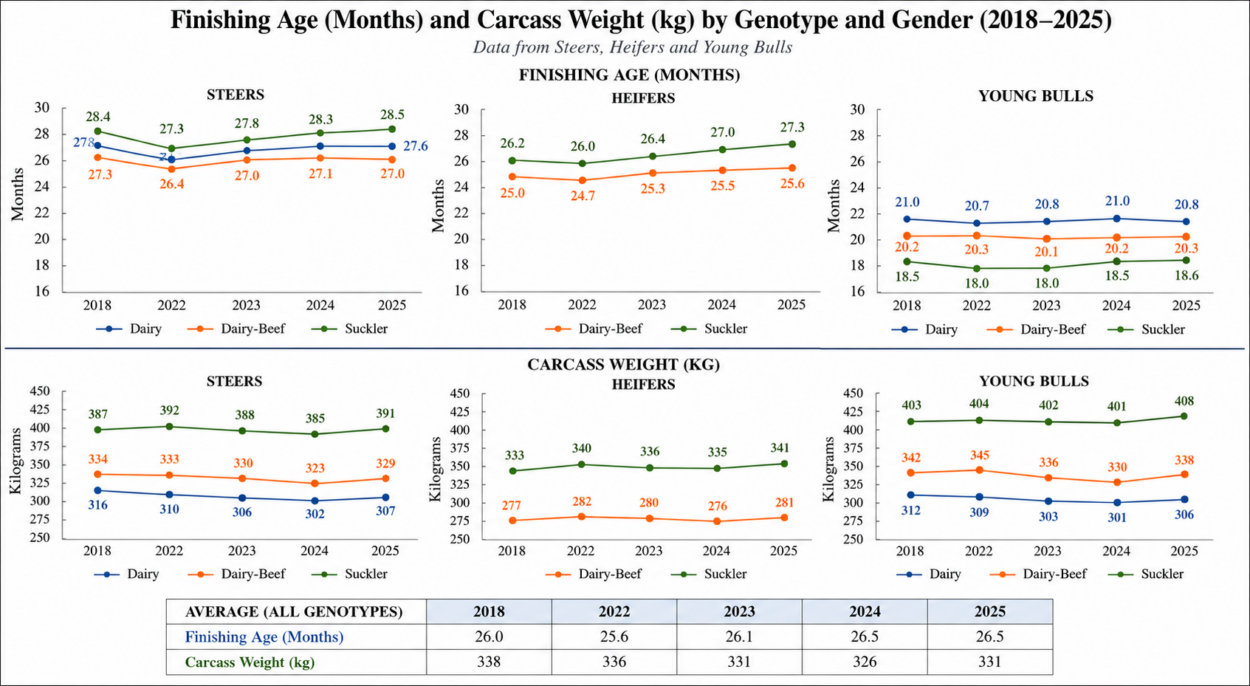
Figure 1. Overview of national finishing age and carcass weight trends for dairy, dairy-beef and suckler steer, heifer and young bull genotypes for 2018 and 2022-2025.
| Average (All genotypes) | 2018 | 2022 | 2023 | 2024 | 2025 |
| Finishing Age (Months) | 26.0 | 25.6 | 26.1 | 26.5 | 26.5 |
| Carcass Weight (kg) | 338 | 336 | 331 | 326 | 331 |
Beyond the impact of poor weather conditions, a continued downward trend in the proportion of male cattle being finished as young bulls has also hindered progress in reducing finishing age during this period. On average, in comparison to steers, young bulls in 2025 were finished 238 days earlier and produced a heavier carcass. If the same proportion of the prime beef cattle population were finished as young bulls in 2025 as in 2018, the national average finishing age would have been 14 days lower, at 26.0 months, thus highlighting the benefits of young bull beef production in reducing finishing age. It is also worth noting that well managed bull beef production systems producing carcasses to market specifications are also more profitable than steer beef systems (Further information: Suckler beef systems for profitable production). This again highlights that strategies to reduce finishing age, in this case finishing males as bulls rather than steers, can deliver on climate and farm profitability objectives.
In terms of carcass fatness, overall ~16%, 6% and 37% of steers, young bulls and heifers, respectively, processed through DAFM-approved beef factories in 2025 had a carcass fat score of ‘4-’ or greater. Looking more specifically at the effect of breed type, ~16% and 33% of suckler-bred and ~20% and 43% of dairy-beef steers and heifers, respectively, and ~6% of dairy steers had a carcass fat score of ‘4-’ or greater. This compares with the commercially-acceptable minimum carcass threshold for fat classification of 2+ and implies that a relatively high proportion of steers and heifers are ‘overfat’, which is a costly production inefficiency. Research at Teagasc Grange, shows that feed efficiency declines markedly when cattle get overfat during excessively long finishing periods (Further information: Nutritional management of finishing beef cattle), such that the cost of feed alone can substantially exceed the market value of animal gain. Overall, this implies that a significant proportion of the national cattle population, especially heifers, have surplus days on feed and can be finished at a younger age delivering advantages in terms of associated financial and environmental costs.
Technical performance on commercial calf-to-beef farms – a provisional update from the Beef-Quest project
Since autumn 2024, the performance of beef cattle on 111 ‘calf-to-beef’ farms, comprised of 49 suckler and 62 dairy-beef enterprises geographically dispersed throughout the country (Figure 2) has been monitored as part of the Beef-Quest project. This is a Department of Agriculture, Food and the Marine (DAFM) funded collaborative research project led by Teagasc, in collaboration with University College Dublin (UCD) and the Irish Cattle Breeding Federation (ICBF).
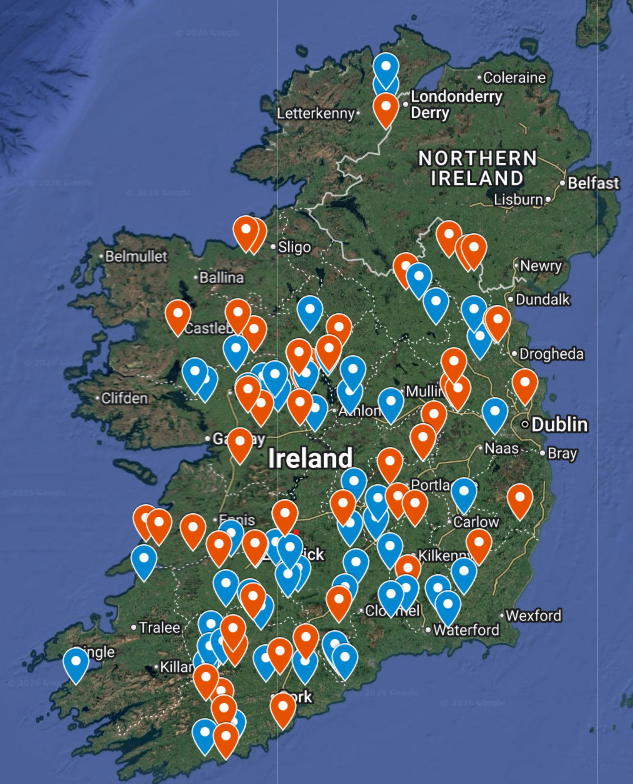
Figure 2. Location of ‘calf-to-beef’ farms enrolled in Beef-Quest project (red = suckler-beef farms; blue = dairy-beef farms).
Although mainly comprised of commercial farms it also incorporates several research and ‘demonstration’ (DairyBeef500, Future Beef, Signpost, Teagasc agricultural colleges) farms. Additional commercial farms are recruited encompassing other beef systems (e.g. calf-to-‘weanling’/‘store’; non-breeding finishers). The project is primarily focused on the performance of animals from the ‘weanling’ (~8-9 months of age) stage onwards and on identifying the main nutrition, health and on-farm environment factors presently constraining animal growth performance and the finishing age of cattle on beef farms. As part of this study, approximately 15,000 cattle have been weighed over the past 18 months at key junctures throughout the production cycle. Along with live weight data from individual animals, samples of silage, concentrates and herbage from the grazing area have been obtained for nutritional analysis and a survey of the cattle housing environment (air quality, stocking density etc) on each farm was carried out. A detailed questionnaire pertaining to animal feeding, animal health protocols and grassland management was conducted.
Although the study is ongoing, provisional results indicate substantial variation in animal growth across farms. For example, Figure 3 shows the mean animal live weight at the start of the ‘first’ indoor winter (i.e. ~9 months of age), at the end of the ‘first’ winter (i.e. ~12 months of age) and at housing following the ‘second’ grazing season (~19.5 months of age) for the top 25% and bottom 25% (based on animal 600-day weight) of a cohort of farms operating spring-calving suckler and dairy calf-to-beef steer production systems. This preliminary data showed that at the end of the ‘first’ grazing season there was already a difference in calf live weight (~30 kg) between the top 25% and bottom 25% of suckler and dairy-beef farms (highlighting deficiencies pertaining to ‘early-life’ animal performance), and this difference in weight increased to ~50 kg by the end of the first winter (Figure 3). During the second grazing season, the divergence in steer live weight between the top 25% and bottom 25% increased even further, especially on the suckler farms (~150 kg difference) compared to the dairy-beef farms (~99 kg). Animal performance on these farms will be monitored until the animals are sold live or finished. Overall, animal performance for farms in the Top 25% was relatively close to target growth rates. Investigation is ongoing to determine what are the primary factors accounting for this disparity in animal growth rate across farms.
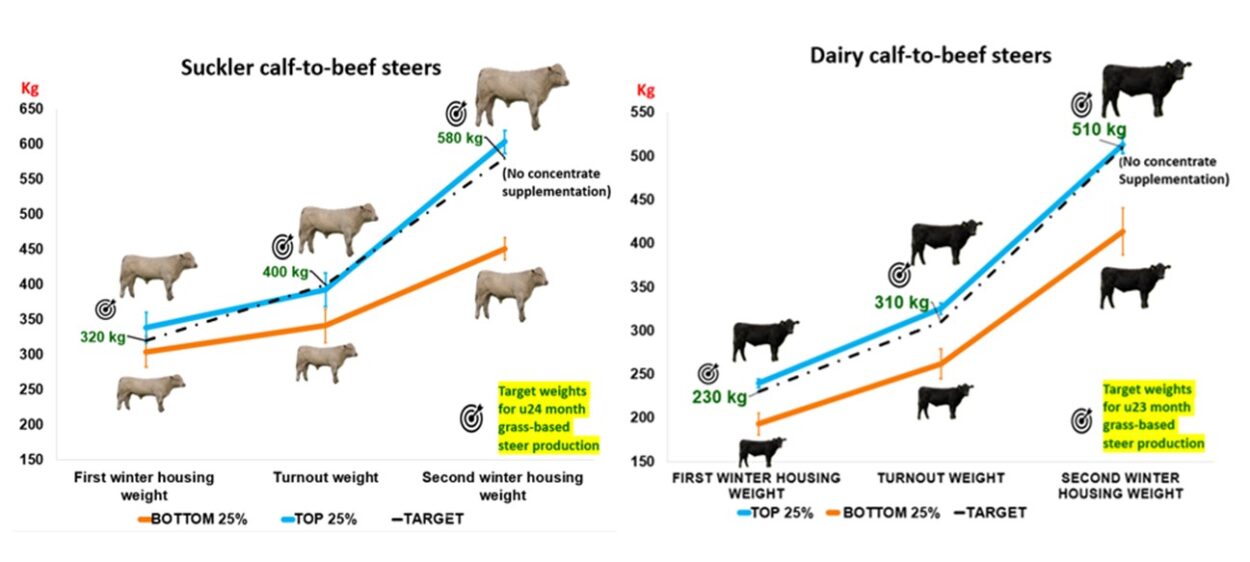
Figure 3. Performance of steers during the ‘first’ winter and ‘second’ grazing season on farms in the top 25 % (blue line) and bottom 25% (orange line) of selected suckler and dairy calf-to-steer beef producers within the Beef-Quest project. The black dotted line represents approximate target weights for the timepoints within grass-based systems.
Animal performance targets
Many types of beef production systems are operated commercially, depending on factors such as the animal origin (i.e. suckler- vs. dairy-bred), progeny sex (i.e. steers, heifers and bulls), on whether it is a ‘component’ – selling/buying live cattle at different ages (e.g. ‘weanling’, ‘yearling’ or ‘store’ cattle) – or a partially (e.g. weanling-to-beef, store-to-beef) or fully (e.g. calf-to-beef) ‘integrated’ system, and ultimately the finishing/target market. For example, in 2025, only 15% of suckler steers and heifers were sold directly to a meat processor from their farm of origin implying that component systems predominate for suckler-bred cattle. Animal growth rate is a significant driver of beef farm profitability and is largely a function of animal nutrition (feed ‘quality’ and quantity), animal genetics (e.g. high Commercial Beef Value, CBV – for purchased growing-finishing cattle – see papers: Suckler beef systems for profitable production and Commercial Beef Value: making genetics work in dairy-beef systems) and herd health. Animal performance targets for suckler and beef × dairy ‘weanling’ (~8-9 months of age)-to-beef systems are illustrated in Figure 4; the same principles apply to other ‘component’ systems. The actual values will differ according to factors such as animal genotype and production system modifications.
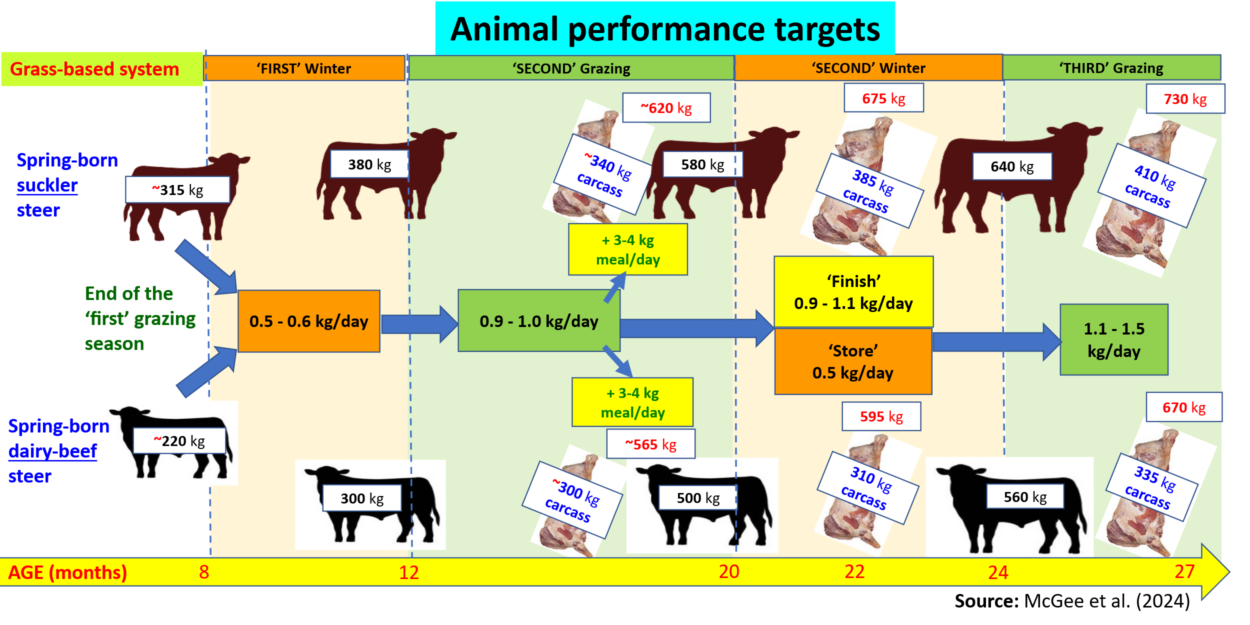
Figure 4. Animal performance targets for spring-born grass-based suckler and beef × dairy steer ‘weanling’ (~8-9 months of age)-to-beef production systems
At the end of the ‘first’ grazing season, spring-born dairy weanlings are about 90 to 100 kg lighter than their suckler-bred counterparts (Figure 4). Despite the fact that these contrasting breed types differ markedly in their intake relative to weight (dairy-bred consume more than suckler-bred), feed efficiency (dairy-bred poorer than suckler-bred) and carcass traits (dairy-bred have inferior kill-out proportion, and carcass weight and conformation score compared to suckler-bred), animal management and live weight gain targets from housing at the ‘first’ winter until ‘finished’ are broadly similar for both suckler-bred and dairy-bred production systems.
‘First’ winter growth targets
During the ‘first’ winter indoor (‘store’) feeding period, a target live weight gain of 0.5 to 0.6 kg/day is acceptable for steers, heifers and bulls destined to return to pasture in spring as, due to compensatory growth, there is no benefit to over-feeding weanlings in winter (Further information: First winter nutrition: silage digestibility and concentrate supplementation to maximise compensatory growth). For example, research at Teagasc, Grange showed that feeding suckler bull weanlings either 2, 4 and 6 kg concentrate fresh weight per head daily along with high dry matter digestibility (DMD) grass silage ad libitum resulted in the animals receiving the 4 and 6 kg concentrate gaining an additional 30 kg and 63 kg live weight during the four-month winter compared with those offered 2 kg concentrate. Subsequently after just 100 days grazing, the 30 kg and 63 kg differences in live weight had declined to -3 kg and 21 kg, respectively. The feeding regime to achieve 0.5 to 0.6 kg live weight/day is designed to minimise winter feed costs and exploit the economic efficiency of grazed grass over conserved forages and concentrates.
‘Second’ grazing season growth targets
Planned early-turnout of cattle to pasture in spring has been shown to improve farm profitability where cheaper pasture replaces more expensive winter forage and a further saving in slurry storage and spreading costs are achieved. In grassland management terms, preparation for early turnout, and having high-quality pastures available in spring, starts in the autumn of the previous year, where paddocks are ‘closed’ in a sequence and rested for the winter. If managed properly, sward nutritive value is invariably high from turnout in spring until mid-summer; however, when grass seed heads appear, nutritive value deteriorates and if not correctly managed can become sub-optimal later in the season.
During the ‘second’ grazing season (February/March to October/November) a target animal live weight gain of ~0.9-1.0 kg/day should be attainable without meal supplementation. Animal growth rates during the first part of the grazing season are usually relatively good, as grazed grass is in the vegetative (leaf development) phase and cattle are usually exhibiting high levels of compensatory growth. Managing the inflorescence (reproductive) stage of grass is critical for maintaining pasture nutritive value and thus avoiding a marked decline in cattle growth during the latter half of the grazing season.
In beef production, where individual animal performance is essential to produce a commercially saleable product, a balance between output per unit area and per animal is needed. Research at Grange has shown that grazing excessively high (~2500 kg dry matter (DM)/ha) or low (<1500 kg DM/ha) pre-grazing herbage masses negatively impacts beef cattle growth at pasture. Grazing pasture to a relatively low post-grazing sward height is desirable to increase grass utilisation; however, grazing too tightly can negatively impact individual animal growth rate, most likely mediated through reduced herbage intake. Research at Grange has shown that rotationally grazing beef × Holstein-Friesian steers to a post-grazing sward height of 5 cm rather than 3.5 cm resulted in animals being 30 kg heavier at housing at the end of the grazing season. Similarly, grazing suckler-bred yearling steers to a post-grazing sward height of 6 cm rather than 4 cm, resulted in animals being 29 kg heavier at housing at the end of the grazing season, and having a 15 kg heavier carcass, demonstrating that the live weight advantage at housing was retained during the finishing period. In practical terms, higher live weights at housing can translate into an earlier slaughter date, thereby reducing feed costs and potentially reducing the carbon footprint of beef systems. For example, in the aforementioned suckler weanling-to-beef system study, to reach the same carcass weight as the cattle grazing to 6 cm, those grazing to 4 cm would require an additional month of ‘finishing’.
Due to the seasonality of grass growth, herd feed demand usually exceeds supply in the autumn on beef farms. Additionally, weather and grazing conditions in autumn are often less than optimum. Consequently, there may be a role for strategic concentrate supplementation (e.g. 3-5 kg/day) at pasture to enhance feed-nutrient intake and thus help animals meet an acceptable carcass fat score (Further information: Nutritional management of finishing beef cattle), thereby potentially eliminating the need for housing and, as grazed grass is considerably cheaper than grass silage, reducing feed costs per animal. Early-maturing breed cattle and heifers may achieve adequate carcass finish off pasture-only, whereas late-maturing breeds typically require concentrate supplementation to maximise carcass weight and achieve target carcass fatness. Because a commercially-acceptable carcass fat score (minimum target of 2+) is currently a primary market requirement, the propensity of cattle to deposit subcutaneous fat is important (see below).
‘Second’ winter and ‘third’ (short) grazing season growth targets
Animals not finished at pasture at the end of the ‘second’ grazing season are re-housed and offered high DMD grass silage supplemented with concentrates (Further information: Nutritional management of finishing beef cattle). Animals destined for finishing at ~22 to 24 months of age receive a moderate allowance of concentrate (e.g. 4-5 kg daily, depending on silage DMD) with a target live weight gain of 1.0 kg /day. Providing high DMD grass silage for all growing-finishing cattle is essential. For example, research has shown that each one-unit decline in DMD of grass silage offered to finishing cattle requires an additional 0.3 to 0.4 kg concentrate daily to sustain growth performance (Further information: Nutritional management of finishing beef cattle). The housing environment that animals are accommodated in is also important. For example, research from Teagasc, Grange clearly shows that over-stocking cattle in pens reduces animal growth rate (Further information: Finishing cattle housing: space allowance and floor type). In terms of floor types, there is evidence that overlaying concrete slats with some rubber mat products can enhance the growth rate and feed efficiency of finishing cattle – a cost-benefit analysis should be undertaken. With finishing cattle, it is important to avoid overly long finishing periods as feed efficiency declines with duration of feeding, and especially at high carcass fat scores (Further information: Nutritional management of finishing beef cattle). In this regard, live weight gain and fatness level of cattle should be monitored regularly to permit timely drafting of finished animals.
In contrast, animals, most likely steers, destined to be turned out to pasture for part of (two to four months) a ‘third’ grazing season and finished at pasture at about 27-months of age receive a much lower (e.g. 1 kg/day), if any, concentrate allowance. Like the ‘first’ winter, their target live weight gain is also only 0.5 kg/day to further exploit compensatory growth during the subsequent short grazing period.
Exploiting genetic divergence for carcass fat score to reduce finishing age
Irish suckler-bred cattle are predominantly late-maturing breed types. Achieving an adequate carcass fat score (2+, ≥6.0, 15-point scale) on grass-based systems at a relatively young age (e.g. pasture-finishing at 19 months old) is more challenging for late-maturing compared to early-maturing breed types. Recent research at Teagasc, Grange evaluated the effect of genetic divergence in carcass fat score (‘lean’ vs. ‘fat’) on growth and carcass traits of Charolais crossbred steers finished on grass-based systems at 19, 23 and 26 months of age. The mean expected difference in genetic merit for carcass fat score was 0.92 units. Corresponding differences for carcass conformation score and carcass weight were 0.5 units and 7.4 kg, respectively, in favour of the lean genotype. When animals were finished at 19, 23 and 26 months, carcass fat score was 1.7, 2.4 and 2.0 units greater, respectively, for the fat genotype. Corresponding differences for carcass conformation score and weight were -1.10, -1.05 and -0.95 units and -9, -9 and 0 kg, for the fat genotype. These results show that late-maturing genotypes with greater genetic propensity for subcutaneous fat deposition can achieve a target fat score at a younger age. The reduction in carcass conformation and weight associated with the late-maturing fat genotype was less than if an early-maturing breed was used.
Profitability and GHG emissions of weanling-to-beef production systems
The profitability and GHG emissions of a spring-born, grass-based weanling-to-beef system on a 50-ha farm, finishing purchased (i.e. November) weanling heifers at 19 months of age and male weanlings as steers at either 20, 23 or 27 months of age, is summarised in Table 1. Using the prices assumed in this analysis (€4.60/kg for purchased weanlings and a beef carcass price of €6.50/kg – Table 1 footnote), suckler weanling-to-steer systems generated much lower net margins than comparable suckler calf-to-beef systems (Further information: Suckler beef systems for profitable production). Within the weanling-to-beef systems evaluated, the 27-month steer system delivered the highest net margin. The purchase price of weanlings had a major influence on system profitability. Across the systems examined, a €0.50/kg change in weanling purchase price altered net margin by approximately €400/ha in the 27-month system to €700/ha in the 20-month system, highlighting the significant exposure of weanling-to-beef enterprises to changes in cattle prices. Likewise, beef carcass price had a similar magnitude of impact on system profitability. The increasing price sensitivity on profit per hectare as finishing age reduced reflects greater animal numbers. Consequently, increases (or decreases) in weanling purchase price and beef carcass price have a comparatively much greater impact on the profitability of the 20-month system. Given the current volatility in both weanling, store and finished cattle markets, determining the most profitable production system has become increasingly challenging (Further information: An overview of beef cattle farming in Ireland). From a GHG emissions perspective, the 20-month system had 16 % lower emissions per kg carcass than the 27-month system.
Table 1. Profitability and greenhouse gas (GHG) emissions of three suckler weanling-to-beef production systems on a 50-hectare farm with heifers finished at 19 months and steers finished at either 20, 23 or 27 months of age1
| Steer production system | 20-month steer | 23-month steer | 27-month steer |
| Heifer production system (constant) | 19 months | 19 months | 19 months |
| Number of cattle finished | 215 | 166 | 122 |
| Organic nitrogen (kg/hectare) | 179 | 162 | 151 |
| Beef output (kg carcass/hectare)2 | 679 | 570 | 445 |
| Farm profitability | |||
| Gross margin (€/hectare)3 | 930 | 1,135 | 1,090 |
| Net margin (€/hectare)3 | 105 | 275 | 354 |
| Net margin (€/head)3 | 25 | 83 | 146 |
| Price sensitivity (impact on margin, €/ha) | |||
| Weanling price effect (+/- 50 c/kg) | 708 | 547 | 402 |
| Beef price effect (+/- 50 c/kg) | 755 | 607 | 458 |
| Concentrate price effect (+/- 50 €/tonne) | 94 | 70 | 40 |
| Nitrogen fertiliser price effect (+/- 50 €/tonne) | 13 | 11 | 11 |
| GHG emissions (kg CO2eq.) | |||
| kg/kg carcass | 13.62 | 14.07 | 16.16 |
| tonnes/hectare | 9.3 | 8.0 | 7.2 |
120-month steers = finished at the end of the ‘second grazing season’ on grass + concentrates; 23-month steers = finished during the second indoor winter on silage + concentrates; 27-month steers = finished off pasture in the third grazing season on grazed pasture.
2Carcass weight gain = weight gain between purchase as weanlings and sale.
3Weanling price, €4.60/kg. Carcass price, €6.50/kg (different systems have a different carcass price to account for seasonality). Protected urea fertiliser, €550/t. Finishing concentrate ration, €420/t fresh. No charge was applied for labour or land, and direct payments were not included.
Acknowledgements
On-farm information summarised here has been generated within projects supported by Teagasc (Beef-Growth; RMIS2339) and DAFM (Beef-Quest; 2023RP892). The authors wish to sincerely thank all the farmers and participants in the Beef-Quest project.
Compiled and edited by Mark McGee and Paul Crosson, Teagasc, Grange Animal & Grassland Research and Innovation Centre, and first published in BEEF2026 – Driving Sustainable Performance, additional reading from BEEF2026 is available here.