
EU Organic Ambassadors visit Teagasc Johnstown Castle to see latest organic farming research
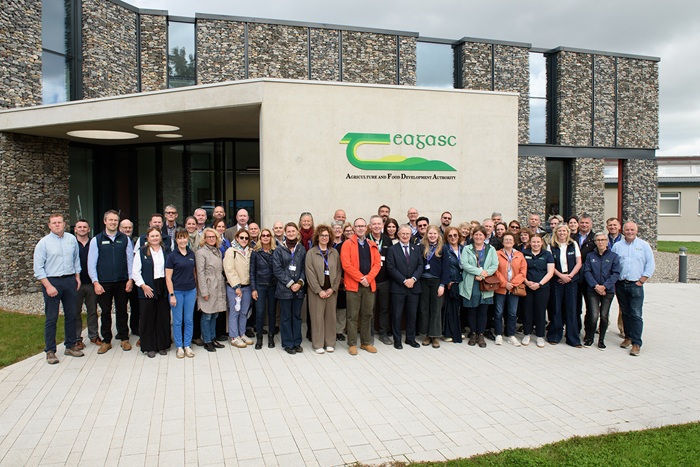
Teagasc organic researchers, specialists and advisors hosted a delegation of EU Organic Ambassadors at the National Agricultural Sustainability Research and Innovation Centre (NASRIC), Johnstown Castle, Co. Wexford, on 8 September, as part of a Department of Agriculture, Food and the Marine (DAFM) organised visit showcasing the development of Ireland’s organic sector.
The visit provided an opportunity to showcase the expanding portfolio of organic farming research, demonstration and knowledge transfer underway in Teagasc and to exchange knowledge and experiences on the development of organic farming across Europe.
The delegation was welcomed by Brian McGee, Head of Division for Organics, Locally Led and Market Supports at DAFM, and Professor Frank O’Mara, Director of Teagasc.
Following an introduction to Teagasc research and innovation in organics, the delegation travelled to the recently established Kildavin Organic Research Farm, where researchers, organic specialists and project staff presented current research and innovation activities.
Professor Frank O’Mara said: “The substantial growth in organic farming in recent years creates new opportunities for Irish agriculture, but it also increases the need for a strong evidence base to inform farmers, policymakers and the wider sector. Teagasc has an important role in generating that evidence and translating research findings into practical knowledge and support.”
Organic research in practice at Teagasc, Kildavin Farm
Dr David Wall, Enterprise Leader at Teagasc Johnstown Castle, welcomed the delegation and outlined the development of the Kildavin Farm as a dedicated platform for organic beef systems research and demonstration. He then led the delegation through the farm to view the cattle and pasture systems and presented the latest findings from the Department of Agriculture, Food and the Marine and Teagasc co-funded GROFarmS project – Growing Resilient Organic Farming Systems beef finishing research trials.
Dr David Wall highlighted how complementary GROFarmS research at Teagasc Grange and Kildavin is building an evidence base for practical and profitable organic beef production. Research at Grange has examined alternative winter finishing diets and opportunities to increase the use of home-grown feed, while Kildavin is evaluating how forage production, grazing management, breed, winter feeding and alternative finishing ages interact within a whole-farm organic beef system.
Dr Wall presented the first results from the Kildavin production system, where cattle are being evaluated across alternative finishing pathways at 19, 23 and 26 months of age. The research is examining the trade-offs between earlier finishing, winter feed requirements and greater use of grazed forage. Together with the Grange trials, this work is building an evidence base to inform the development of efficient and profitable organic beef production systems under Irish conditions.
“The Kildavin farm provides us with an important opportunity to evaluate organic beef production at a whole-farm systems level. By combining the work here with the controlled research at Grange, we can examine different feeding and finishing strategies and generate practical evidence on the options available to organic beef farmers under Irish conditions,” Dr David Wall said.
Dr Philip Creighton also presented results from the GROFarmS organic sheep research programme at Teagasc Athenry, while Dr Kevin Kilcline outlined emerging evidence on the economics and sustainability of commercial organic farms from the Teagasc National Farm Survey.
Showcasing a growing portfolio of organic research and innovation
The delegation was introduced to a wider range of research and innovation initiatives addressing challenges across the organic farming and food system.
Dr Mary Ryan presented the European OH-FINE project and its work on farmer knowledge needs, knowledge exchange and organic Agricultural Knowledge and Innovation Systems.
John Hendrick and Martin Bourke showcased work being undertaken in the Organic Tillage and Vegetables (OTV) European Innovation Partnership (EIP) on practical innovations for organic crop production and mechanical weed management.
Elaine Leavy, Teagasc Organic Specialist and Maura O’Callaghan, IFAC Project Manager of the Organic Beef & Lamb Innovation Group (OBLIG) presented ongoing work on strengthening organic livestock supply chains and reducing the leakage of organically produced animals into conventional markets.
Joe Kelleher outlined the Mid-West BioDistrict initiative and its place-based approach to developing organic food systems and shorter supply chains. The programme also featured research by Tara Fox-Gilna on productive organic grassland management and Jennifer Byrne on the FARM project, which is assessing the feasibility of developing greater domestic organic feed-milling capacity in Ireland.
Dr Kevin Kilcline, Teagasc Research Economist, said: “The visit provided an opportunity to demonstrate the breadth of organic research and innovation now being undertaken by Teagasc and partners. Alongside research on beef, sheep, grassland and crops, we are developing evidence on farm economics and sustainability, farmer knowledge and decision-making and the market and supply-chain challenges facing the sector, with a focus on developing the competitiveness and resilience of organic farmers.”
The visit provided an opportunity to share emerging Irish research with the EU Organic Ambassadors while also exchanging experiences and ideas on the challenges and opportunities facing organic farming across Europe.
To find out more about Teagasc’s expanding portfolio of organic farming research, visit here.