
Four decades of missed opportunity
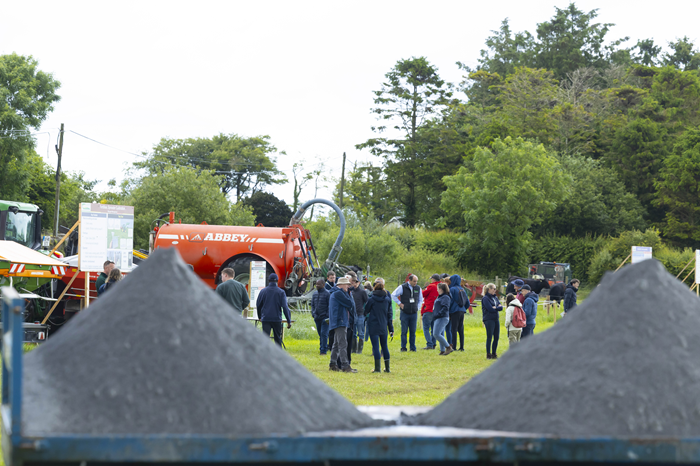
The challenges facing and opportunities available to the Irish agricultural sector were made clear to all who attended the Farming for a Better Future Open Day at Teagasc Johnstown Castle on June 10. Worryingly though, an effective solution that has been readily available for generations has largely been underutilised.
“Hope isn’t a strategy,” explained John Maher, Manager of the Teagasc Grass10 Campaign, at the opening demonstration on the day, before adding: “It’s been a very long time, all the way back in 1982, when Irish farmers spread adequate volumes of lime.”
“We need action now and Irish farmers should take every opportunity to spread lime,” echoed Mark Plunkett, Specialist on the Teagasc Signpost Programme.
This deficit, however, isn’t just one or two loads of lime, as it stands and as explained by Mark Plunkett: “We’re short the area of 100,000ha or 500,000 tonnes of lime annually.”
The demonstration, a co-ordinated effort between the Teagasc Signpost, Grass10 and ASSAP Programmes, provided farmers with the facts on lime spreading and the resulting benefits in terms of grassland performance, nutrient availability and water quality.
Setting the scene, Mark Plunkett explained: “The price of fertiliser doesn’t look to be coming down anytime soon and we need a lot of lime on Irish farms; for dairy farms, 40% of soils are still sub-optimum for lime, 60% of drystock farms need lime and 40% of tillage farmers are below target pH.”
“There are big benefits to be gained in terms of productivity, climate and economics. We cannot afford to continue ignoring lime and farming on low soil pH,” he added.
As to the cost and soil pH targets, Mark Plunkett continued: “A typical lime application is two tonnes per acre at €35/tonne. That works out at €70 per acre, and when spread over five years, it comes to just €14 per acre per year. You would not buy much bagged fertiliser for €14 per acre”.
“We need a soil pH of 6.3-6.5 on mineral soils for ryegrass. For clover, we need additional lime, with a target pH of 6.5-6.8.”
Grassland benefits
From a grass production perspective, John Maher noted that moving for a low soil pH to optimum results in additional grass production in the order of 2.5t DM/ha annually.
“Correcting soil pH would deliver additional feed on many farms. The average farm in the country would produce the equivalent of eight extra bales of silage per hectare simply by correcting soil pH.
“Applying lime raises soil pH and increases availability of both nitrogen and phosphorus. However, it also improves the quality of the swards being grazed, which helps animals to perform better. Animals will also graze these swards out more effectively.
“The other piece of the jigsaw is that if soil pH falls too low, ryegrass will struggle to survive. If pH drops below 6, clover has no hope – red or white. At a pH of 5.5, ryegrass will underperform but survive. If soil pH falls below that, ryegrass will not survive,” John Maher added.
Free fertiliser
Joe Maher, ASSAP Advisor based in Naas, talked farmers through the fertiliser benefits of bringing mineral soils from a low pH to optimum.
“Invest in lime before investing in phosphorus to correct P indexes,” was one of his key take-home messages. Why? Correcting soil pH releases much of the locked-up P already present in the soil, making it available for plant growth.
“It takes about 150kg of phosphorus per hectare to move a farm from P index 1 to index 2, and again from index 2 to index 3. That is a significant cost. To change the P index using compound fertiliser would require the fertiliser P supplied by around 1.5 tonnes of 10-10-20, the P element alone costing approximately €450,” Joe Maher added.
Additionally, from a nitrogen perspective, Joe Maher added: “Correcting soil pH will release up to 70kg/ha/year of N when moving from a very acidic mineral soil to the correct pH of 6.3-6.5. As it stands, nitrogen costs approximately €2/kg of N, and by correcting soil pH, there’s a cost saving there of €140.”
Maria Kearney, ASSAP Advisor based in Dungarvan was tasked with examining the economics of correcting soil fertility on a farm-scale level, explaining:
“We want to grow grass as cheaply as possible. In the current market, reducing fertiliser use while growing more grass is extremely important.
“Correcting soil pH has a huge impact on farm profitability. For the average dairy farmer, moving from sub-optimum to optimum soil pH can deliver an additional profit of €173 per acre each year. On a 100-cow dairy farm, this equates to approximately €17,000, representing a 12:1 return on investment. On drystock farmers, this return on investment is 7.5:1.”
For more on the benefits of applying lime, visit here.
More from Teagasc Daily: Building more resilient farming systems at Johnstown Castle
More from Teagasc Daily: One slurry in, two products out
More from Teagasc Daily: Actions to support farmland biodiversity
More from Teagasc Daily: Breaking the pathway with phosphorus and sediments