
One slurry in, two products out
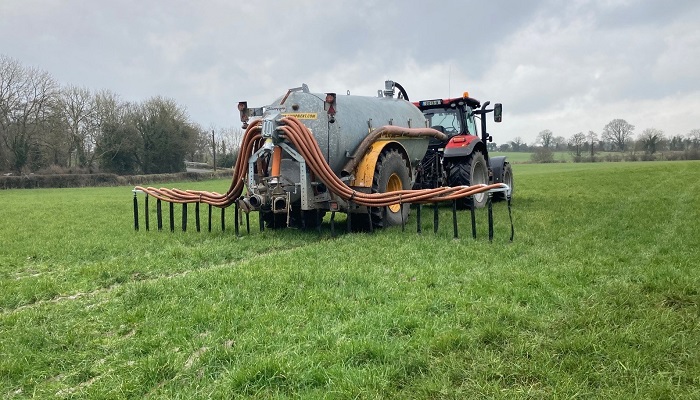
The role of slurry separation and the potential uses of the resulting solid and liquid fractions was a topic of much interest at the Farming for a Better Future Open Day, which took place at Teagasc, Johnstown Castle, on June 10.
In the paper titled: ‘Solid-Liquid Separation & the Soil-Health Value of Solids’ brought to live through the manure management demonstration, Shaun Connolly, Gabriela Cardenas Alvarez, Luis Lopez Sangil, Anika Akther, Owen Fenton, Giulia Bondi, Fiona Brennan and David Wall discussed the potential uses of separated slurry – both the liquid and solid fractions.
Delegates heard that a mechanical separator splits raw slurry into a liquid fraction and a solid fraction. The liquid fraction carries the available nitrogen (N) and potassium (K). Lower phosphorus (P) and lower dry matter (DM) make it ideal for precision N application closer to grazing, with a wider grazing window after spreading.
The solid fraction carries most of the P and almost all of the organic matter, it can be exported off-farm to reduce nutrient surplus, used as bedding (if the dry matter is very high), or applied where soil structure is poor.
Visitors to the manure management demonstration also heard that separation also enables the next step in the slurry-to-fertiliser pathway: RENURE-qualifying products start as a liquid fraction.
In the below video, Shaun Connolly discusses the importance of proper slurry management, along with providing an overview of the slurry seperator:
Why the solid fraction matters for soil health?
Typical slurry contains ~45 kg organic matter per m³. Separated solid or straw-bedded FYM contains ~200 kg/m³, over four times as much.
Organic matter does four key jobs in soil: aggregate stability (binds particles into crumbs, resists compaction and erosion), water holding (up to 20× its weight), feeds soil biology (microbes that cycle nutrients), and slow-release N through the season.
Delegates were reminded that ‘organic fertilisers build soil organic matter — chemical fertilisers alone can lead to soil organic matter mining’.
Also discussed was new Teagasc research (Lepore et al., 2025) X-ray CT scanning and physical measurements were used to test how slurry, FYM and gypsum restore grassland soil degraded by machinery traffic.
Key findings:
- FYM was the most effective amendment, it improved bulk density and pore volume within 6 months of application, restoring soil structure faster than slurry or gypsum.
- Slurry was effective in moist soil conditions, while gypsum enhanced recovery in dry soils over the longer term.
- All amendments failed under waterlogged conditions, reinforcing the message that timing of application and trafficking matters as much as the product itself. You can’t fix compaction damage by spreading onto saturated ground.
The practical implications were also discussed; where soil structure has been damaged, applying FYM or separated solids is the fastest route to recovery, but only when ground conditions allow for it. Remember use right product, at the right time, in the right conditions.
For further insights from the Farming for a Better Future Open Day, visit here.
More from Teagasc Daily: Building more resilient farming systems at Johnstown Castle
More from Teagasc Daily: Farming for Soil Health: Assess your Soil Health
More from Teagasc Daily: Understanding how nitrogen management affects climate and water quality
More from Teagasc Daily: The latest from Johnstown Castle on calf rearing