
Hedgerows: ‘Commuter corridors’ for wildlife
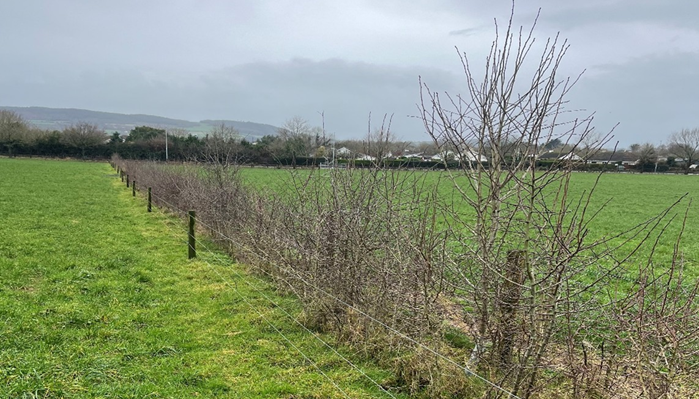
Coinciding with National Hedgerow Week 2026, a partnership between the Heritage Council and Teagasc, the role of hedgerows as commuter corridors for birds, pollinators and small animals is discussed.
One of the key reasons hedgerows have such high ecological value is because of their role as wildlife corridors. Hedgerows that criss-cross our landscape allow the movement and distribution of animals across the land, connecting them to and between other habitats they use like woodlands, lakes and grasslands.
These hedge ‘commuter corridors’ (including the grasses, wildflowers and plants in the verges) can sustain and help the movement of many bird species, pollinators and small animals.
Take bats, they use hedgerows to navigate between roosting sites and foraging areas, seen as a safe passage through the landscape and avoiding open areas where they may be more vulnerable to predators. And bees like to move along hedgerows too as they get some protection from the wind and rain, as well a food source.
Connecting habitats
Hedgerows that are well-connected to a wider network of other hedgerows and habitats are thought to support greater biodiversity. If connectivity is missing and the landscape is fragmented, this restricts the distribution of some species, limiting genetic diversity, and can even be a threat to the survival of others, with isolated populations more at risk of local extinction.
For example, in the West of Ireland where the lesser horseshoe bat is found, it is now found in pockets in different counties that have genetic differences due to large scale landscape fragmentation preventing their movement.
There are different sizes of gaps or fragmentation in hedgerows that can break up connectivity in different ways – at the landscape level as mentioned above but also gaps in individual hedgerows can cause issues. Large gaps (5m or more, which are increasingly common on farms due to larger machinery necessitating larger gates) make it difficult for many animals to safely cross, and even small gaps can be an obstacle for some animals.
Protecting and enhancing hedgerow corridors and their verges will improve wildlife habitat connectivity and strengthen wildlife populations. Gaps in hedgerows can be replanted to re-connect, as long as there is no risk of them being shaded out when trying to grow. The existing hedgerow could also be laid, if it is in an appropriate condition.
At the landscape level, increasing connectivity could mean planting new hedgerows, extending current hedgerows to re-form lost connections, or extending hedgerows to help them connect to other habitats in the wider landscape such as any patches of woodland.
The above was published as part of National Hedgerow Week 2026, a partnership between the Heritage Council and Teagasc.
Click here for more information on National Hedgerow Week 2026.
More from Teagasc Daily: Hedgerows – a lifeline for birds and insects
More from Teagasc Daily: Maintaining and improving water quality and mitigating climate change – the role of hedgerows
More from Teagasc Daily: Hedgerows and our heritage
More from Teagasc Daily: Shade and shelter – an understated benefit of hedgerows