
Bringing an old hedge back to life
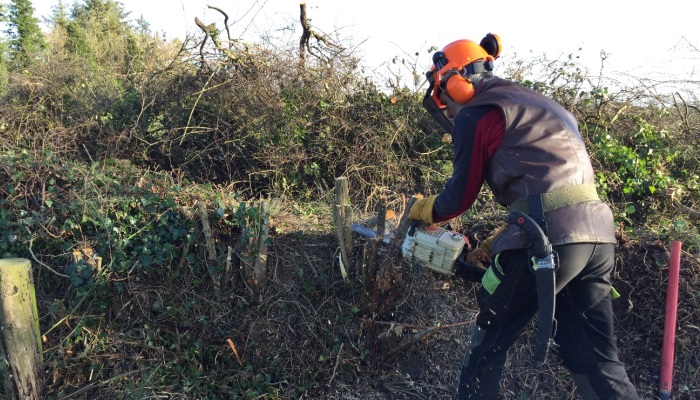
An old, gappy hedge isn't necessarily a lost cause. As part of National Hedgerow Week, a partnership between the Heritage Council and Teagasc, we examine some management practices to bring an old hedge back to life.
Even if it has become thin or overgrown, and old, gappy hedge can often be restored instead of removed or left there looking bleak. In many cases, giving an existing hedge a new lease of life is better for wildlife, the soil, climate, livestock and more than starting again.
Hedge laying and coppicing
Traditional techniques such as hedge laying and coppicing have been used for generations to rejuvenate hedgerows.
Hedge laying involves partially cutting and bending stems over, so they continue to grow, creating a thick, living barrier.
For further details on how to lay a hedge, visit here.
Coppicing involves cutting shrubs close to the ground to encourage vigorous new shoots from the base. It can look drastic at first, but don’t be put off. Within a few growing seasons, the hedge will often be thicker and healthier than before.
For further details on how to coppice a hedge, visit here.
Rejuvenating a hedge
Rejuvenating a hedge has practical benefits too. A dense hedge is usually better at containing livestock and makes a stronger field boundary. It also helps slow water running off fields and traps sediment before it reaches drains and streams.
Wildlife quickly responds as well. Thicker hedges provide better nesting sites for birds, while flowers support pollinators and autumn berries provide food for wildlife. Rather than tackling every hedge at once, many farmers restore one section each winter. Over time, this creates a mix of young and mature hedges across the farm, ensuring there’s always good habitat available.
New hedge establishments
It can also be an option to plant some new hedge species to fill the gaps in an old gappy hedge, in addition to laying or coppicing the old species, as long as the new species won’t be shaded out whilst trying to grow.
If a hedge really is beyond repair, planting a new native mixed-species hedge is a great investment. But wherever possible, it pays to protect and restore the hedges already there. They’ve taken decades to develop into the rich habitats we see today, and that’s something a newly planted hedge simply can’t replace overnight.
Major hedge work should always be carried out between late autumn and the end of February, outside the bird nesting season.
The above was published as part of National Hedgerow Week 2026, a partnership between the Heritage Council and Teagasc.
Click here for more information on National Hedgerow Week 2026.
More from Teagasc Daily: Hedgerows – a lifeline for birds and insects
More from Teagasc Daily: Maintaining and improving water quality and mitigating climate change – the role of hedgerows
More from Teagasc Daily: Hedgerows and our heritage
More from Teagasc Daily: Shade and shelter – an understated benefit of hedgerows
More from Teagasc Daily: Hedgerows: ‘Commuter corridors’ for wildlife
More from Teagasc Daily: Hedgerow management: how best to manage your hedges