
Routine genotyping identifies hidden infertility
Cliona Ryan
Cattle, sheep, and horses can be born with extra or missing chromosomes, a condition similar to Down’s syndrome in humans. Affected animals may appear physically normal but the conditions can cause infertility or premature death. As a result, farmers may unknowingly rear infertile animals with no way to identify them until breeding fails and rearing costs are already incurred.
At €60 per animal, conventional chromosome testing (karyotyping) is not economically viable at national scale. Teagasc pioneered an automated detection method using genotype data already collected through national evaluations, enabling chromosomal screening at no
additional cost. Detection thresholds and implementation-ready code were developed, and this work is now implemented in the Irish Cattle Breeding Federation’s genotyping pipeline to screen artificial insemination bulls entering the national breeding programme.
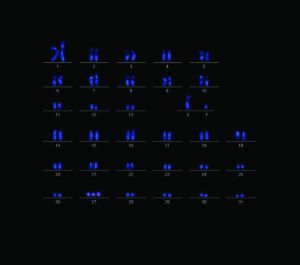
Across cattle and horses, owners of affected animals were contacted, and farm visits were conducted alongside veterinarians to collect blood samples for karyotyping confirmation and to provide farmers with personalised reports showing their animal’s genotype profile.
This research demonstrated that routine genotyping data can reliably identify infertile animals before they enter breeding programmes, and the approach is now implemented in practical use. Spanning nearly 1.3 million cattle, 63,000 sheep, and 21,000 horses,
this research estimates that approximately 1,500 calves, 3,000 lambs, and 37 foals are born with chromosomal abnormalities in Ireland each year. Rearing an infertile heifer to breeding age costs approximately €1,500, a loss that now can be prevented through early detection using existing genotyping data.
Contact: cliona.ryan@teagasc.ie
Other contributors: Irish Cattle Breeding Federation; Horse Sport Ireland; University College Dublin; Munster Technological University
Funding: Department of Agriculture, Food and the Marine; Research Ireland (VistaMilk)
Impact Pathway: Technology Development and Adoption
Sustainable sheep breeding
Nóirín McHugh, Edel O’Connor, Lucy Chipondoro, Fiona McGovern, Philip Creighton, Jonathan Herron
The €uro-Star sheep breeding indexes have been proven to increase farm profitability while reducing the carbon footprint per kilogramme of carcass produced. As climate targets increasingly focus on emissions intensity per animal, a new component to the breeding indexes is required to quantify total animal emissions while continually improving flock productivity.
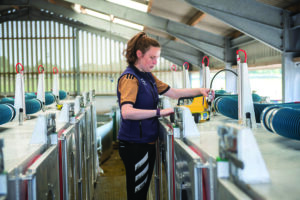
Approximately 20,000 individual animal methane emissions records have been measured by Teagasc in collaboration with Sheep Ireland. This data has enabled the development of genetic models that predict the methane emissions from individual animals. Simultaneously, life cycle assessment has been undertaken to calculate the associated carbon costs with traits already included in the sheep breeding indexes. The integration of methane breeding predictions combined with the calculated carbon emission values on key traits underpinned the creation of a new methane sub-index within the €uro-Star sheep breeding indexes.
The methane sub-index is just one component of the overall breeding indexes and is integrated alongside key production traits, which importantly ensures that the €uro-Star indexes identify animals that simultaneously increase farm profitability while reducing emissions. Launched in late 2025, the updated €uro-Star sheep breeding indexes, incorporating the methane sub-index, will be used by Irish sheep farmers to select rams in the 2026 breeding season, supporting more productive and environmentally sustainable sheep farming.
Contact: noirin.mchugh@teagasc.ie
Other contributor: Sheep Ireland
Funding: Department of Agriculture, Food and the Marine
Impact pathway: Technology Development and Adoption
Smarter milking settings improve dairy efficiency
John Upton, Martin Browne
Dairy milking systems have traditionally operated with conservative cluster removal settings. This often results in unnecessary low flow periods at the end of milking and associated overmilking, increasing labour demand, exposing cows to avoidable teat stress, and limiting overall system performance at farm level. Research conducted at Teagasc Moorepark, supported by the VistaMilk Research Ireland Centre, evaluated the impact of adjusting automatic cluster removal (ACR) settings on milking performance. The study combined on-farm trials with detailed vacuum and milk flow measurements.
Findings were put into practice through a collaboration with Dairymaster, supporting the development of the Swiftflo Personalised Milking platform, enabling cow-specific ACR settings. Industry partners, advisory colleagues, education specialists and farmers were engaged to support adoption.
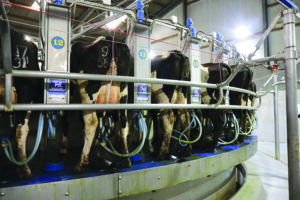
The research has led to improved milking efficiency through reduced milking duration (approximately 95 seconds per cow, around 14%) and reduced overmilking. Implementation through Dairymaster’s Swiftflo system has enabled practical uptake at farm level. The approach is applicable across an estimated 250,000 to 300,000 cows in Ireland, with potential for wider international reach.
These improvements enhance parlour throughput, reduce labour demand and support better cow comfort during milking. Importantly, these gains in efficiency are achieved without compromising milk yield or quality, directly benefiting farm profitability and milking system performance.
Contact: john.upton@teagasc.ie
Other contributors: VistaMilk Research Ireland Centre; Dairymaster
Funding: VistaMilk Research Ireland Centre; Dairymaster; Department of Agriculture, Food and the Marine
Impact pathway: Technology Development and Adoption